
Edge Study

  • Explore the CX Switch with the AOS-CX Switch Simulator

    Aruba has released the AOS-CX Switch Simulator. Today, I would like to take a look at this. Many people have asked why Aruba does not provide a simulator for training or hands-on experience. Although they did provide an OVA file, users had to find the necessary information, install it, and test it on their own without any guidance or instructions. The AOS-CX Switch is a next-generation cloud-native switch. Compared to existing legacy switches and operational…
  • [ACSA Training #27] How RSTP Works

    RSTP (Rapid STP) operates a loop-free topology through the following algorithm: Selection of the Root Switch; Selection of the Root Port (RP) of all other non-root switches or non-designated bridge switches; Selection of the Designated Port (DP) of the links connecting each switch; Other ports operate in a blocked state to prevent loops; Root Switch…

  • [ACSA Education #26] RSTP Elements

    Continuing from last time, we will explore STP (Spanning Tree Protocol), specifically RSTP (Rapid STP). We will examine the key factors that the RSTP algorithm uses to determine which ports to use for traffic delivery and which not. Bridge Identifier Bridge Protocol Data Unit Rapid Spanning Tree Port States Rapid Spanning Tree Port Cost Rapid Spanning…

  • [ACSA Training #25] Spanning Tree Protocol

    Last time, while discussing network redundancy, we also talked about loops that can occur as a result. As an alternative, I briefly mentioned STP (Spanning Tree Protocol). Today, let's take a closer look at Spanning Tree Protocol. STP (Spanning Tree Protocol) Overview: IEEE 802.1d, the standard version of STP (Spanning Tree Protocol), [addresses] redundant environments…

  • [ACSA Education #24] Redundant Network

    Network communication is critical to IT infrastructure. It often has a significant impact on services. As shown below, if there is only one path connecting to the Core-1 switch, and the link between the two access switches and the Core-1 switch is severed, the network will be disconnected, and ultimately, Host A and Host B will be unable to communicate with each other. To solve this…

  • [ACSA Training #23] Frame Transmission Process

    Previously, while examining representative Layer 2 technologies such as VLANs and 802.1Q, we also mentioned frames. In a previous post, I also explained Ethernet frames, which correspond to Layer 2 in the OSI model. Therefore, today, I would like to examine how these frames operate during Layer 2 communication using actual examples. First, assuming the same VLAN, several…

  • [ACSA Education #22] Forwarding Table

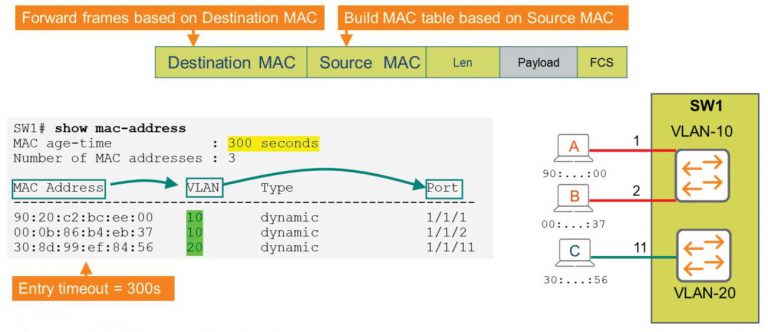
    Layer 2 switches transmit data based on MAC addresses. To do this, the switch uses a MAC address table. When a device connected to the switch sends a frame, the table is automatically created based on the MAC address of the source frame. So, how does it work? MAC Address Table: When power is turned on to Switch SW1, the MAC address table is initially empty...

  • [ACSA Training #21] 802.1Q

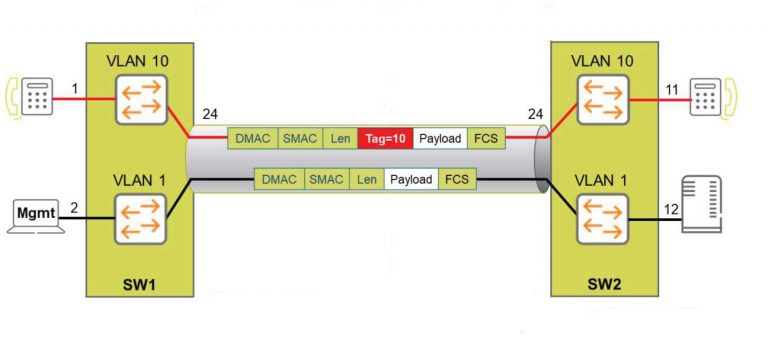
    In the previous post, we learned about VLANs. By creating a virtual switch within a single physical switch, we were able to create and manage broadcast domains more efficiently. Limitations of VLANs... However, let's take a look at the following figure. The figure shows two switches with ports configured in VLAN 10 and VLAN 20, respectively. Now, to connect these two switches, SW1's…

  • [ACSA Training #20] Virtual LAN

    LAN and VLAN. A LAN (Local Area Network) refers to a group of devices within the same broadcast domain. As shown in the figure, there are LAN-A and LAN-B. Two devices are connected to LAN-A. Host A is connected to Port 1, and Host B is connected to Port 2. Another switch, LAN-B, has a similar configuration. When the switch broadcasts a message from an arbitrary port…

  • [ACSA Education #19] Domain

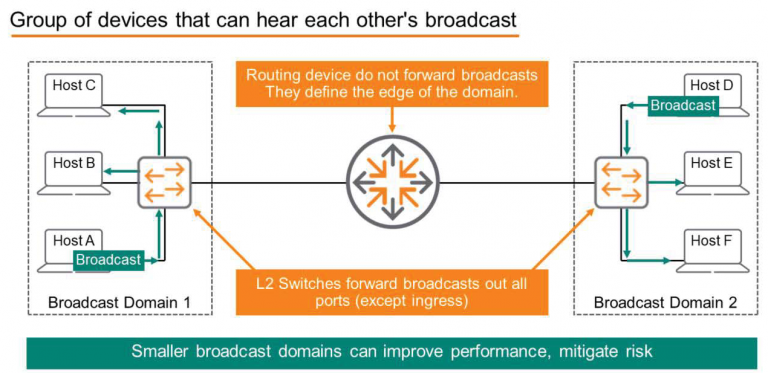
    In the previous post, we examined the basic commands of the AOS-CX switch. This time, we will explore design, deployment, configuration, and troubleshooting to enhance our understanding of Layer 2 concepts. First, let's look at the concept of Layer 2 domains. Collision Domain. Let's imagine Alice and Bob are having a conversation. Even though Alice has something she wants to say,…