A common spanning tree (CST) defines a single spanning tree instance for the entire network, regardless of the number of VLANs. All BPDUs use Untagged VLAN 1, so VLAN information is not considered.
Additionally, there is no load balancing, which can lead to alternate paths or lower line utilization and potential performance degradation.
MSTP (Multiple Spanning Tree) is a solution to these problems.
Multiple Spanning Tree – 802.1s
The above problems IEEE 802.1s (Multiple Spanning Tree Protocol, MSTP)This can be resolved by: MSTP builds a new topology, or instance, of the Spanning Tree Protocol, which improves upon RSTP. This means that instances can forward traffic from different VLANs, allowing load balancing and maintaining optimal paths.
The figure below shows two topologies created on the same physical network.
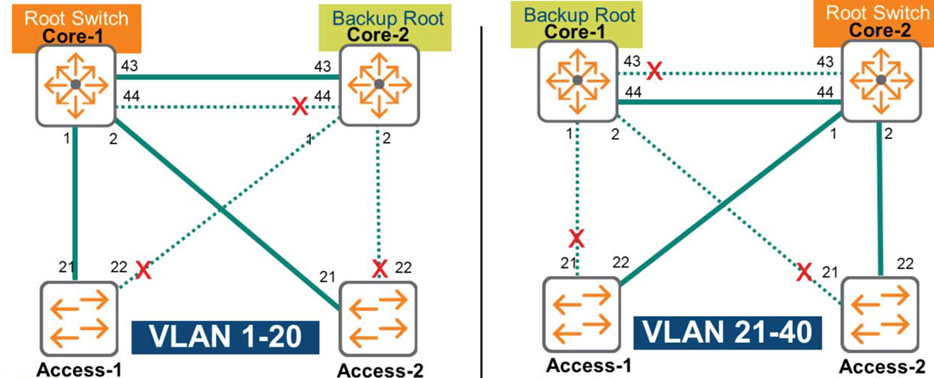
The left diagram shows that VLANs 1-20 all share a single RSTP environment. Core-1 is the root switch, and the spanning tree extends from there. VLANs 1-20 share both unused links and forwarding links that can be used for redundancy.
The image on the right shows that VLANs 21-40 share a different RSTP environment. Core-2 is the root switch, and the topology flows from that root. The bold lines are used by VLANs 21-40, and other links can be used for backup.
That is, the backup link for VLAN 1-20 is the primary link for VLAN 21-40, and vice versa.
MSTP – Region
MSTP is Region. A Region is a group of switches consisting of identical instances mapped or associated with a VLAN group. To ensure that all devices have the same VLAN mapped to an instance, MSTP Hash algorithm (or digest) is used.
※ reference: A hash algorithm is a mathematical function that is affected by its input (x). It is impossible to infer the input (x) value from the output (y) alone. Therefore, hash algorithms are also called one-way functions.
Another feature of hash algorithms is that if the input values are identical, the output values will always be identical.
MSTP uses this feature.
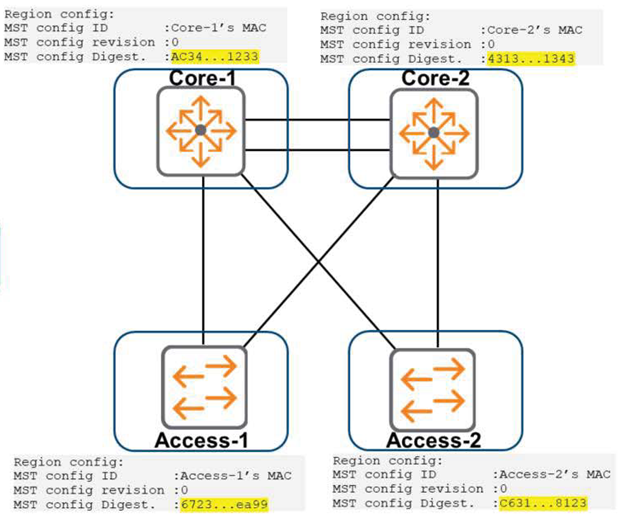
AOS-CX switches operate on MSTP by default, but because each device has different configuration parameters, it operates in its own region. In other words, it operates like a Common Spanning Tree (CST), creating a single topology and a single instance for all VLANs.
As you can see in the following figure, each switch has MSTP enabled, but because their digest values are different, these switches are in different regions.
Instance 0 or Internal Spanning Tree (IST) is used in both cases:.
– A common instance of MST (Multiple Spanning Tree)
– Generate CST in multi-region deployments for backward compatibility with RSTP
For this reason, instance 0 is also known as Common Internal Spanning Tree (CIST).
MSTP – Region Configuration
On ArubaOS-CX switches, MSTP can be configured as follows:.
1. Set spanning tree mode to MSTP
“The ”spanning-tree mode” command can set MSTP or RPVST (Rapid Per VLAN Spanning Tree) mode.
Switch(config)# spanning-tree mode mstp※ Note: To change the spanning-tree mode, you must first disable spanning-tree.
– Switch(config)# no spanning-tree
2. Specify the MST region name and revision number.
Switch(config)# spanning-tree config-name <Config-name>
Switch(config)# spanning-tree config-revision <revision-number>
Revision numbers are used to distinguish between region configurations. This is extremely useful when changing configuration settings within a region and tracking the version being used. It's also useful when creating a new region within a subset of switches in the current region and using the same region name.
3. Map VLANs to MSTP instances
“The ”spanning-tree instance” command creates a new instance using the VLANs mapped to an existing instance.
Each instance must have at least one mapped VLAN. Once a VLAN is mapped to an instance, it is automatically de-mapped from any previously mapped instances. All MSTP instances can have all VLANs configured on the switch.
Switch(config)# spanning-tree instance <instance-id> vlan <vlan-id>4. Specify switch priorities for instances (Optional)
Switch(config)# spanning-tree instance <instance-id> priority <priority-value>The same Priority value can be used for RSTP, and the Priority value ranges from 0 to 15.
5. Activate Spanning Tree Globally
Switch(config)# spanning-treeOkay, now that we know about the commands, let's try to structure them like the example in the figure below.
Looking at the picture, you can see that Instance 1 and Instance 2 have been created. There will be a total of three instances, including the default instance 0.
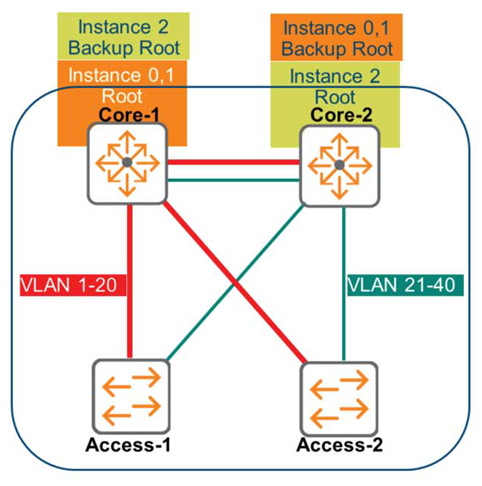
Create a single region where you can create multiple instances for load balancing and to specify the optimal path. Instance 1 uses the Core-1 switch as the root switch and is mapped to VLANs 1-20. Instance 2 uses the Core-2 switch as the root switch and is mapped to VLANs 21-40.
[Common configuration for all switches]
Switch(config)# spanning-tree config-name CXF
Switch(config)# spanning-tree config-revision 1
Switch(config)# spanning-tree instance 1 vlan 1-20
Switch(config)# spanning-tree instance 2 vlan 21-40
[Core-1 Switch Configuration]
Core-1(config)# spanning-tree priority 1
Core-1(config)# spanning-tree instance 1 priority 1
Core-1(config)# spanning-tree instance 2 priority 2
[Core-2 Switch Configuration]
Core-2(config)# spanning-tree priority 2
Core-2(config)# spanning-tree instance 1 priority 2
Core-2(config)# spanning-tree instance 2 priority 1
This configuration creates two instances, as shown in the figure above, and maps a VLAN to each instance. Additionally, by assigning priorities to the Core-1 and Core-2 switches, each instance will have its own root switch.
With this, we have looked at RSTP, which is a significant improvement in terms of speed over the old-fashioned STP, and MSTP, which provides a more optimized spanning tree in a multi-VLAN environment.
As network environments become increasingly complex and the number of VLANs increases, it's crucial to have a solid understanding of and apply spanning tree from initial design through network expansion. Because it's so crucial, I urge you to set up your own lab environment and conduct numerous tests to thoroughly study and master it.