Aruba started its business in 2002 as a wireless network specialist company under the name Aruba Networks.I have done it.
Until its merger with HPE, Aruba's wireless network solutions demonstrated industry-leading technology and performance.
HPE Aruba Networking WLAN delivers AI-driven mobility and enterprise-grade design. Intelligent, secure, and fast edge connectivityIt provides.
Various AP models have different operating environments such as indoor/outdoor, remote/reception environments, etc., Various levels in terms of performance and capacityWe provide the best choice to suit your needs.
Building on this history, Aruba's wireless networking portfolio demonstrates its industry leadership.
We provide architectures and solutions tailored to your needs, from wireless APs that support various environments to controllers (gateways) with differentiated performance.
AP (Access Point)
HPE Aruba Networking APs (Access Points) eliminate the complexity commonly encountered by third parties. Excellent service and segmentation Implement the function.
Especially new Wi-Fi Technology provides the following key benefits:.
- Improved reliability: Essential for mobile users, IoT devices, and latency-sensitive applications, even in environments with busy Wi-Fi traffic. Security and stabilityIt provides.
- Synergy with 5G strategy: For enterprises pursuing 5G strategies, HPE Aruba Networking Wi-Fi can replace small cells or distributed antenna systems (DAS) to provide a seamless transition to 5G. efficient onramp Can perform a role.
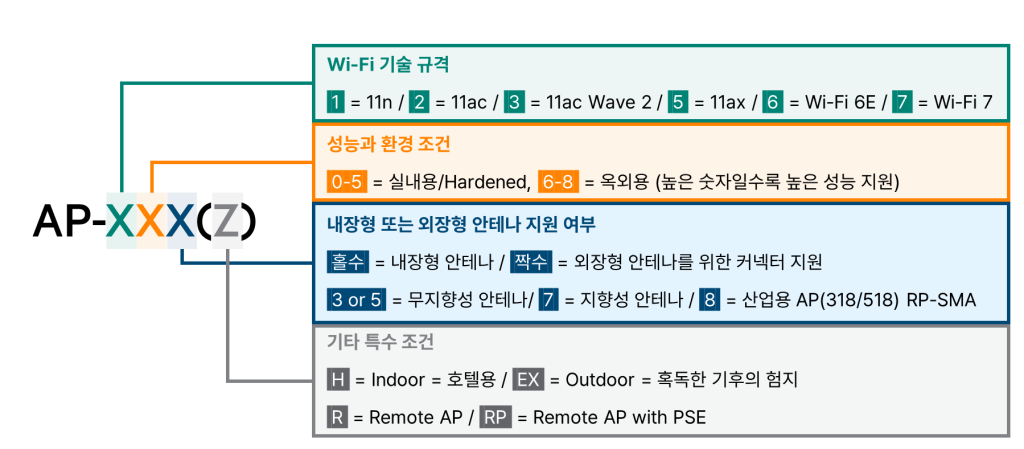
100 series APIt supports 802.11n and supports 2×2 and 3×3 streams depending on the model.
200 series APSupports 802.11ac (Wi-Fi 5) mode. Each AP is marked with CAP (Campus AP) or IAP (Instant AP) to distinguish whether it is a controller-based AP or a standalone AP without a controller.
IAPs can be converted to CAPs for use in controller-based environments, and can also be converted back to IAP environments. However, CAPs cannot be converted to IAPs.
300 series APSupports 802.11ac Wave2. Supports MU-MIMO function and has built-in BLE function.
Currently, models in the 100/200/300 series are EoS (End-of-Sales), and some of them have ended technical support.
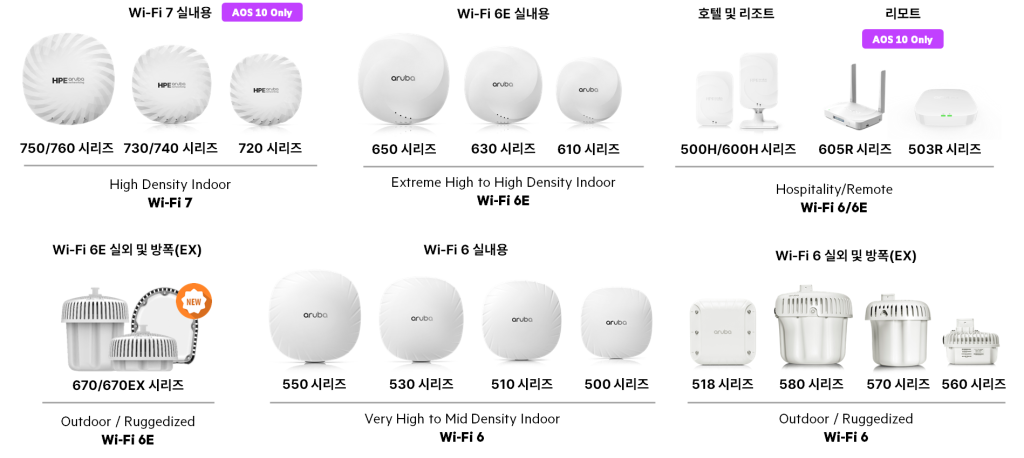
500 series APSupports 802.11ax (Wi-Fi 6) method.
Wi-Fi 6 APs offer a number of distinct features, including AI-based Wi-Fi performance improvements, always-on connectivity, WPA3 authentication security, and AI-based power-saving features like GreenAP mode, which saves energy up to 70%.
In addition, technologies provided by Wi-Fi 6, such as OFDMA and MU-MIMO, provide efficient and uninterrupted service to multiple client terminals in high-density environments.
Additionally, in line with the increasing trend of IoT terminals, a chipset for Zigbee or BLE connection is built in to support various types of IoT terminal connection methods, allowing it to function as a gateway for IoT connections.
Outdoor APs are built to survive in harsh environments.
It can withstand extreme temperatures, exposure to persistent moisture and precipitation, and is securely sealed to block airborne contaminants. All electrical interfaces are industrial-grade and protected against sudden increases in current and voltage.
Gateway (Controller)
In a large-scale network environment HPE Aruba Networking Gateway (Controller)The main reason why we need to introduce To simplify network design and facilitate solution management.no see.
Key features of the gateway
Gateways play a central role in handling wireless traffic.
- Wireless Traffic Termination: All wireless traffic is tunneled to the gateway.
- Security and Forwarding: Tunneled traffic is routed through the gateway. fire doorAfter passing through security checks, you will be delivered to your final destination.
- Eliminate VLAN complexity: This method is network-wide. Excessive VLAN proliferationSimplifies network configuration by preventing:.
HPE Aruba Networking offers a variety of gateway options to meet your needs for scalability, 24x7 operations, and enhanced security.
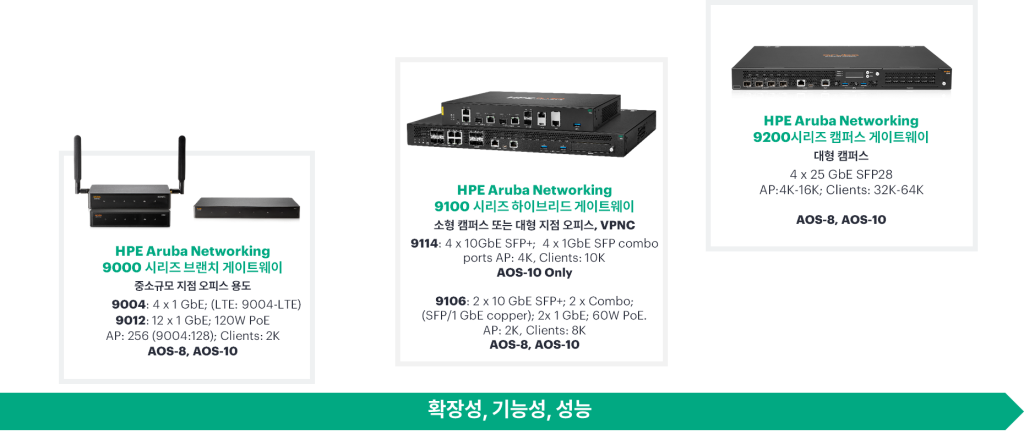
In AOS 10 environment Need for gateway introduction (optional)
Using gateways in a campus environment Although not required (you can configure the solution with just AP), than the AP-only solution. A much more scalable solutionIt provides.
In an AOS 10 environment, we recommend using a gateway if one or more of the following apply or are desired:.
- Simplified network design
- SD-WAN features conjugation
- Enhanced security: Tunneled WLAN, segmented/guest WLAN, network encryption
- Greater mobility: Supports inter-domain L2/L3 roaming
- Dynamic Radius proxy
- Massive Scalability: Environments operating more than 5,000 clients per site and/or more than 500 APs per site
Mobility Conductor (formerly Mobility Master)
Aruba's Mobility Conductor can be described as the next generation master controller.
A special solution provided in AOS 8 can be deployed as a hardware-based or VM-based appliance.
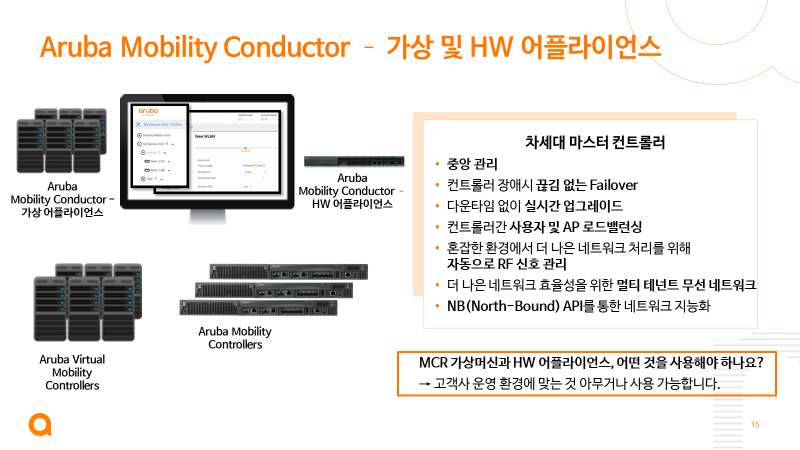
Mobility Conductor allows multiple controllers to be clustered together, enabling software updates without any interruption.
Remote AP
Aruba also offers a variety of options for providing remote access, including SD-Branch, VIA, or RAP.
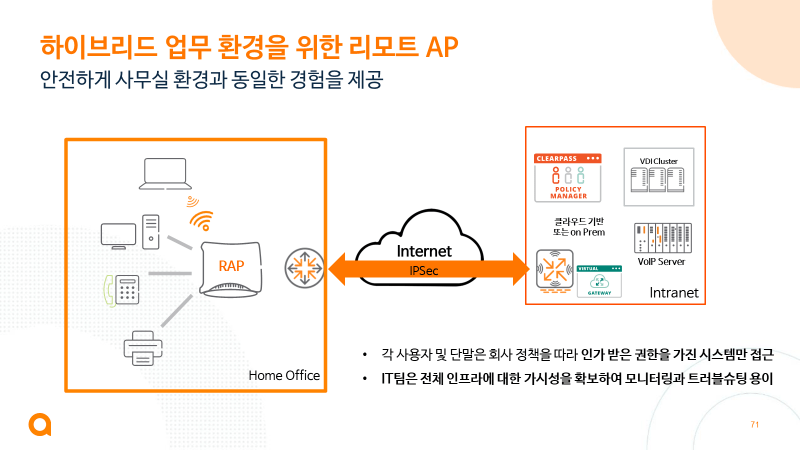
Regardless of where I am located, I can put the Aruba Controller in the VPNC role and enable VPN connections to the Aruba Controller remotely.
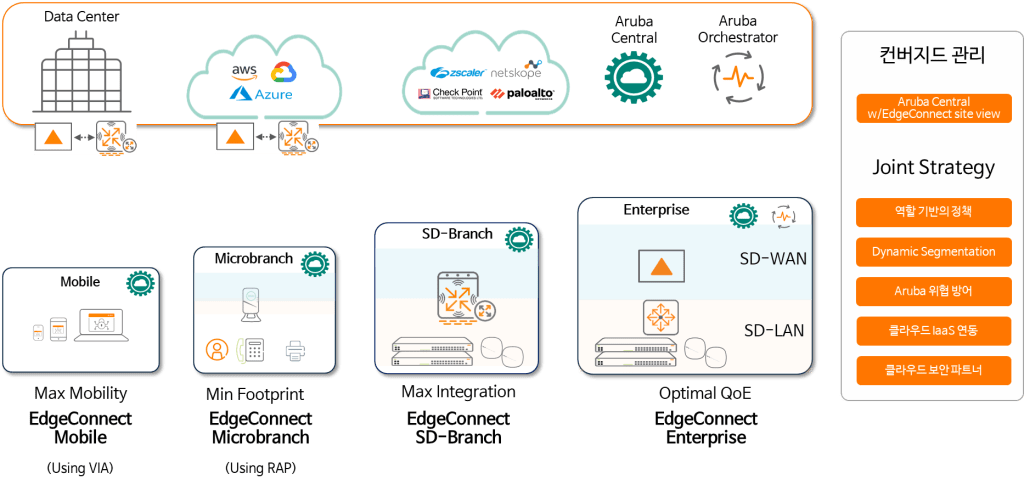
Due to COVID-19, network access is now required across diverse environments and locations. To address this, Aruba offers SD-WAN fabric solutions tailored to your needs. These solutions all connect to the Aruba VPNC (Controller) or EdgeConnect appliances via IPSec VPN tunnels, providing traffic visibility, security, and policy automation.
Aruba, born at the edge and in wireless networks, offers unparalleled technology, performance, and functionality. I believe Aruba's diverse portfolio speaks volumes. Simply comparing, no other manufacturer offers such a diverse portfolio of APs and controllers.
I think this is why Aruba is shouting about Intelligent Edge, Edge-to-Cloud.