
VLAN

  • [ACP-DC Training#8] 2-Tier Design for Small Data Centers

    Layer 2 two-tier designs are simple to deploy, operate, and troubleshoot because they utilize existing traditional protocols. They can be managed without specialized knowledge of overlay protocols or complex designs. This architecture is suitable for small to medium-sized data centers, but in larger environments, it can also be implemented at the data center POD level. In a two-tier data center, host information is traditional bridge…

  • [ACSA Training #23] Frame Transmission Process

    Previously, while examining representative Layer 2 technologies such as VLANs and 802.1Q, we also mentioned frames. In a previous post, I also explained Ethernet frames, which correspond to Layer 2 in the OSI model. Therefore, today, I would like to examine how these frames operate during Layer 2 communication using actual examples. First, assuming the same VLAN, several…

  • [ACSA Training #21] 802.1Q

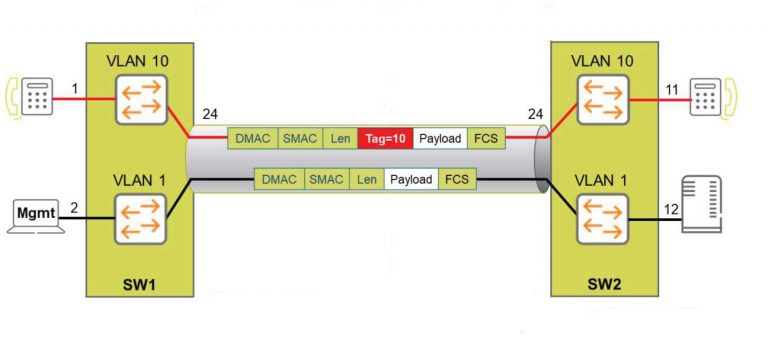
    In the previous post, we learned about VLANs. By creating a virtual switch within a single physical switch, we were able to create and manage broadcast domains more efficiently. Limitations of VLANs... However, let's take a look at the following figure. The figure shows two switches with ports configured in VLAN 10 and VLAN 20, respectively. Now, to connect these two switches, SW1's…

  • [ACSA Training #20] Virtual LAN

    LAN and VLAN. A LAN (Local Area Network) refers to a group of devices within the same broadcast domain. As shown in the figure, there are LAN-A and LAN-B. Two devices are connected to LAN-A. Host A is connected to Port 1, and Host B is connected to Port 2. Another switch, LAN-B, has a similar configuration. When the switch broadcasts a message from an arbitrary port…