
ACMA

  • [ACMA Training #7] AOS 8 License (2)

    In the previous post, we looked at the types of licenses in AOS 8. This time, we will examine how to manage and activate these licenses. Centralized License Management: AOS 8.x supports a centrally managed license architecture, where Managed Device (MD) groups share a license pool. Since Primary and Backup Mobility Conductors (Mobility Masters) can share a single set of licenses…

  • [ACMA Training #6] AOS 8 License (1)

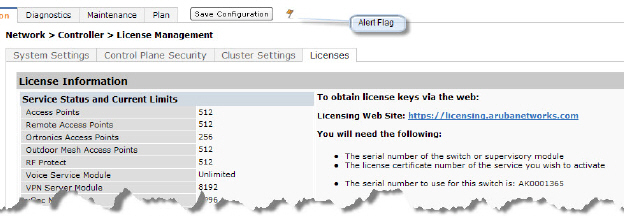
    In this post, we will look into AOS 8 licenses. As of November 2022, AOS 8.11 has been released, but since the ACMA certification (HPE6-A70) is based on AOS 8.6, I will explain accordingly. Therefore, please note in advance that there may be slight differences. License Classification: Each license can be divided into Evaluation or Permanent licenses. Permanent licenses are…

  • [ACMA Training #5] AOS 8 Features

    In the previous post, we explored the architecture of the AOS 8 operating system. As wireless network infrastructure becomes increasingly active and widespread, its stability and performance are becoming more critical. In particular, there is a growing trend among companies to adopt Digital Workspaces and Mobile Offices, which utilize Wi-Fi instead of traditional wired LANs for business purposes. Therefore, in line with these changes and trends…

  • [ACMA Training #4] AOS 8 Architecture

    The ACMA certification exam is conducted based on the AOS 8 operating system. Therefore, it is important to understand the AOS 8 architecture. In the previous post, I already explained the Aruba wireless LAN portfolio. While explaining APs (Access Points), I discussed the concepts of CAPs (Campus APs) and IAPs (Instant APs). Today, I will discuss the structure of the AOS 8 architecture, and the past…

  • [ACMA Training #3] RF Transmission Output

    All manufacturers, including Aruba, specify the power (output) of the AP's antenna port. RF power can be measured in units of mW (milliwatts) or dBm (decibels per milliwatt). 0 dBm is equal to 1 mW. When the dBm value becomes negative, the milliwatt value drops to a decimal point. In other words, mW represents data linearly, while dBm represents data in the form of a logarithmic function. RF power is the AP's coverage area's…

  • [ACMA Training #2] RF Basics

    Wireless networks are primarily designed considering coverage or capacity. When designing for WLAN coverage, the design must be based on the area to be covered. If a coverage-based design is configured to provide 100% coverage across the entire area, using high-power APs allows for a design with fewer APs. On the other hand, when designing a capacity-based WLAN…

  • [ACMA Training #1] Introduction to Wireless LAN (802.11)

    Following the previous basic training on the ArubaCX switch, we would like to proceed with training on Aruba Wireless Local Area Networks (WLAN). In this post, we will provide a basic introduction to wireless LANs and explain the technologies involved. Introduction to Wireless LAN Organizations: To break down the term, wireless LAN is called a Wireless Local Area Network (WLAN). Various organizations responsible for these wireless LAN standard technologies…