The Internet Protocol Suite is a conceptual model and communications protocol used on the Internet and computing networks.
Because the underlying protocols of this suite are TCP and IP, it is commonly known as the TCP/IP Stack.
This model provides end-to-end data communication. It specifies how data is packetized, addressed, transmitted, routed, and received.
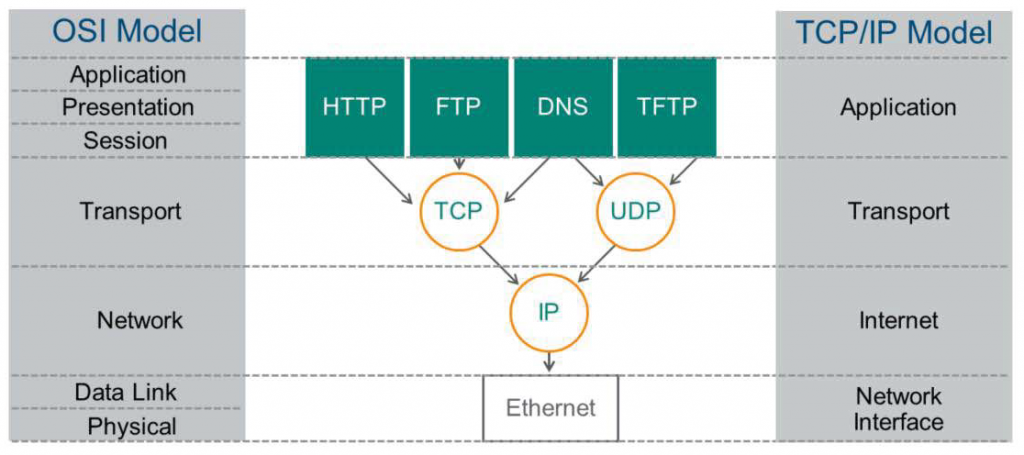
The TCP/IP model OSI 7-layer modelIt is also compared to the OSI 7-layer model, which consists of 7 layers, but the TCP/IP model maps to 4 layers. In the OSI model, the Application, Presentation, and Session layers are all mapped to the Application layer of a single TCP/IP.
Application Layer
That is, the TCP/IP-based Application Layer faces the user and creates data (Application Layer), arranges the data in an appropriate format (Presentation Layer), and manages the session (Session Layer).
Transport Layer
The Transport Layer of each model is directly mapped.
This layer is responsible for flow and error control. This layer establishes an end-to-end connection between two devices traversing a series of logical networks. The two options used in TCP/IP networks are UDP and TCP.
Internet Layer
The Network Layer of the OSI model maps to the Internet Layer of TCP/IP. Both perform the same functions, including defining packet formats and addressing formats and routing data through logical network paths.
IP version 4 (IPv4) and IP version 6 (IPv6) are protocols that operate at this layer.
Network Interface Layer
The functions of the OSI Data Link Layer and Physical Layer are both defined in the Network Interface Layer of the TCP/IP model. This layer also includes protocols related to physical communication media (copper cable, optical fiber, radio waves). It's also important to note that physical Media Access Control (MAC) also occurs here.
Common protocols operating at this layer are Ethernet and Wi-Fi.
In the next post, we will learn about Ethernet Frames, IPv4, and TCP/UDP headers in the TCP/IP Stack.