Today, we'll learn about the types of traffic.
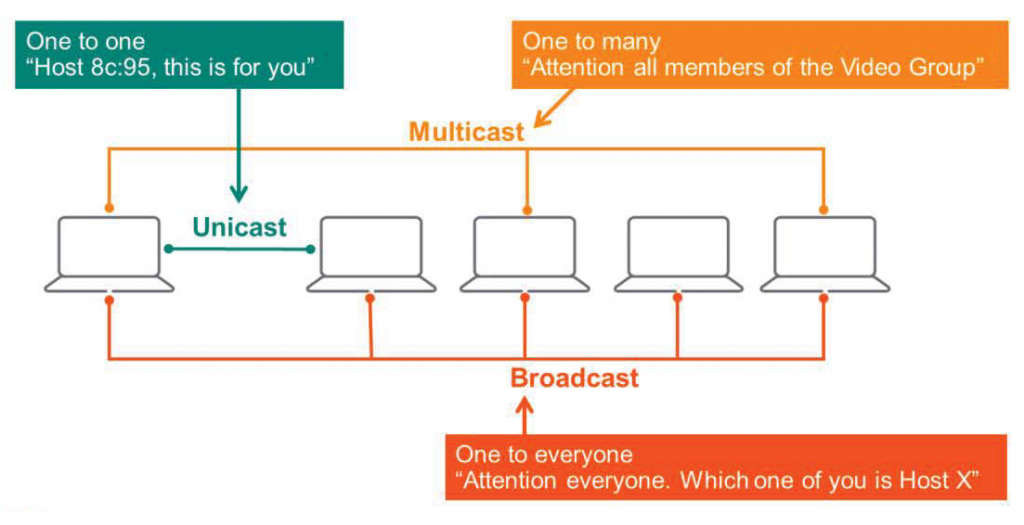
Computer communications can be classified into three categories:.
- Unicast
- Multicast
- Broadcast
Unicast
Unicast is One-to-one communication(1 transmitter – 1 receiver).
To give a simple example, let's assume there are several students in a classroom. A teacher calls out the name of a specific student, say A, at the classroom door and delivers a message. The teacher becomes the transmitter, and student A becomes the receiver.
Similarly, when a PC transfers a file to a server, both devices use unicast communication.
Multicast
Multicast is One-to-many communication(1 transmitter – multiple receivers).
For example, in a classroom, a teacher delivers a message from the podium to only the students in Group 1. This message would originate from the teacher and be delivered to the students in Group 1.
In a network environment, for example, there's video streaming. A video source (transmitter) transmits a video stream to multiple receiving devices (PCs, tablets, smartphones, etc.).
Here, multicast traffic can be sent to many devices, but not to all devices in the network.
Broadcast
Broadcast is One-to-all communication(1 transmitter – all receivers).
When a teacher makes an announcement to all students in a classroom, this can be considered a Broadcast.
Likewise, there is a network address that allows all stations to receive and process.
At Layer 2, the MAC address is FF:FF:FF:FF:FF:FF, and at Layer 3, the IP address is 255.255.255.255.
This allows one computing device to discover other computers on the network.
So today we briefly looked at Unicast, Multicast, and Broadcast.
In the next post, we will learn about TCP/IP.