HPE Aruba Networking is introducing new products to meet the needs of customers who want faster and more reliable Wi-Fi connections. Wi-Fi 7 technologyWe have launched an access point that uses Wi-Fi 7 technology. This new HPE Aruba product incorporates significant technological advancements in addition to Wi-Fi 7 technology.
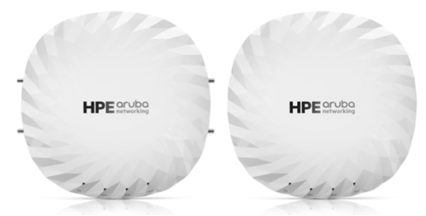
AP-734 and AP-735
Key Features
- Wi-Fi 7 (Wi-Fi 802.11be)
- Multi-Link Operation (MLO)
- Tri-Band support: 2.4Ghz, 5Ghz, 6Ghz
- Flexible wireless service support with dual 5Ghz or dual 6Ghz operation
- Supports 320MHz channel width in the 6GHz band
- Ultra Tri-band (UTB) filtering technology apply
- Provides dual 5Gbps ports for Ethernet uplink redundancy and PoE failover
- Dual IoT Radio
- Dual USB ports
- 802.11az FTM support
- Supports Bluetooth 5.4 (HADM)
- barometric pressure sensor
At 6Ghz Device class
AP-735It operates as a Low Power Indoor (LPI) device class. When operating as LPI, Automated Frequency Coordination (AFC) for the 6 GHz band is not required. When operating as Standard Power (SP), AFC is required and is coordinated through the Frequency Coordination Orchestrator (FCO) service in HPE Aruba Central.
The AP-734 is an access point that can be equipped with an external antenna.
The AP-734 operates at standard power (SP) and requires AFC for 6 GHz service.
AOS 10 operating system
Wi-Fi 7 access points, including the AP-734 and AP-735, require AOS 10.7 or later.
The AOS 10.x operating system requires HPE Aruba's cloud platform Central.

All the necessary features of Wi-Fi 7 will be included through a continuously updated cloud platform.
Differences from Wi-Fi 6E
According to the Wi-Fi Alliance, Wi-Fi 7 (802.11be) adds several new features.
- Multi-Link Operation (MLO)
- Limited TWT (R-TWT)
- Multiple Resource Units
- Static Puncturing
- Stream Classification Service
- 4096-QAM (4K QAM)
- 320MHz channel bandwidth in the 6GHz band
Speed and Feed
Although the “up to 320MHz channel bandwidth” is only available optionally on the 6GHz band, Wi-Fi 7 will be able to achieve speeds twice as fast as Wi-Fi 6E’s maximum channel width of 160MHz.
The 320MHz channel width consists of two adjacent 160MHz channels in the 6GHz band. In countries like Korea, where the 1,200MHz band is fully available in the 6GHz band, there are three available channels. This is equivalent to the three channels typically available in the 2.4GHz band.
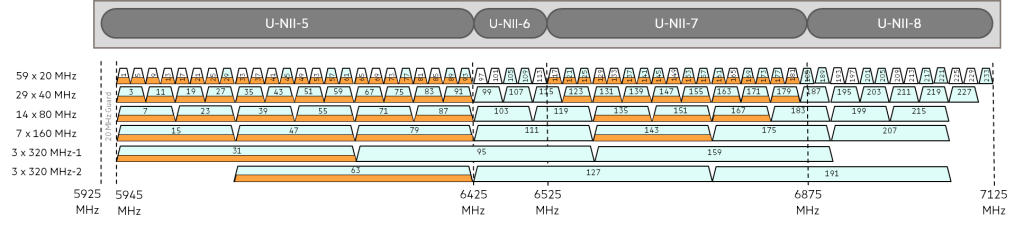
However, due to channel count limitations, most customers are expected to use the more practical 80MHz or 160MHz channel widths.
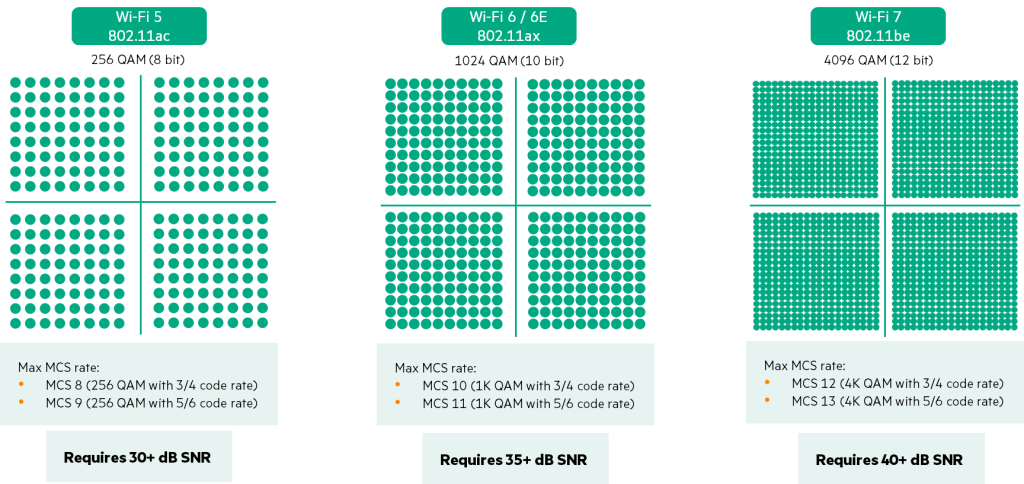
As with the new channel widths, Wi-Fi 7 also supports optional 4096-QAM (4K QAM) modulation.
4K QAM offers a maximum speed of 20% compared to existing 1024-QAM (1K QAM). However, 4K QAM has significantly more stringent RF requirements than previous higher-order modulations. This is due to the complex modulation scheme, which includes more bits per symbol, and the need for closer distances between clients and APs.
Maximum speed depending on channel width selection
- Option #1 when using the 1200MHz band
| treason | Channel bandwidth | Maximum speed |
| 2.4Ghz | 20Mhz | 344 Mbps |
| 5 Ghz | 40Mhz | 688 Mbps |
| 6 Ghz | 80Mhz | 1.4 Gbps |
| Total | 140Mhz | 2.4 Gbps |
- Option #2 when using the 1200MHz band
| treason | Channel bandwidth | Maximum speed |
| 2.4Ghz | 20Mhz | 344 Mbps |
| 5 Ghz | 40Mhz | 688 Mbps |
| 6 Ghz | 160Mhz | 2.9 Gbps |
| Total | 220Mhz | 3.9 Gbps |
- When using the maximum channel width on three wireless bands:
| treason | Channel bandwidth | Maximum speed |
| 2.4Ghz | 40Mhz | 688 Mbps |
| 5 Ghz | 160Mhz | 2.9 Gbps |
| 6 Ghz | 320Mhz | 5.8 Gbps |
| Total | 520Mhz | 9.3 Gbps |
reference: Please note that using the maximum channel width in each radio band, such as 40 MHz at 2.4 GHz, 160 MHz at 5 GHz, and 320 MHz at 6 GHz, is not recommended for enterprise deployments because channel reuse is not possible.
Since this is intended to show the theoretical maximum possible speed, a smaller channel width configuration is recommended for real networks.
Improved stability with multi-link utilization (MLO)
One of the most exciting features in Wi-Fi 7 is MLO, which allows clients and APs to exchange wireless frames across multiple links.
If your smartphone connects to the AP and transmits data using both 2.4GHz and 5GHz, you can improve all aspects of wireless network performance, including throughput, latency, and stability.
MLO terminal types are divided into two categories:.
One is Improve latency by alternating linksdo.

Clients that alternate between links can detect carriers on multiple links and switch between them.
This is called an Enhanced Multi-Link Single Radio (EMLSR) client.
Another one is to increase maximum throughput. Use two links simultaneouslyYou can do it.

There are several device types for multi-wireless clients:.
A client that can simultaneously transmit and receive on a link is called a Simultaneous Transmit Receive (STR) client.
To use simultaneous MLO, the client terminal must have multiple wireless radios.
In general, most mobile clients fall into the first type.
Adding an additional wireless radio requires more power, which drains the battery faster, and requires more physical space inside the device due to the additional RF circuitry.
Utilization of 6GHz band spectrum
Already, 70 countries around the world, including Korea, have opened the 6GHz band for unlicensed technology such as Low Power Indoor Wi-Fi (LPI).
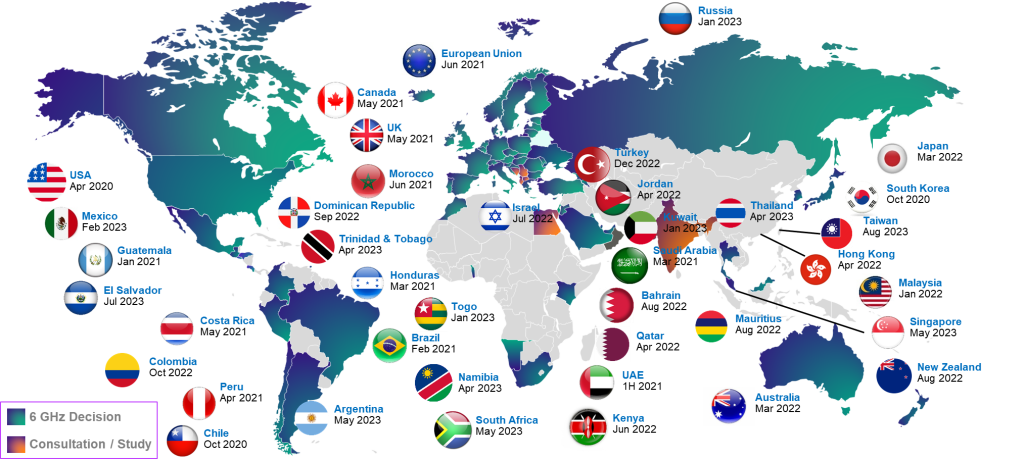
Wi-Fi 7 can also take advantage of the additional 1200MHz of the 6GHz band that comes with Wi-Fi 6E.
6GHz is the band where Wi-Fi 7 can shine with multi-gigabit processing, thanks to its significant increase in spectrum and capacity.
Flexible wireless radio support
The AP-735 supports flexible wireless signals. It switches the 2.4GHz radio to operate at either 5GHz or 6GHz.
This allows for additional tri-radio modes such as dual 5GHz+6GHz or dual 6GHz+5GHz.
You can flexibly choose between 2/5/6, 5/5/6 or 5/6/6 wireless radios.
In dual 6GHz mode, one radio uses the lower 6GHz band of U-NII-5 and the other radio uses the upper 6GHz band of U-NII-7 or U-NII-8. Dual 6GHz mode does not support U-NII-6.
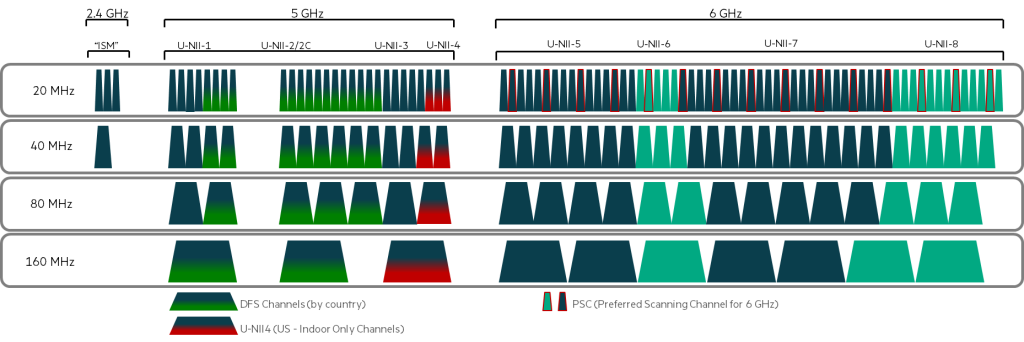
Flexible channel utilization
Wi-Fi 7 introduces two features that work together to provide more flexible spectrum utilization in situations where there are overlapping Wi-Fi networks or interference from legacy non-Wi-Fi networks.
Static PuncturingThis feature allows Wi-Fi 7 transmissions to avoid certain subchannels.
Wi-Fi 6 introduces resource units (RUs) as contiguous spectrum blocks of varying sizes for OFDMA.
However, Wi-Fi 7 allows the use of non-contiguous multiple resource units (MRUs).

Using static puncturing together with MRU can avoid subchannel interference when transmitting on non-contiguous channels.
Considerations for Implementing Wi-Fi 7
PSE (Power Sourcing Equipment)
As more components, radios, and features are added to the AP, its power requirements also increase.
802.3af (Class 3) PSE is not supported, but for AP-730 series APs, you can boot the AP for staging purposes.
In case of 802.3at (Class 4) Intelligent Power Management (IPM)You can use it by activating it.
Disabling IPM will cause some components (such as USB ports) to become unusable.
Mounting
The newly released AP-730 series access points provide the same mount kit as the previous generation.
You can use the same mounting system you are used to with your AP-5xx series or AP-6xx series access points.
Snap-on Cover
You can order an exterior snap-on cover to fit your AP-735 or AP-734.
Snap-on covers can be painted using non-metallic paint.
console cable
The AP-730 series, like previous platforms, uses the familiar orange Micro-B USB 3.3V TTL serial console cable (AP-CBL-SERU).
Uplink speed
This new AP, which uses wider channel bandwidth, supports multi-gigabit!
You should consider deploying these APs using switches that support Smart Rate (802.3bz).
Besides that…
The newly released AP-730 series is not simply an updated product that supports a new Wi-Fi version.
It offers more features than the standard specifications of Wi-Fi 7.
IoT (Internet of Things)
HPE Aruba Networking is building the industry's largest IoT platform ecosystem with hundreds of partners.
The new Wi-Fi 7 AP platform supports twice as many IoT radios and devices as before.
The AP-735 adds two IoT radios and two USB ports. The IoT radios can be assigned to either Bluetooth 5.4 (with HADM support) or Zigbee (802.15.4). The dual IoT radios allow you to choose between dual BLE or a BLE + Zigbee combination.
You can also connect devices with other IoT protocols, such as EnOcean products, via the USB port.
Location tracking
The new Wi-Fi 7 platform enables more accurate and secure location services through a variety of technologies and methods.
- Barometer
- GNSS/GPS
- Bluetooth 5.4
- Fine Time Measurement (FTM) with 802.11az
Bandpass filtering
Ultra Tri-band Filtering (UTB) system allows dynamic and flexible use of closely adjacent channels between radios in the same housing. Patented filtering technologyIt eliminates interference and allows the use of both 5GHz and 6GHz channels.

This is crucial for deployments in areas where the entire 6 GHz band is not permitted. Competitors who lack a solution to the filtering problem of accommodating the 5 GHz and 6 GHz bands in close proximity to the same AP require 30% fewer channels for individual AP channel assignment.
Intelligent power saving
The AI-based power-saving feature is an enhanced version of what HPE Aruba Networking previously called Green-AP.
This feature allows you to intelligently schedule APs to sleep and wake up.
It operates based on the core technology of WOL (Wake-on-LAN).
This feature works with client awareness and automated scheduling based on time series data for both clients and APs.
Fixed IoT clients connected 24/7/365 are also considered, and coverage is calculated to ensure continuous coverage for these clients. This feature is smart enough to account for APs that must always be on, such as outdoor and mesh APs, or even for APs that are designated IoT gateways.
Currently, power-saving features require a minimum of 20 APs. However, HPE-Aruba plans to gradually reduce the minimum number of APs through ongoing learning.
security
- GCMP-256 and Beacon Protection: Wi-Fi 7 modifies WPA3-Personal to support the GCMP-256 protocol.
- MACsec: Extend Ethernet protection by leveraging MACsec functionality from access switches to APs.
- Personal Wireless Network (PWN): ID identification allows segmentation of individual terminals within a VLAN.
For example, in a dormitory, it would be possible to share various devices owned by a student with his or her roommate, but restrict sharing with friends in other rooms.
Please note that the current security mode of PWN is limited to WPA2 secured networks due to limitations of legacy standards.
That is, the current PWN does not support 6GHz operation.The HPE Aruba Networking CTO team WPA3-PersonalWe are researching a standards-based approach to solve the multi-password problem.
HPE Aruba Networking is ushering in a new era of connectivity with the AP-734 and AP-735 models, powered by Wi-Fi 7, which offers improvements over existing Wi-Fi 6/6E, including faster data transfer speeds and improved reliability.
This new platform incorporates advanced features such as Multilink Operation (MLO) to improve data rates and reliability, 4096-QAM, flexible channel utilization to avoid subchannel interference, and flexible radio support, highlighting technological advancements that go beyond simple Wi-Fi operation to suit complex enterprise environments.
Aruba's new 730 Series APs serve as a platform to expand location tracking, IoT, security, and AI solutions.
This platform will meet the growing demands of modern enterprises for improved performance, new features, and powerful solutions.
For more information, visit the HPE Aruba Networking homepage.