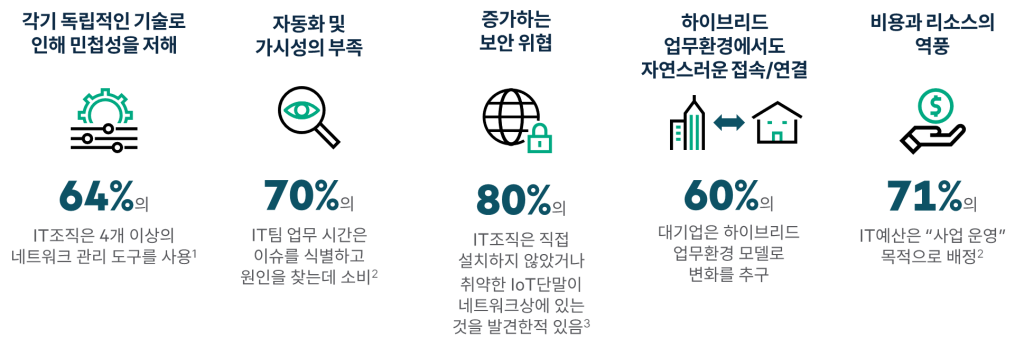
Nowadays, various technologies are being integrated, the proliferation of IoT devices that are not clearly classified and are often referred to as ‘others’, and the increase in data-intensive applications are causing Network Operationsis becoming very complex and the burden on security and scalability is also increasing.
Can you give me an example?
Many of the world's leading universities use HPE Aruba Networking products.
In the wake of the pandemic, many universities are working to enhance student academic quality and convenience through modern campus experiences.
An interesting observation is that many students are using gaming consoles in their dorms and creating and distributing private network services that can only be shared with a select few. How will the access control, security, and performance requirements for dormitory networks change significantly, ultimately increasing the workload on network operations teams?Imagine.
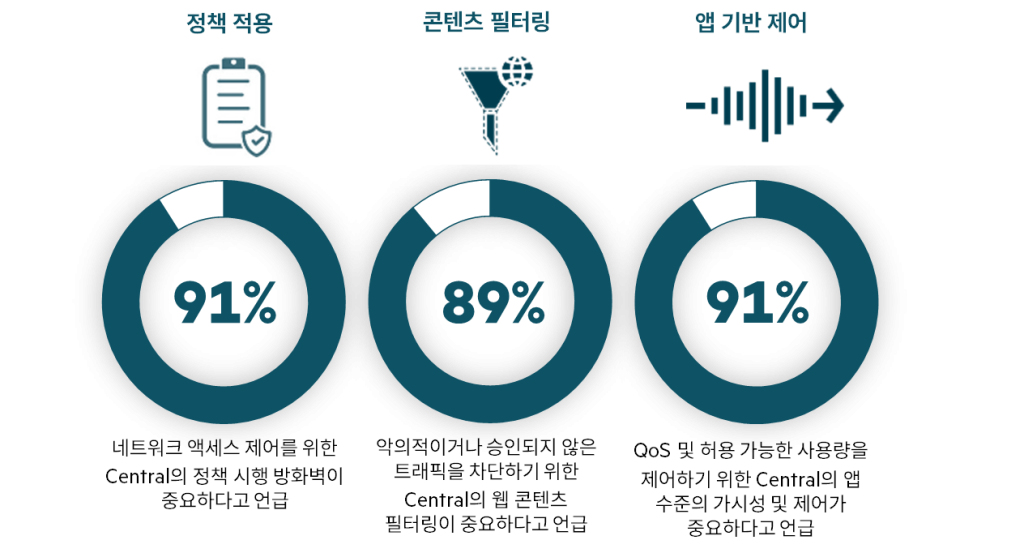
IT leaders across industries are overcoming similar challenges by doubling down on tools for simplification, automation, and resilience. Efficiency of network operationsWe are trying to increase it.
Introducing Next-Gen HPE Aruba Networking Central
Presented at ATM'23The next-generation Central leverages data on the network to provide an intuitive, operator-centric environment with deeper AI capabilities than before, maximizing the efficiency of network operations from the moment network equipment is introduced to the operational stage.
Next-generation Central enables people-centric access, interpretation, and understanding of network data.
This design foundation will enable both domain experts and non-expert engineers to more easily solve complex problems across diverse data sets, construct and maintain complex networks, and more.
Now, let's take a closer look at how to do this, considering three key recurring customer complaints:
Manual correlation and inefficiency
Network problems are usually “Wi-Fi isn’t working” or “The internet is slow.”It starts with a very simple ticket called .
Then, front-line support teams, such as help desks, start with questions like:
- Is this problem limited to one student, or does it affect many other students?
- Is it a wireless LAN problem, a wired LAN problem, or a WAN problem?
Is the problem occurring on your personal network or on the university network? - Is this an issue related to a critical business application?
- Is the performance degradation due to security issues?
These complex data sets are spread across multiple screens, burdening workers, slowing down analysis, and increasing the risk of human error.
To solve these problems Interrelate, interpret, and display data using a dynamic, multidimensional framework like never before.Must do.
The next-generation Central is designed to address these challenges precisely through a multidimensional solar system view.
The objects (suns) that need to be investigated can be sites/networks/devices/clients/applications, respectively.
And all the related factors that can determine the outcome of the investigation are depicted as 'planets' around the 'sun' (see figure below).
Each planet contains:
- Network (WLAN, LAN, WAN, Event)
- Clients (user and device metrics for access, usage, classification, and behavior)
- Applications (both institutional and individual – metrics for resource consumption, performance scores, and user/device relationship pivots)
- Security (authentication and authorization policies, IDS/IPS, security and QoS policy compliance, behavioral anomalies, threat scores) and
- Notifications (AI-assisted problem diagnosis for connectivity, performance, configuration, and health)
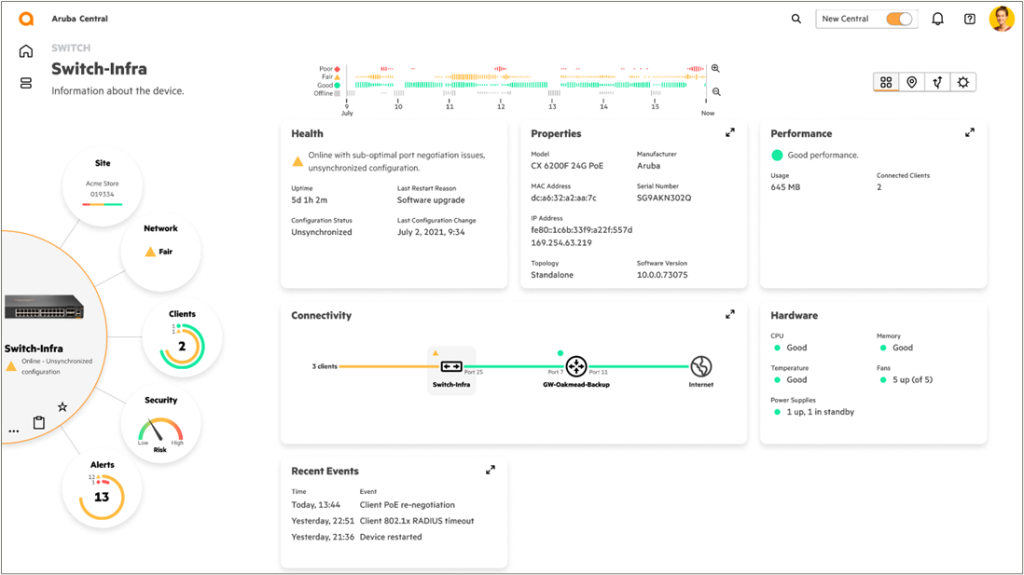
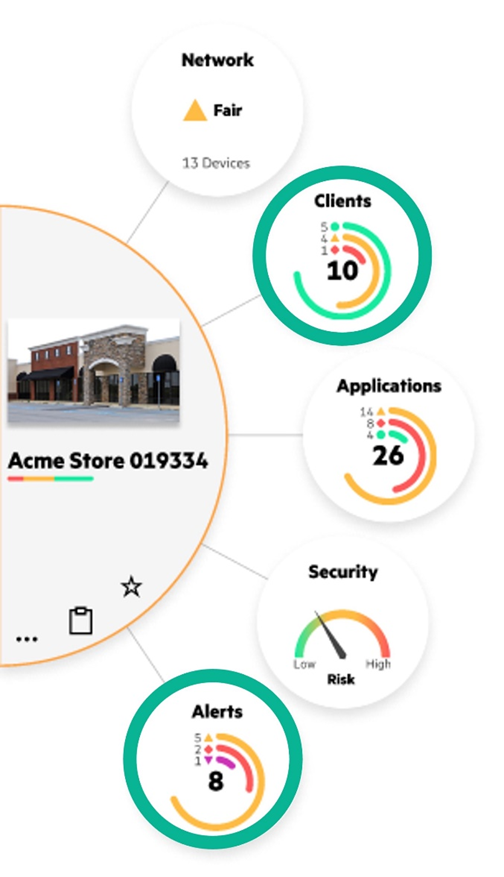
Planets are quantified by their status in specific attributes to create a comprehensive status score, allowing you to visualize all of these aspects in one place.
Contextualizing this vast amount of data provides operators with unprecedented flexibility to analyze their networks at various levels of detail.
One of Atmosphere'23's partners said,’A picture is worth a thousand words.‘' he said.
The updated interface is geared more toward the end-user perspective, better suited to the "day-to-day life of a network administrator," rather than a dashboard, says Joel Grace, senior vice president of IT infrastructure and cloud practice at solutions provider Sayers.
Increased MTTR and support costs
Another challenge enterprises face with their networks is reducing mean time to resolution (MTTR) by quickly resolving difficult-to-resolve issues.
According to a customer survey conducted in 2021, issues such as client connectivity, application performance degradation, service performance degradation, and Wi-Fi coverage are among the network issues that are most difficult for IT teams to identify and resolve and have the greatest impact on revenue. It takes up to 25 hours and causes an average of $155,000 in lost annual sales.It appeared as .
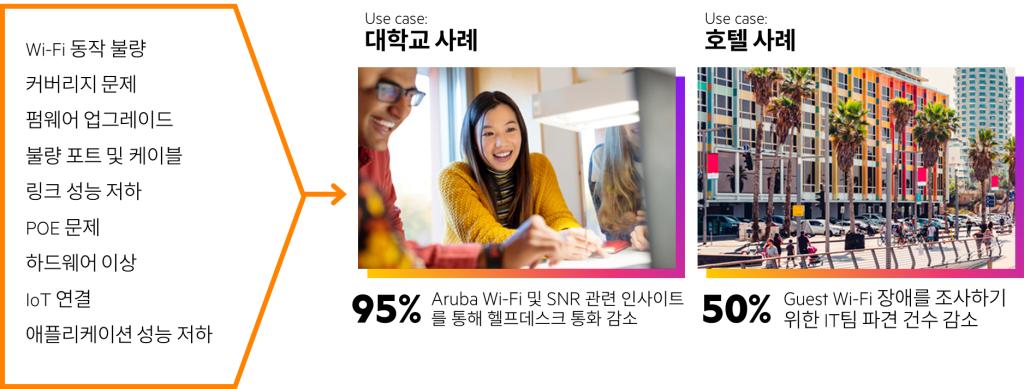
Typical troubleshooting methods include sifting through massive amounts of SIEM logs, application logs, and network diagnostic commands, capturing live packets, searching through various alerts to triangulate possible past events, and even jumping into the CLI for deeper analysis.
Even AI-based alerts can't catch all issues unless learning patterns to detect them have been developed.
It was clear that the solutions currently on the market lacked the tools to address transient network issues.
Next-generation Central introduces the pioneering concept of 'Network Time-Travel', allowing operators to 'go back in time' to solve problems.
Think of it as time travel from the 1980s with the Terminator.
In this case, instead of hunting down John Connor, we're trying to figure out where/what/how/when the network issue occurred!
This feature builds a series of snapshots of complex data sets in a time machine that records events, statistics, status, configurations, logs, reports, alerts, and more.
Network operators can go back in time, sorting through information and identifying the root cause of the problem, much like pressing a rewind button.
HPE Aruba believes this has the potential to define the future of network troubleshooting technology.
Additionally, AI-driven performance metrics on client experience and device health help operators proactively manage their networks, quickly finding those elusive "needle in a haystack" issues.
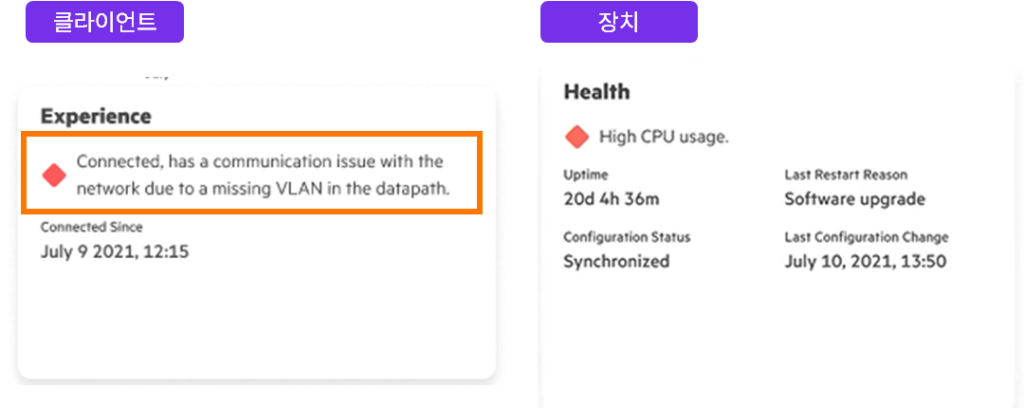
Central not only quickly analyzes root causes, but also presents specific impacts (or their surroundings) and recommendations for resolution, significantly reducing operator fatigue and reducing troubleshooting time by freeing operators from the barrage of alarms and events.
Network operation status monitoring
A common complaint from customers is that it is difficult to visualize the operational status of the entire network on a single screen.
A network administrator deploys a new site and wants to ensure that the network is functioning as expected.
Imagine requesting a summary view that highlights the status of physical links, segment distribution (VLAN/VRF), operational status of overlay tunnels, congestion, and specific issues or properties for specific segments of the network.
The innovative "Sunburst" topology allows you to visualize a bird's-eye view of your network, with physical and logical connections and network performance characteristics layered into a single, innovative view. This form of interactive visualization has proven to be an ideal design model for displaying large, complex, and hierarchical data.
Sunburst View is the most efficient operational graph, scalable to networks of all sizes, allowing operators to dynamically layer attributes like segments, link connectivity, status, location, presence, and heat maps to their liking.
Just like Google Maps, operators can quickly navigate by searching, zooming, pivoting, and applying multiple visualization layers to network elements. This truly innovative technology allows network engineers to understand complex, large-scale networks, make agile changes, assess the impact, and see how the network operates.
HPE Aruba Networking Central continues to evolve!
This blog has only scratched the surface of what the next generation of Central will be about.
The next generation of Central is just getting started. Stay tuned for more features and innovations to come.