Many companies around the world are more than doubling their investments in digital transformation in the wake of the pandemic.
And these innovations continue, offering many benefits.
As the adoption of artificial intelligence and intelligent edge computing accelerates, data provides better insights and informs operational actions.
Additionally, emerging technologies such as augmented/virtual reality, 5G wireless environments, and SD-WAN are delivering groundbreaking digital usage experiences.
We are now beginning to picture the unimaginable amount of data being generated, analyzed, moved, and stored.
Rather than decreasing, global traffic continues to increase.
These innovations, spanning computing, storage, and even networking, are needed everywhere, from centralized locations like data centers to the edge, where work begins and ends. Infrastructure must keep pace as data centers evolve into "centers of data.".
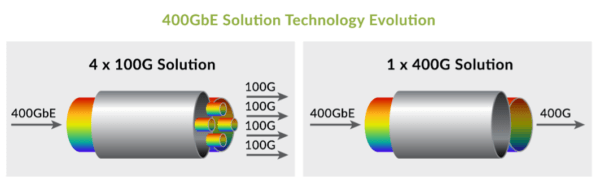
400GbE is here, and it's going to be huge!
Until recently, 10GbE seemed like a massive amount of traffic connecting servers and storage.
Then, 25GbE and 40GbE are starting to take hold, and 100GbE links are being integrated to deliver the performance needed for data-intensive applications.
The adoption of more efficient protocols like NVMe places additional strain on the network. A server with four NVMe drives can quickly saturate a 100 Gbps link.
100GbE has been the most widely deployed network speed in the data center switch market since 2019, primarily in the cloud.
Specifically, looking at the enterprise segment of the data center switch market, enterprises are transitioning to faster 100GbE ports to support AI/ML (artificial intelligence/machine learning) and edge-based workloads that are difficult to accommodate with existing 10/25GbE network speeds. Even in 2021, this segment saw the strongest growth. (Source: 650 Group)
The server access sector is also changing rapidly.
The 650 Group predicts that 25GbE and 100GbE ports will account for 73% of the controller and adapter market by 2024.
Not only will server designs be rapidly transitioning to 100GbE, but it will not be uncommon to see 100GbE ports in advanced workloads.
Analyst firms are all predicting rapid bandwidth increases over the next decade.
It's not just about speed.
Data center network architecture is also evolving.
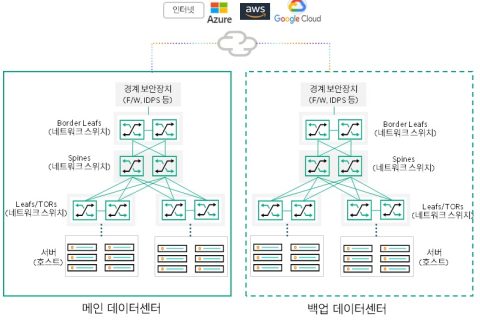
We're moving to a leaf-spine topology for greater responsiveness and agility at scale, both in the data center and at the edge.
EVPN-VXLAN network fabric extends layer 2 connectivity over the physical network, creating a more agile, secure, and scalable network.
The consumption model of IT is also changing.
Many companies have found it difficult to implement changes like digital innovation at the desired time because they follow a renewal cycle based on capital depreciation.
We are now exploring and adopting the Hardware-as-a-Service (HaaS) model to overcome these limitations.
HPE Aruba's 400GbE-capable data center switches meet this trend.
To meet these rapidly evolving IT trends, the Aruba CX 9300-32D data center switch has been launched.
The Aruba CX 9300-32D supports 200G, 100G, and 25G*A 1U fixed-configuration switch with 32 400GbE ports supporting port breakout. This switch provides next-generation 12.8Tbps capacity.
The switch is designed to provide flexible, cost-effective, high-density 100G/200G/400GbE for connectivity from servers, storage, and within the network fabric.
* 25G breakout coming soon
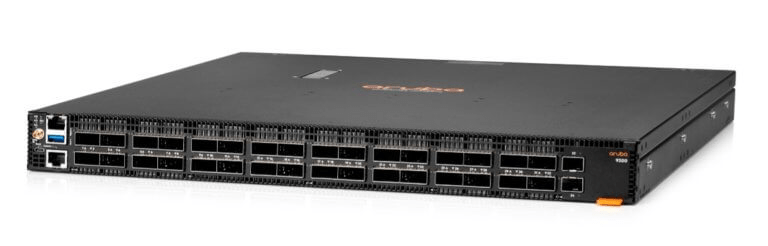
The CX9300-32D switch reduces power requirements and floor space while transitioning server farms from existing 10GbE to a Spine configuration of 25GbE or 100GbE/400GbE EVPN-VXLAN, protecting enterprise investments from a cost perspective.
It can support large data center pods of up to 6,000 25G servers or 2,000 100G servers. This represents an eight-fold increase in scalability and port density compared to the current Aruba CX 8325-32C switch, which scales to 700 x 25G servers.
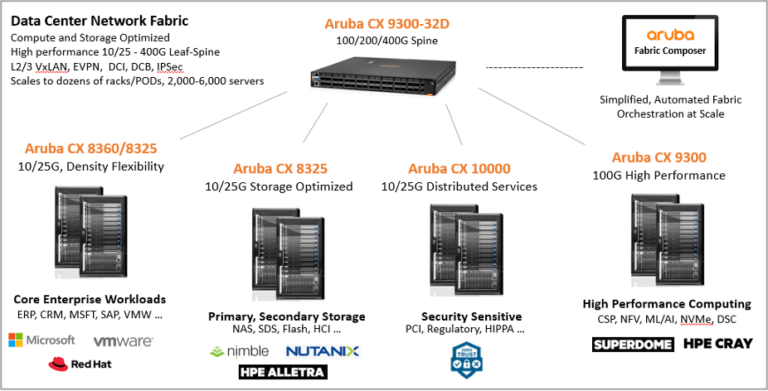
The CX9300-32D can also be used as a 25/100G Leaf switch or a 100/400G Spine switch.
When deployed with Spine switches, you can connect to Leaf switches such as the CX8325-48Y6C, CX8360-48Y6C, and CX10000-48Y6C, and connect servers with 100G, 200G, or 400G.
The operator also Aruba Fabric Composer (AFC)Manage increasingly large and complex network fabrics. Aruba Fabric Composer dramatically simplifies automation, orchestration, and end-to-end visualization from the fabric underlay to the virtualized overlay, accelerating provisioning across rack-scale compute and storage.
Data Center Use Cases for Aruba CX Switches
This 400GbE announcement follows ongoing integration between HPE and Aruba, encompassing dozens of HPE solutions across hyperconverged, mission-critical, high-performance computing (HPC), and new Ethernet storage fabrics.
All these solutions are equipped with the recently launched Pensando Distributed Service Switch CX 10000It will be very complementary.
Design today, plan for the future with Aruba
HPE has long been an industry leader in servers, virtualization, and storage, while Aruba is a proven and proven leader in networking.
HPE and Aruba's integration across the entire IT stack provides enterprises with a compelling advantage that can help them adopt groundbreaking infrastructure innovations to realize their digital strategies.
To change the game, you need to lay a solid foundation that is agile, scalable, and high-performance.
Enterprises will now be able to deliver unparalleled digital experiences and performance to their customers with unprecedented operational efficiency.