Prologue: Invisible Intrusion, But Packets Don't Lie
Previous PostIn Anthropic Claude MythosWe discussed how to preemptively block attacks at the network perimeter to counter the zero-day threats triggered by [the event]. The SRX's examined at the time AI-Predictive Threat Prevention (AI-PTP)It was a precision interceptor weapon that predicted and blocked unknown threats in real time with only the first few kilobytes (KB) of payload in an inline proxy-less environment.
However, if you are an engineer and a security practitioner protecting infrastructure, you will inevitably face the cold, hard questions of the next step.
“If an attacker has exploited a vulnerability and already established a foothold in the internal infrastructure before a vendor releases a patch or signature, how can we identify them?”
Jon Green, CTO of HPE Networking, raised a very straightforward topic in a recent article.
“Is Mythos just another LLM, or is it the most dangerous cyber weapon in the world?”
(Is Mythos just another LLM, or is it the world's most dangerous cyberweapon?)
The empirical conclusions of security experts are clear.
While it may not be an invincible monster capable of neutralizing all defenses in an instant, its ability to detect complex memory management flaws or atypical bugs within large-scale codebases far surpasses that of human analysts. If an attacker exploits this, they could have already quietly established a foothold in a corner of the internal network before the vendor even issues a patch advisory.
This is the true nature of the 'covert infiltration' we face.
Then, how are we supposed to detect attackers lurking inside IoT devices or home routers that lack even an endpoint agent? The answer is surprisingly close at hand.
The infrastructure that carried traffic, that is Waking up the network fabric itself with a real-time security sensorno see.
1. The Cold Reality of the Age of Mythos: The Collapsed 'Golden Time'‘
In the security industry, the discovery and exploitation of vulnerabilities were a routine cycle, but the emergence of generative AI has compressed the unit of that timeline from 'weeks' to 'hours'.
As part of 'Project Glasswing,' HPE conducted an evaluation by directly applying Claude Mythos to its software and firmware codebases....was done. The empirical lesson was clear. If defenders can find defects in their products using AI, attackers can also use the same model to uncover zero-day vulnerabilities in the supply chain and infrastructure.
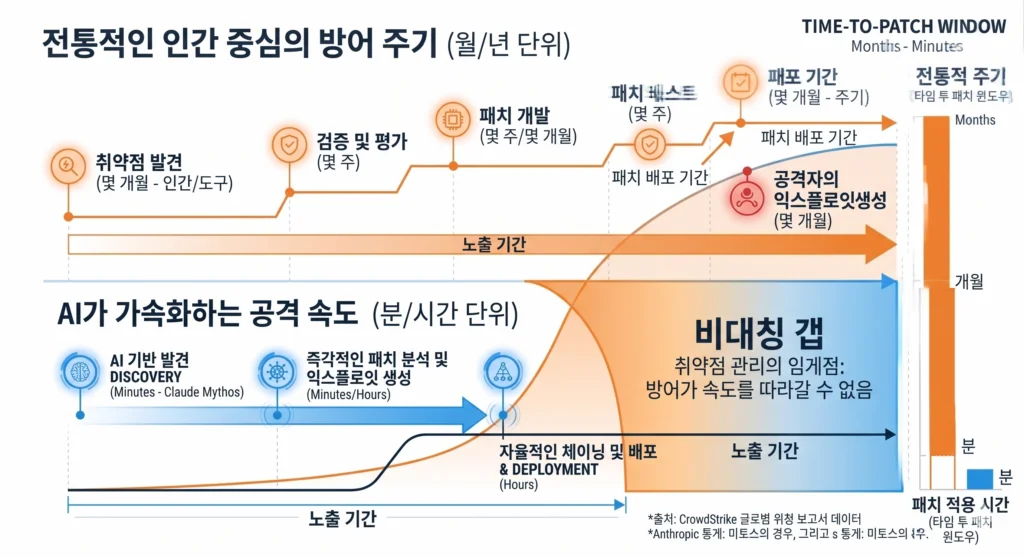
[Traditional Vulnerability Cycle]
Vulnerability Discovery ──▶ Vendor Analysis/Patch Development ──▶ Issuance of Security Advisory ──▶ Patch Distribution During Scheduled Maintenance ──▶ Blocking of Exploitation Attempts

[The Vulnerability Cycle of the Mythos Era]
Attacker AI Vulnerability Discovery ──▶ Immediate Exploitation/Internal Infiltration ──▶ (Time difference occurs) ──▶ Vendor Awareness and Emergency Response
The 'golden time' between vulnerability exposure and exploitation has virtually disappeared.
Enterprises must now completely redesign their defense systems based on the premise that “we may already have been compromised.”.
2. Inside-Out: Why the Network Is the Most Effective Security Sensor?
There is a process that an attacker who has successfully infiltrated the system must go through to achieve their goals (data leakage, ransomware distribution, etc.).
It is precisely elevation of authority and lateral movement.
At this point, engineers' approach to infrastructure must change completely.
“In an era of AI-driven threats, organizations must begin treating networks not merely as infrastructure for carrying traffic, but as 'real-time security sensors.'‘
(In the era of AI-driven threats, organizations need to start treating the network as a real-time security sensor — not just infrastructure that moves traffic.)The biggest obstacle an attacker encounters here is not the endpoint. network fabricno see.
- Eliminating Blind Spots for Agent-less Devices: Enterprise networks are connected to numerous IoT devices, printers, IP cameras, and OT sensors where EDR or security software cannot be installed. Attackers often use remote workers' home routers or vulnerable smart building sensors as footholds to gain access to the internal backbone network.
- Packets do not lie: The moment an infiltrating attacker establishes a handshake with a C2 (Command and Control) server or sends a scan packet to a database segment with which there is normally no reason to communicate, that action inevitably passes through wired and wireless switches and routers.

Ultimately, the network must not be merely a civil infrastructure that carries packets from A to B, but must function as the most precise security sensor that monitors abnormal behavior of the entire infrastructure in real-time, 24 hours a day.
3. From Alert to Drop: Physical Implementation of Zero Trust
There is a fatal mistake many organizations make: when abnormal traffic is detected, they simply trigger an 'Alert' on the SIEM or dashboard and wait for the security operations team to manually analyze it. Human analysis processes cannot keep up with attackers moving at machine speeds.
True Zero Trust should result in a 'physical drop' as soon as an unauthorized session is identified.
| Defense phase | Traditional response (Reactive) | Inside-Out Zero Trust Response (Proactive) |
| Authentication point | One-time authentication upon core firewall/VPN login | Authentication of the edge switch port and wireless AP unit closest to the user |
| Status monitoring | Trust session persistence after successful initial connection | Continuous monitoring of traffic profiles and behavior even after session establishment |
| When abnormal signs are detected | SOC Notification Received ➔ Ticket Creation ➔ Manual Isolation Review | The session at the edge port Immediate forced termination (Session Drop) and terminal dynamic isolation (Quarantine) |
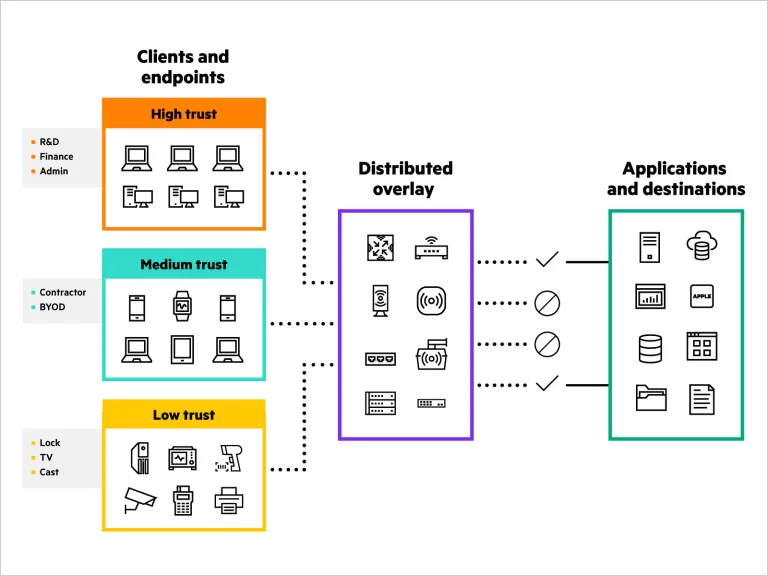
At the edge switch and AP level Dynamic SegmentationBy implementing this, even if an endpoint is compromised by a zero-day vulnerability, you can immediately cut off lateral movement paths spreading across the network at the edge.
4. Improving Operational Structure More Important Than Technology: The Engineer's Realistic Dilemma
Changing an organization's 'operational inertia' is more difficult than building an architecture. To secure infrastructure resilience in the AI era, the following three operational fundamental improvements are essential.
① Embrace 'Operational Tradeoffs'
The era of waiting 2 to 3 weeks for regular PM (maintenance) Windows and patching after thoroughly running integrity tests is over.
Rather than insisting on perfect pre-verification and giving attackers a long-term persistence, The decision to immediately push emergency security patches, even at the risk of minor service delays or temporary disruptions.This is required.
② Eliminate infrastructure complexity and standardize
When vendors release emergency patches, the first targets they test and distribute are widely used standard releases.
Infrastructure that insists on overly complex custom configurations or non-standard topologies inevitably leads to delays in patch verification and deployment.
Standardization of infrastructure is the fundamental strength of security resilience.
③ Break the NetOps and SecOps Silos
While network operations teams (availability-centric) and security teams (control-centric) play back-and-forth with different telemetry tools, breaches spread. Network telemetry and security events must be bundled into a single pipeline through a unified AI-Native monitoring platform.
Epilogue: Beyond the Data Pipe, Toward the Most Sensitive 'Sensory Organ'
The emergence of Claude Mythos has clearly presented infrastructure engineers with a painful challenge.
Now that the speed of finding and exploiting vulnerabilities has accelerated to the speed of machine learning, manual monitoring that involves waiting for regular inspection cycles or manually checking warning logs on the screen is no longer effective.
However, there is one physical law that does not change, no matter how sophisticatedly an attacker penetrates the code.
In order for them to expand their reach internally (Lateral Movement), seize authority, and extract data The fact that you must necessarily pass through the pathways of wired and wireless switches and routersno see.
Ultimately, the success or failure of the defense depends on a shift in perspective regarding the network.
- The era of 'simple pipelines' that merely delivered packets to their destinations is over.
- Networks must now become 'living neural networks and sensors' that capture abnormal, minute signals occurring throughout the infrastructure in real time and physically sever communication at the edge as soon as they detect a risk.
A structure that intercepts indiscriminate incoming attacks with AI-PTP at the front end, while immediately cutting off the lifeline of infiltrating attackers with a 'sensor-driven network' internally. This airtight Inside-Out architecture is the most reliable resilience that enterprises facing the double-edged sword of AI must possess.