On May 26th, Aruba Wi-Fi 6E Solution Launch NewsI have conveyed it.
Wi-Fi 6E is Approved by the government in October last yearBy providing Wi-Fi service using the unlicensed 6GHz frequency band, it can provide much greater capacity at faster speeds than before.
This will enable faster speeds and higher performance for high-bandwidth applications such as augmented reality (AR)/virtual reality (VR) and high-definition video transmission such as 8K video.
Introducing Aruba's Wi-Fi 6E Solution
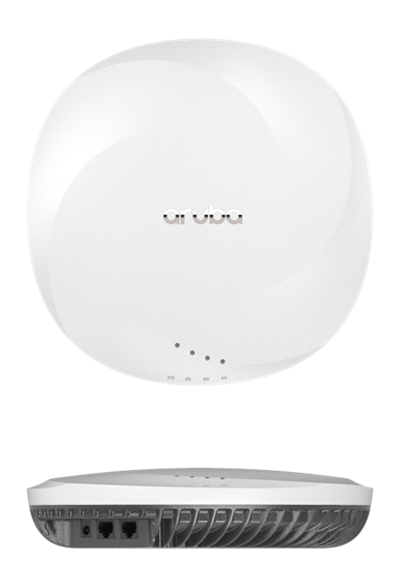
This time Aruba introduced New Access Point 630 SeriesIt is said to be designed to make the most of the 6Ghz band.
It comprehensively supports three wireless frequency bands, providing up to 3.9bps throughput and can provide up to seven 160MHz channels in the 6GHz band. It also supports dual-port 2.5Gbps speed per port. SmartRate It is said that it can provide ports (multi-gigabit ports) to ensure non-stop failover with redundancy for Ethernet and PoE power.
Real Aruba YouTubeLooking at it, we were able to confirm that speed tests were conducted using a prototype of the AP-630 series. The test results using a 40MHz channel in the 2.4GHz band and an 80MHz channel in the 5GHz and 6GHz bands showed a multi-gigabit performance of 2.2Gbps.
This means that we were able to achieve performance exceeding gigabit Wi-Fi even without using the 160MHz channel band.
Aruba's Ultra Tri-band filtering technology
Some countries have more space, but in some countries the 5Ghz and 6Ghz bands are separated by just 50Mhz.
In this case, interference may occur between the channels of the two bands.
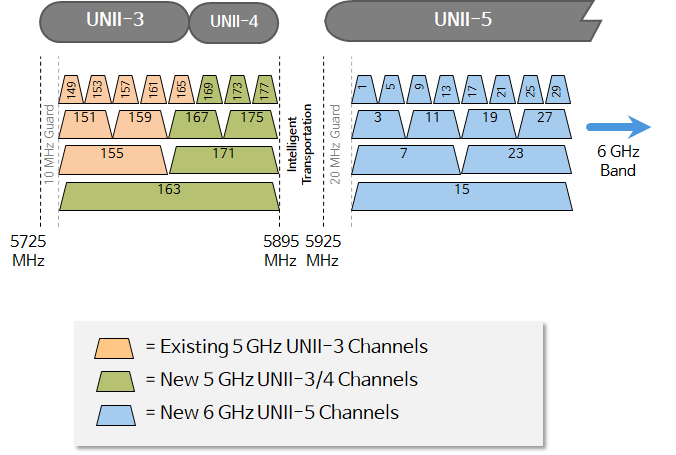
Looking at the image above, the green channels 171 and 175, and the blue channels 3 and 7, are very close to each other. This means the upper 5GHz band and the lower 6GHz band can interfere with each other, degrading performance in both bands.
Aruba is working to minimize these impacts. Ultra Tri-band FilteringWe approached this with an innovative technology called , which switches the type of filter used depending on the selected channel.
This means that if an AP uses the upper channel of the 5GHz band, that same AP cannot use the lower channel of the adjacent 6GHz band, and vice versa. Ultimately, rather than restricting channels per AP, the band can be automatically adjusted based on the channels used by the AP, maximizing bandwidth utilization.
Future Directions for Wi-Fi 6E
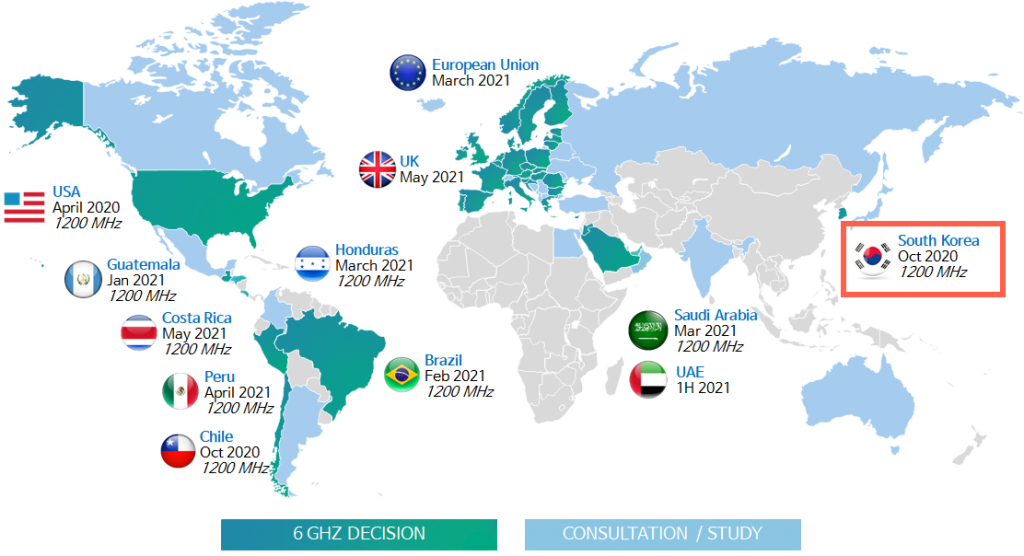
As you can see in the picture, many countries are approving and reviewing the use of the new 6Ghz band.
It has already been approved for use in parts of Europe, South America, and the Middle East, including the United States and Korea, and many countries, including Canada, Russia, Japan, and Australia, are currently reviewing it.
More than 3 billion people in over 70 countries will benefit from this, and that number will continue to grow.
Mobile devices using the Snapdragon 888 processor already support Wi-Fi 6E, and more chipsets and terminals will support Wi-Fi 6E.
Wi-Fi 6E network design
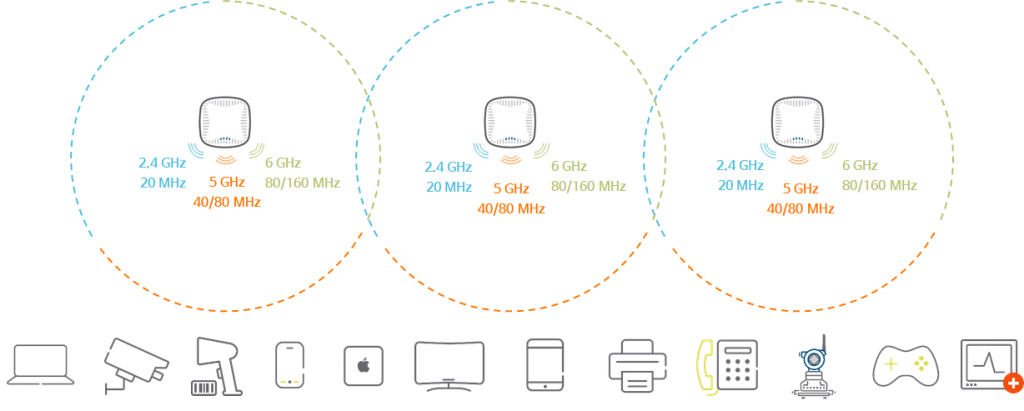
As mentioned earlier, Wi-Fi 6E uses three frequency bands.
By efficiently designing and deploying this frequency band, we will be able to handle more traffic.
Aruba configures the 2.4GHz band with 20MHz channels to allow connections for devices that only support the 2.4GHz band, such as IoT devices, and configures the 5GHz band with 80MHz channels, allowing six channels to be used, allowing connections for general high-performance devices that do not support the 6GHz band. Finally, the 6GHz band uses seven 160MHz channels to enable high-speed, high-performance connections for the latest devices.
Starting with wireless, Aruba has unveiled the industry's first enterprise-grade Wi-Fi 6E solution.
As a company that always leads the market, this time too, it showed an innovative side.
With the number of client devices rapidly increasing, the market is increasingly demanding faster and higher-capacity networks. Wi-Fi 6E seems to be the solution to meet these market demands.
Aruba's AP-630 series is expected to be available in the third quarter.
You can also check out related content on YouTube below.