Rate Limit
If the spanning tree configuration is incorrect, a loop in Layer 2 may be created.
In these situations, AOS-CX can specify how much traffic it can receive on an Ethernet port or Link Aggregation Group (LAG), including broadcast, multicast, or unknown unicast traffic.
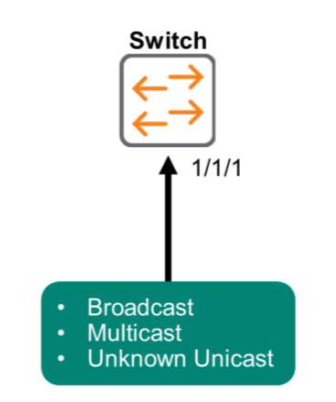
This feature is independent of Spanning Tree, but is a mechanism to protect CPU utilization and allow administrators to connect to the switch at any time.
You can apply the command at the interface level as follows:.
switch(config)# interface 1/1/1
switch(config-if)# rate-limit broadcast 4000 pps
Loop Protection
So far, the focus of our look at spanning tree has been on intentionally preventing loops of redundant network ports, such as duplication, when configuring a network.
However, in actual network operations, loops can arise due to the unintentional connection and configuration of numerous ports. These loops typically occur on the switches closest to the user (edge ports).
As you can see in the picture below, two Ethernet ports on the Access-1 switch are connected with cables.
Looking at the picture alone, it may seem like something like that would never happen, but when you actually operate a network, it happens more frequently than you might think.
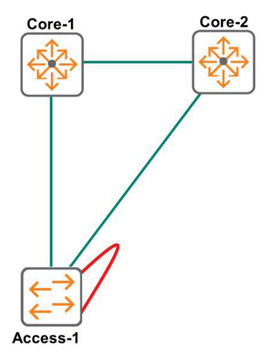
The Loop Protection feature protects the edge switch by transmitting loop protocol packets on the port.
Ports with this feature enabled will automatically send Loop Protection Packets at specified intervals (Default: 5 seconds).
At this time, when a Loop Protocol Packet is received on a port with the Loop Protection function enabled, the switch recognizes that a loop has occurred and takes action on its own.
AOS-CX switches support the following actions:.
- Raise alarms using SNMP without disabling ports
- Disable forwarding. Ports that transmit loop detection packets are disabled (default).
- Disable both sending and receiving
This feature can be applied on Layer 2 interfaces or LAGs.
switch# config
switch(config)# interface 1/1/1
switch(config-if)# loop protection
switch(config-if)# loop-protection action {do-not-disable | tx-disabled | tx-rx-disabled}
The Loop Protection feature is useful in environments like offices where users plug cables into wired ports. Please remember to use it appropriately when necessary.