A switch must provide connectivity to many devices located on different VLANs. All traffic generated here must communicate with each other, sharing links between switches.
Therefore, multiple links are sometimes connected between switches for resiliency. However, this does not increase the bandwidth of the connection between the two switches. Even if two links are connected, only one is used, resulting in low link utilization, no load balancing, and suboptimal performance.
The solution to this is Link Aggregationno see.
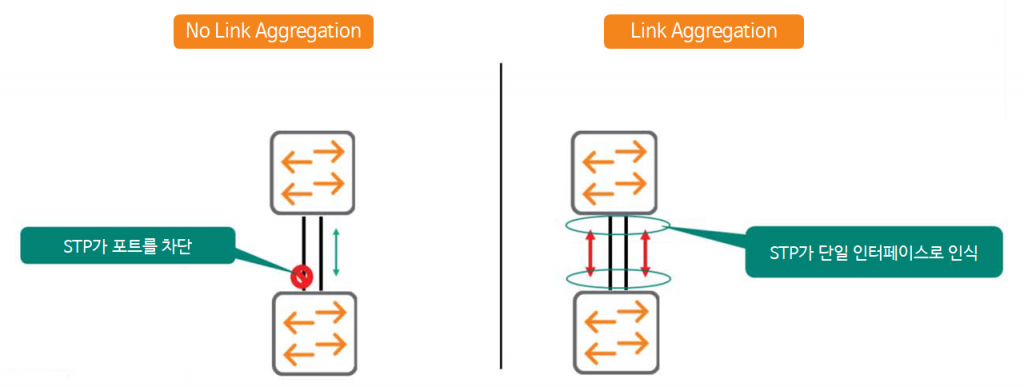
Link aggregation refers to combining multiple physical interfaces into a single logical interface.
Protocols like STP do not block this bundle because they see it as a single interface.
You can now bundle traffic between switches, from a single 10Gbps link to two, four, or more. This allows for significantly greater bandwidth because traffic is distributed across each port. Furthermore, even if one port fails, traffic is forwarded to the remaining ports, providing significantly greater resiliency.
reference: Link Aggregation is used not only on links between switches, but also on links connecting servers, storage, and routers.
Link Aggregation Overview
When link aggregation is enabled on a switch, the protocol creates a virtual interface. It then configures physical ports to become members of that virtual interface. Various protocols and processes on the switch only recognize and reference the virtual interface, ignoring the individual physical interfaces.
AOS-CX switches refer to virtual interfaces as Link Aggregation Groups (LAGs), and physical interfaces as member ports. It's important to note that broadcast and multicast traffic is transmitted over only one physical link in the bundled group. This behavior prevents link aggregation from creating Layer 2 loops.
Interface requirements
Interfaces mapped to the same Link Aggregation Group (LAG) must be configured in a consistent manner.
That is, all of the following must match:.
- Duplex Mode (Full-Duplex | Half-Duplex)
- Link Speed
- Media
The AOS-CX switch displays a warning message if you try to map a mismatched interface to a LAG.
For example, a 10 Gbps SPF+ interface cannot be added to a LAG10 group that consists of 1 Gbps interfaces (1000BASE-T).
also, AOS-CX switches for each LAG Up to 8 physical interfacescan have as a member port. “show capacities” You can check the switch capacity via the command.
Okay, so we've briefly covered LAG. Now, let's delve into it in depth.