HPE Full Stack PQC Roadmap for Neutralizing Quantum Threats
With the dawn of the era of Artificial Intelligence (AI) and the Agentic Enterprise, global infrastructure is undergoing an unprecedented transformation. However, behind this dazzling technology, where countless AI agents and data are connected in real-time, lies a massive shadow that threatens the survival of businesses.
It is the advent of quantum computing, which can fundamentally shake the encryption systems we currently use.
The Emergence of Qubits and the Shaking Foundations of Modern Cryptographic Systems
The core of quantum computers lies in the fact that they differ from traditional digital computers starting from the unit of computation.
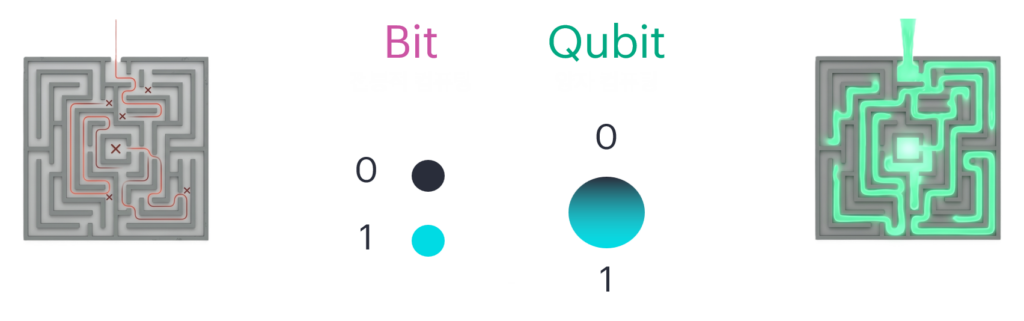
Unlike conventional 'bits' that can only handle a fixed state of 0 or 1, the quantum world uses qubits in a 'superposition' state where 0 and 1 states can exist simultaneously. The easiest way to understand this concept is to imagine 'finding your way in a complex maze.'.
Conventional digital computer (Bit): You start from the entrance of the maze, follow one path, and return if you get blocked; you take another path, and if you get blocked again, you return—this process is repeated countless times. It is a 'sequential method' where you find your way step by step.
Quantum Computer (Qubit): It is like pouring 'water' all at once into the entrance of a maze. As the water flows, it [reaches] all the forks and dead ends inside the maze ‘'at the same time'’ Explore and find the optimal path to the exit in a single go.
Thanks to the ability to process such countless cases simultaneously in parallel, quantum computers exhibit exponential computational efficiency that far surpasses the limitations of traditional computers..
⚠️ Neutralizing Algorithms and Security Threats
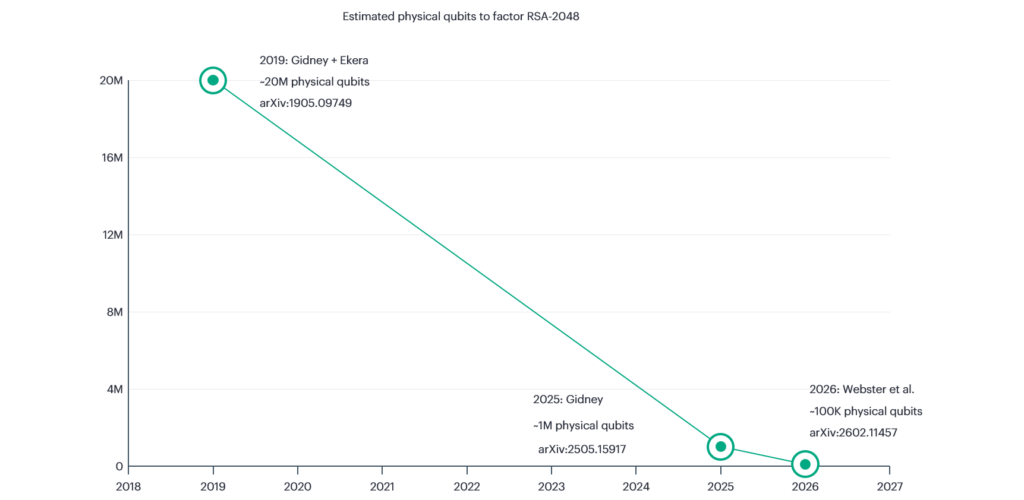
Shore's Algorithm: Qubit Cost Reduction
The moment this overwhelming computational power meets 'Shor's algorithm,' the foundation of modern security crumbles. This is because today's asymmetric encryption systems, which have relied on the mathematical complexity of prime factorization and discrete logarithms, are being cracked far too easily.
Completely Broken Password: All public key cryptographic algorithms, such as RSA, ECDSA, ECDH, and Diffie-Hellman, that form the foundation of TLS handshakes, IPsec key exchanges, and certificate (PKI) systems in production environments.
Degraded Password: Symmetric key cryptography and hash functions such as AES-128 and SHA-256 (Since the effective key length is halved by 'Grover's algorithm', the symmetric key size must be increased to 256 bits or more for defense.)
Global PQC Official Standards and Current Status of Global Market Response
Countries and standardization organizations around the world are already busy responding to these threats.
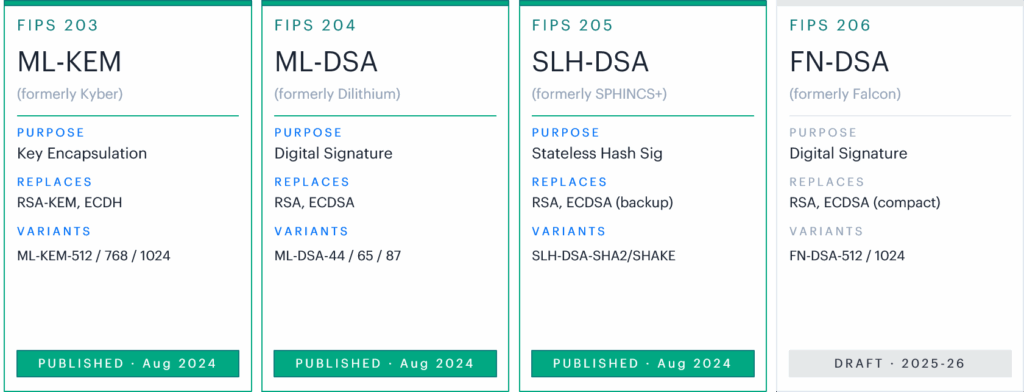
The U.S. National Institute of Standards and Technology (NIST) is capable of withstanding attacks from both traditional and quantum computers PQC (Post-Quantum Cryptography) We have finalized the official standard algorithm specifications.
Key Exchange Standard (FIPS 203): Replacing RSA-KEM and ECDH ML-KEM
Digital Signature Standard (FIPS 204/205/206): Replacing RSA and ECDSA ML-DSA, SLH-DSA, FN-DSA
Regulatory trends are also very steep.
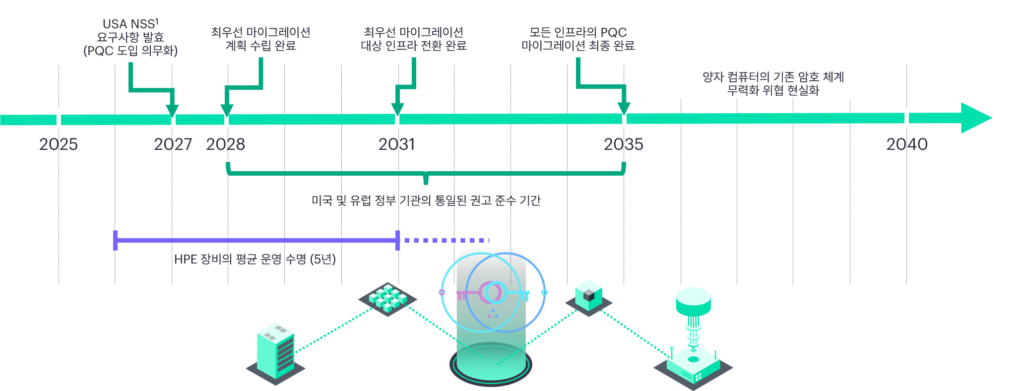
The U.S. government is a higher security standard CNSA 2.0Announced and made the full implementation of the PQC algorithm mandatory in the National Defense and Security System (NSS) starting in 2027. CNSSP-15 They have begun enforcing policies. Canada, Germany, and the European Union (EU) are also requiring the PQC conversion of infrastructure assets by successively introducing legal regulations and transition guidelines.
HPE's Quantum Vision and HPE Networking's Solution Strategy
The future HPE envisions goes beyond a mere defensive position of blocking attacks.
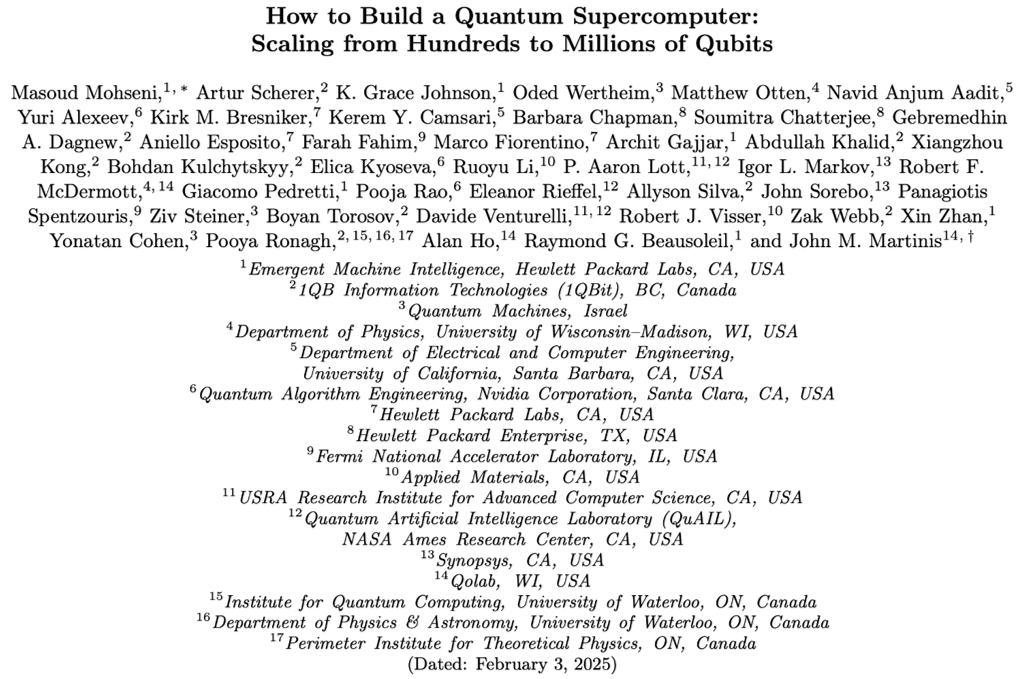
The vision presented by HPE Labs is 'Quantum Supercomputer' organically combining HPC (High-Performance Computing) + AI + Quantum‘ It is an ecosystem. To securely connect this immense future value, HPE is deploying 'Crypto-Agility' into enterprise infrastructure, which flexibly responds to changes in cryptographic algorithm standards.
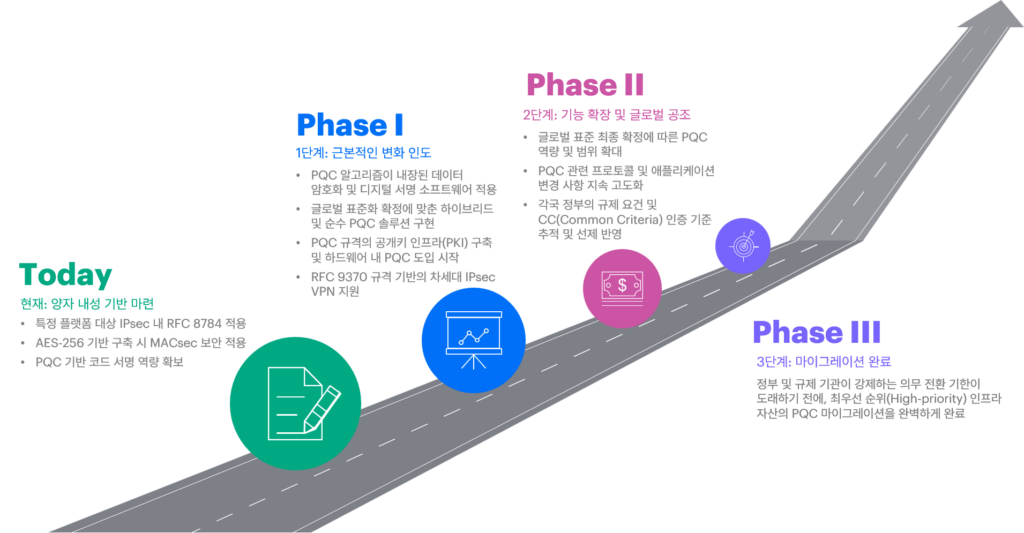
Under this vision, HPE Networking (Aruba and Juniper) The product family established a company-wide three-phase migration roadmap and embarked on a comprehensive overhaul of the entire product line..
🛡️ Product and Software Security Improvement Strategy
HPE PQC Roadmap
Complete Generational Shift of Vulnerable Algorithms: The latest encryption libraries within routers, switching infrastructure (AOS-CX, Junos), and wireless LAN infrastructure OpenSSL 3.5 PQC SpecificationWe are migrating to and gradually removing existing vulnerable asymmetric cryptographic engines.
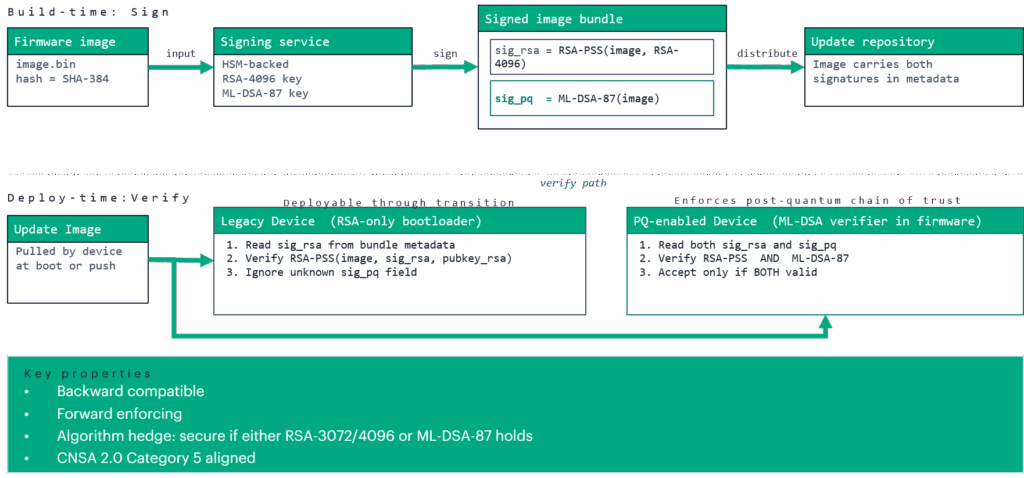
TPM and Device Identification Updates for Hardware Integrity: To protect the unique identity of the equipment and software integrity, the hardware trust root from the manufacturing stage Directly binding the PQC algorithm (ML-DSA) to the TPM 2.0 chipsetThrough this, we are establishing a dual-signature verification environment that fundamentally prevents tampering during booting and firmware updates.
ML-DSA-87 Dual Signing for firmware integrity
Hybridization of Encryption Protocols for Hyper-connected Channels: Across SD-WAN (EdgeConnect) tunnels connecting communication between branch offices or management cloud channels (Central, ClearPass) Applying Hybrid Key Exchange Specifications (RFC 9370/9242) and Quantum Security IPsec technologyWe are implementing a strategy to implement an ultra-high-speed encryption channel that supports large-capacity quantum key payload processing while being free from real-time packet transmission bottlenecks or performance latency.
The threat of HNDL, ask the manufacturer right now
Currently, not only the rest of the world but also Korea is accelerating a paradigm shift in infrastructure security with active research and guidelines for Korean-style quantum-resistant cryptography.
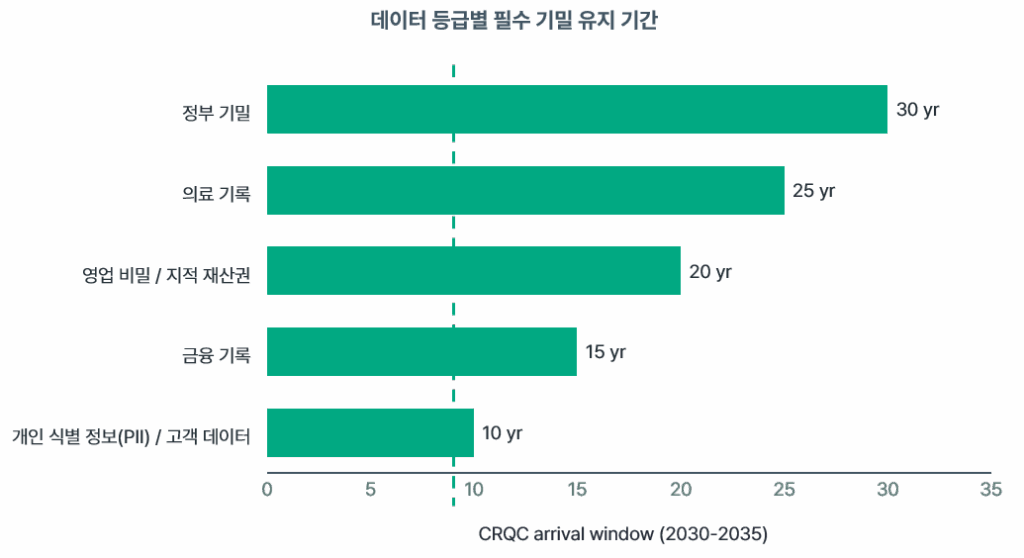
The complete commercialization and popularization of quantum computers may still take a little more time. However, if we recall the aforementioned HNDL (Harvest Now, Decrypt Later) concept, the quantum threat is by no means a story of the future.
This is because the encrypted traffic hackers stole from our networks today could return as the most fatal boomerang for companies the moment quantum computers are turned on a few years from now.
The average lifespan of network equipment is over 10 years.. If the infrastructure solution being introduced today is not prepared with quantum-resistant cryptography, that infrastructure will become a massive security hole within a few years..
For business continuity and airtight security, ask the IT/network vendors you are currently using right now.
“Is your solution preparing for PQC (Quantum-Resistant Cryptography) in the upcoming era of quantum computing with a clear roadmap?”