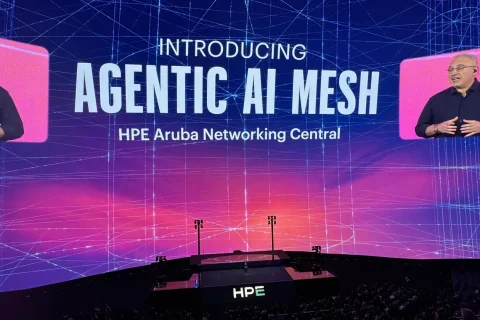
Today, I would like to discuss the security domain from Rami Rahim's keynote—specifically, the 'Unified SASE Orchestrator' based on HPE Networking EdgeConnect.
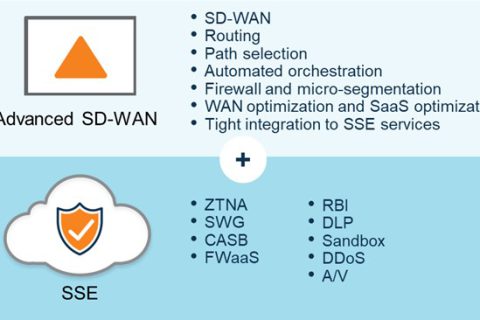
Numerous security vendors in the market tout SASE, claiming, "We, too, can manage SD-WAN and SSE (Cloud Security) on a single screen." However, if you look at it objectively from an engineer's perspective, most of them are merely "SASE in name only," consisting of solutions purchased from two different companies with only the shells (UI) roughly stitched together.
To understand the essence of the innovations HPE showcased at this Discover, The sharp criticism belowYou must first face it squarely.
“The security strategies of many companies are still focused only on 'where data resides.'.
However, in the modern business environment Data never stays still and flows ceaselessly.“
An era where data flows ceaselessly, without a single second's rest, between SaaS, branch offices, mobile, and external AI services.
Built to perfectly control and optimize this moving data The 3 Key Architectural Differentiators of a Truly Integrated SASEI am sharing.
1. Single-Pass Based Edge Acceleration Architecture
Third-party solutions that simply combine the console into a single unit must perform two internal operations when processing traffic at the CPE level. The SD-WAN engine first analyzes the packet to determine the route, and then internally passes it to the SSE (security) engine to execute decryption and firewall inspection.
Since packets are processed twice, the internet at the branch office terminal slows down, and the equipment load is bound to skyrocket.
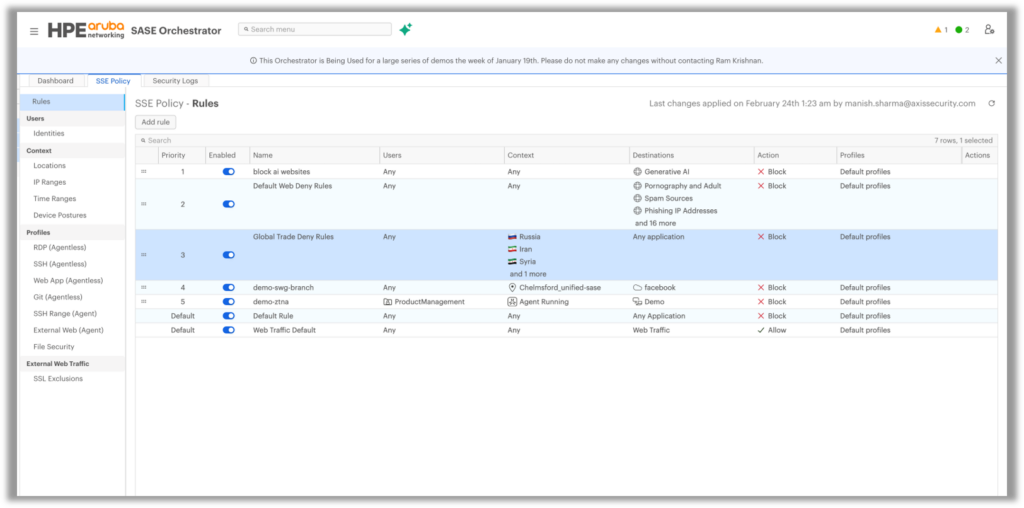
- HPE Networking Innovation: HPE's Orchestrator, fully integrated at the software level, unified the data path of branch office equipment into a single path.
- packets passing through the equipment A single processIn Single-Pass Architecture, circuit routing (SD-WAN optimization) and security inspection (DLP, firewall, ZTNA policy) are performed simultaneously.
- As a result, inline latency and network equipment resource load at user terminals in each branch are dramatically reduced, providing a pleasant edge environment where network performance does not degrade even when security is tightly enabled.
2. Organic Convergence of Context: The Meeting of Business Intent Overlay and Zero Trust
In the past, in separate systems, the SD-WAN team and the security team operated completely independently.
SD-WAN thought only, "This traffic is for an important video conference, so send it via the fastest line," while SSE only monitored, "Does this traffic contain confidential information?" There was absolutely no communication between the technology that paves the network's 'path' and the 'security' that protects it.
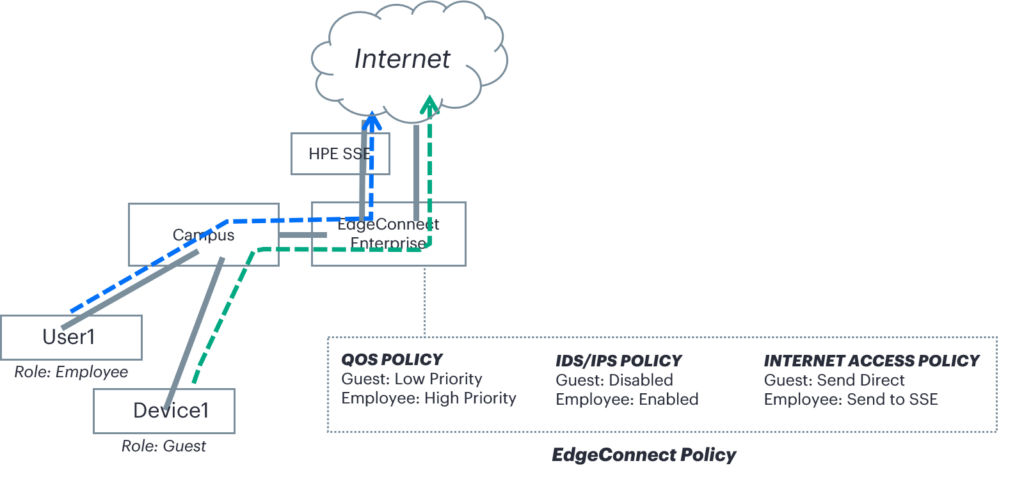
- True Synergy: Now, Business Intent Overlay and Zero Trust Policies are perfectly combined and interact within a single context.
- For example, the user
GeminiWhen using the AI service, the orchestrator determines the user's 'authentication credentials and security risk (SSE area)' in real time, while dynamically allocating optimal 'network bandwidth and QoS (SD-WAN area)' in real time to ensure that the AI traffic is not interrupted. It is a structure where security and user experience (UX) work as one.
3. 'Cross-Domain' AI Ops (Network + Security) via SASE Copilot
“Why is the branch office internet so slow?”
In the past, in fragmented environments where screens were used separately, network engineers and security engineers had to wage a battle to find the culprit using their respective device logs to solve this simple problem.
We had to examine the logs from both devices to determine whether this was a line quality (SD-WAN) issue or a firewall decryption bottleneck (SSE) issue.
- AIOps Integration: The backend of the integrated SASE orchestrator includes SASE CopilotThis is installed.
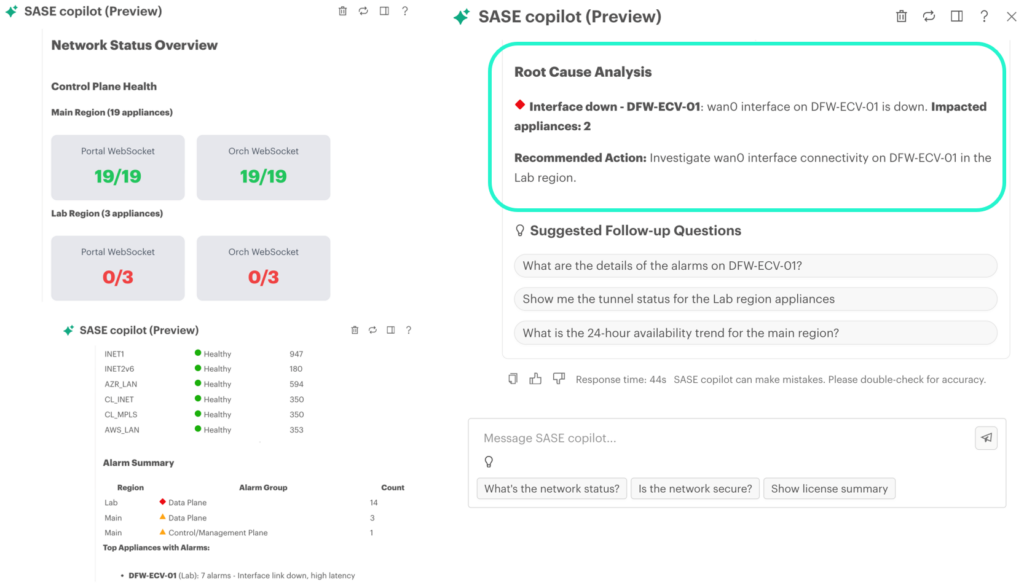
- SASE Copilot uses a single engine to simultaneously handle wired, wireless, WAN line telemetry, and security detection logs, and analyzes the correlations (reasoning).
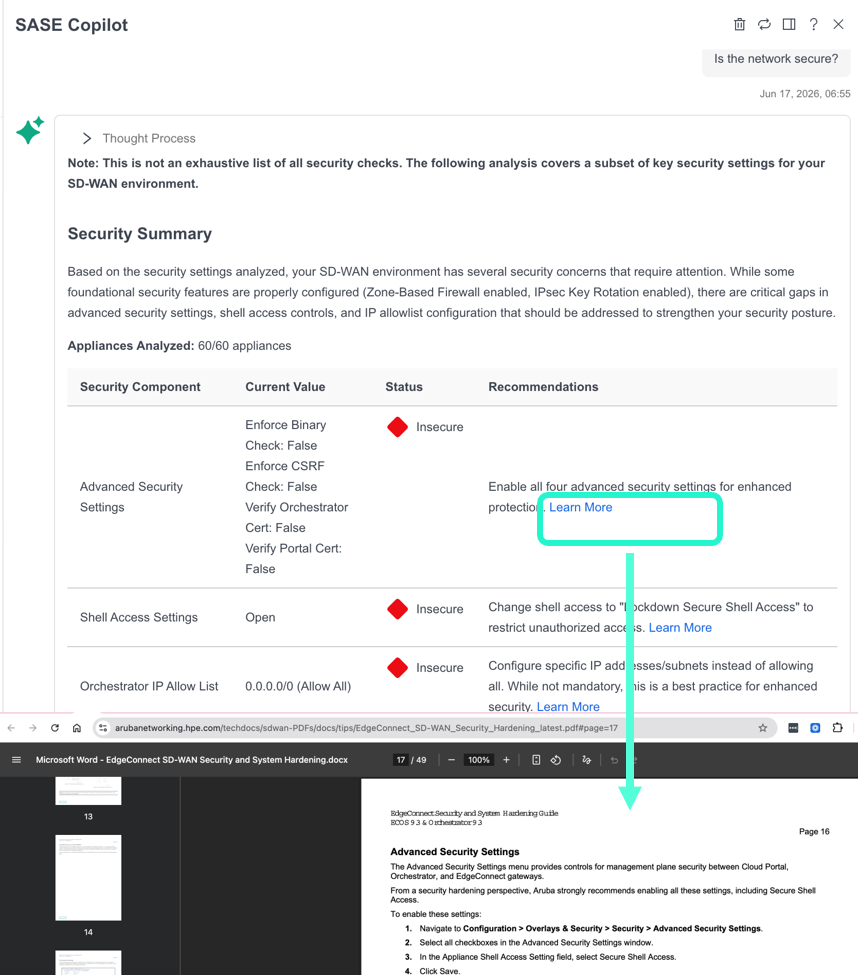
- When an administrator asks a question in natural language, a sophisticated response that crosses network and security domains states, “The reason the branch office is currently slow is not a line failure, but because a specific user uploaded a high-capacity file, temporarily backing up the SSE firewall’s DLP scan queue.” Provides Integrated Cause Analysis (RCA) immediatelydo.
Regardless of how the data moves
We are living in an era where data does not stay in one place but constantly flows between hybrid cloud, edge, and external AI APIs.
The era of superficial integration that simply displays two menus on a single console is over.
HPE Networking's integrated SASE combines packet processing algorithms (Single-Pass), fully shares operational context (Business Intent + Zero Trust), and unifies even the AI analytics domain.
The era of 'trade-offs'—compromising performance for enhanced security or loosening security for speed—has come to an end. Tracking and securely protecting data in real-time, regardless of where or how it moves across your estate—that is the true capability HPE Networking has perfected. The Future of Secure AI-Nativeno see.