The biggest topic that has recently shaken the automotive industry is undoubtedly Tesla's FSD (Full Self-Driving). This technology, which minimizes driver intervention and allows the system to make decisions on its own to safely reach a destination, has imprinted upon us the convenience and efficiency that autonomous driving brings.
However, this wave of change is now spreading to the network, the foundation of our IT infrastructure. What we have known until now SDNSoftware Defined Networking has focused on centralizing control and securing flexibility through software, but it is now time to redefine its meaning.
as soon as Self Driving Networkno see.
Moving beyond the era where humans manually specify paths and input policies, networks now diagnose their state and find the optimal path on their own. autonomous drivingIt is time to prepare for the era of.
Why 'Autonomous Driving'? (Evolution Beyond AIOps)
Many people said, “existing AIOpsYou may have the question, ”What is different from that?”.
If existing AIOps focused on an auxiliary role (Copilot) that analyzes failures based on collected data and notifies operators, Self Driving NetworkIt goes a step further and places emphasis on 'autonomy,' where the system recognizes problems and executes solutions on its own.
The reason we need to pay attention to autonomous driving networks is clear.
- Solving explosive complexityDue to the increase in IoT devices and multi-cloud environments, engineers have reached the limit of manually managing all settings.
- Zero-Wait Availability(MTTR’s Innovation): Instead of responding after a failure occurs, AI analyzes traffic in real-time and automatically reroutes or optimizes when it detects signs of performance degradation.
- Focus on business valueBy entrusting repetitive and simple troubleshooting tasks to the network, engineers can focus on more creative and strategic design work.
The Core of HPE's Autonomous Driving Network: Marvis
HPE is at the center of this trend, providing the most advanced autonomous driving solutions.
In particular, virtual network assistants MarvisIt clearly presents the direction in which autonomous driving networks should move forward.
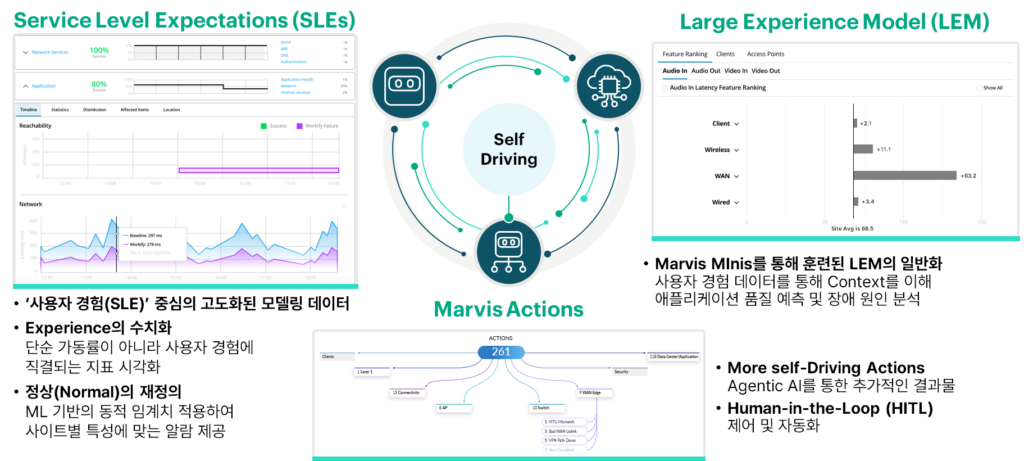
MarvisIt is not just a simple dashboard. It performs the role of a skilled engineer monitoring the network 24 hours a day.
| Key Features | Detailed description |
| Interactive interface | Instead of complex CLI commands, it provides immediate causes and solutions to natural language questions such as “Why was the Wi-Fi on the 3rd floor slow yesterday?”. |
| Self-Healing | If the system detects abnormal connection patterns or performance degradation, it automatically corrects settings to maintain user experience quality. |
| Pre-emptive Action | It identifies potential configuration errors or firmware issues in advance before failures surface, providing proactive guidance to operators. |
Application Cases of Domain-Specific Autonomous Driving Networks
Autonomous driving technology operates organically across all areas of the network and minimizes manager intervention.
① Self-Driving Implemented in SD-WAN: Autonomous Path Selection
In the past, WAN management involved engineers monitoring line status and manually distributing traffic.
but Self-Driving WANThe infrastructure performs the role of navigation by identifying 'road conditions' in real time.
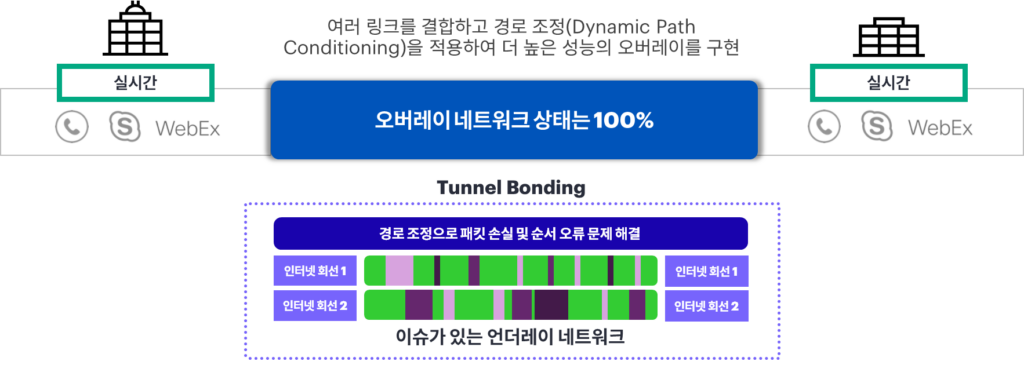
- Real-time Quality Measurement (DPI & Telemetry): It identifies thousands of application traffics and measures the latency, loss, and jitter of each line in milliseconds.
- Autonomous Traffic Steering: If the quality of a specific line deteriorates, it immediately reroutes high-priority business traffic (e.g., video conferencing) to the most optimal path without user intervention.
- Zero-Touch Provisioning: When expanding branches, simply connecting the equipment downloads the central policy and automatically configures an optimized tunnel without any separate configuration.
② The Brain of the Data Center, Apstra: Intention-Based Autonomous Operation
Data center networks are the area with the highest complexity.
HPE's ApstraIt realizes true autonomous driving here through 'Intent-Based Networking'.
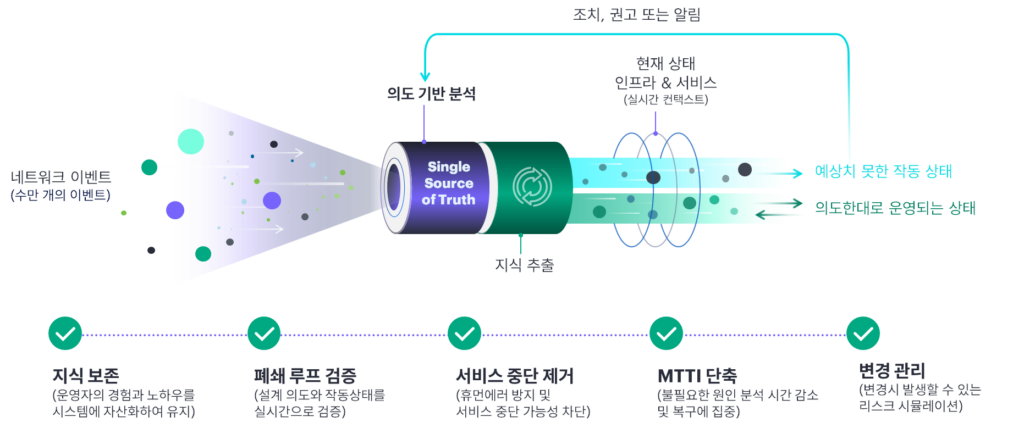
| step | Autonomous driving mechanism | Details |
| Design | Intent Definition | Instead of complex CLI, engineers simply input the intent that they “want to implement this service,” and the AI creates a blueprint. |
| Deploy | Automatic Config | Even in a multi-vendor environment, it automatically generates and pushes settings tailored to each device, fundamentally preventing configuration errors (human error). |
| Operations (Assurance) | Closed-Loop | It verifies for 24 hours whether the real-time status matches the initial 'intention'. If a discrepancy occurs, it immediately notifies the administrator and prepares for self-healing. |
③ Campus Network and Marvis: 24/7 Digital Assistant
Among all the domains of the network, the place where autonomous driving technology brings about the most dramatic changes is by far the Campus It is an area.
In an environment where countless users are on the move and thousands of IoT devices are mixed together, it is now an outdated method for engineers to go around individually addressing complaints of "the internet isn't working.".
Let's examine how autonomous driving is realized in a campus network through three key layers.
1. Self-Healing & Optimization Wireless Environment
Wireless networks are the most difficult to manage because they deal with invisible radio waves.
The autonomous driving campus resolves radio interference and load balancing on its own.
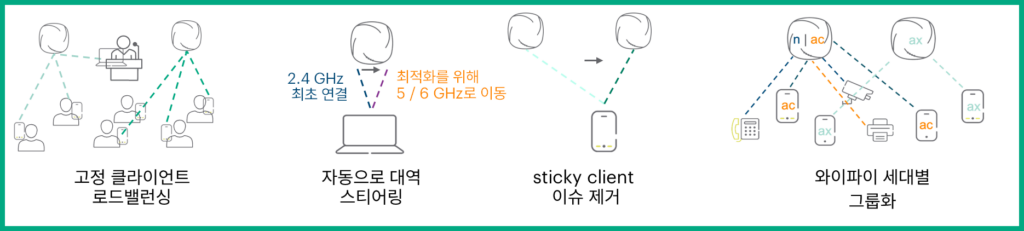
- Dynamic Propagation Management (RRM): The AI learns the signal strength and channel interference of surrounding APs in real time. If users flock to a specific area, it automatically adjusts the output, and if an adjacent AP fails, it performs 'self-healing' by having nearby APs immediately expand their propagation range to fill the gap.
- Client Match: AI detects 'Sticky Client' phenomena, where older devices consume overall network performance at slow speeds or users flock to specific APs. The system automatically guides devices to the optimal AP to equalize overall bandwidth.
2. Marvis: The brain that identifies and answers problems on its own
The pinnacle of campus autonomous driving is MarvisIt is the existence of intelligent assistants such as...
This is not a simple chatbot, but a 'digital engineer' that understands the entire state of the network.
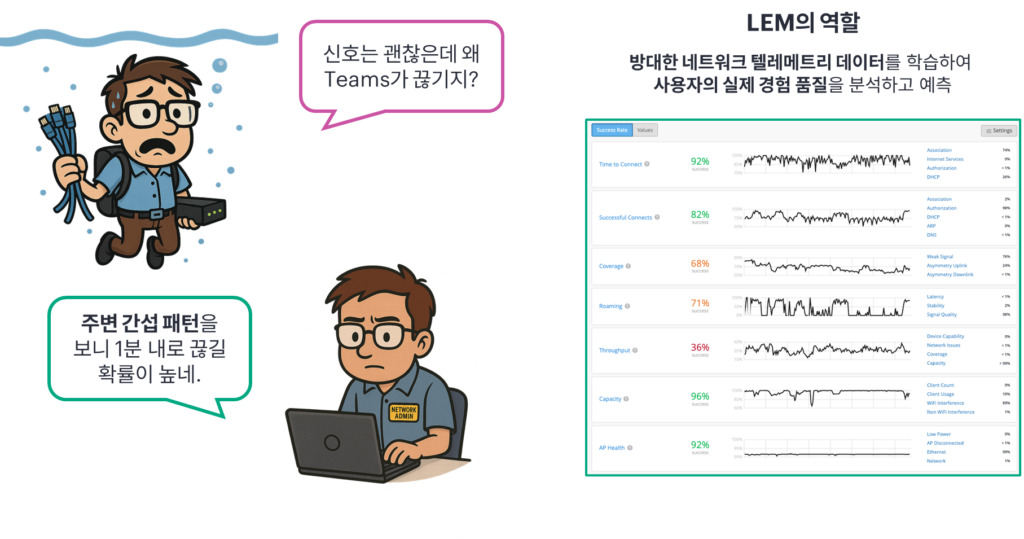
- Virtual Network Assistant (VNA): “In response to the question, ”Why does my laptop keep disconnecting in the conference room?”, Marvis scans hundreds of millions of data points in an instant. In just a few seconds, it accurately identifies whether the issue is a DNS server response delay, a problem with the authentication server (Radius), or a driver issue with the device itself.
- Correlation Analysis It identifies the single 'Root Cause' that caused the service failure among hundreds of minor events. Thanks to this, engineers are freed from the arduous labor of sifting through log data.
3. Autonomous Driving Extended to Wired Switches (Wired Assurance)
Not only wireless but also wired infrastructure (switching) is on track for autonomous driving.
- Automatic setup and verification: As soon as the switch is connected, it automatically recognizes the profile and completes the port configuration. If a cable failure or port error occurs, the system immediately detects it and compares it to past normal patterns to determine whether hardware replacement is necessary or if the issue can be resolved by changing the settings.
- User Experience Insight (UXI): Sensors that test network quality from a user's perspective are integrated with the autonomous driving system. Before a human perceives it, the AI detects that "connection speed to a specific service is currently slowing down" and generates a response guide.
Conclusion: The future of networks lies in 'autonomy'
Self-Driving NetworkIt is not a technology that takes away engineers' jobs.
Rather, it is a technology that frees us from the 'driver's seat' of simple, repetitive troubleshooting and night work.
Engineers will now focus on advanced roles as 'network architects' rather than 'drivers,' designing policies aligned with business objectives and overseeing whether AI is driving in the right direction. Software DefinedThe network, made more flexible, has now met AI and started running on its own.
Is your business ready to embrace this change?