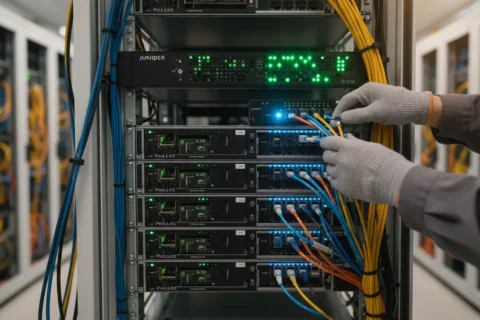
The cybersecurity landscape is rapidly changing.

https://www.cdomagazine.tech/aiml/ai-to-help-cyber-criminals-execute-more-frequent-attacks-heres-how
https://securityintelligence.com/articles/what-to-know-about-new-generative-ai-tools-for-criminals/
The advent of generative AI has brought us productivity, but it has also brought about the negative side effect of "democratizing attacks.".
We have now entered an era where anyone can use AI to create sophisticated attack code and mass-produce variant malware, even without advanced hacking knowledge.
At the same time, AI workloads are driving unprecedented growth in the scale and patterns of network traffic.
As east-west traffic and large-capacity data transfer within data centers rapidly increases, latency occurs when security devices inspect traffic, ultimately leading to a decline in service quality.
In these changing times, existing static firewalls are bound to reach their limits.
Why do traditional firewall approaches fail?
Firewalls of the past focused on blocking “known threats.”.
But in the AI era, threats mutate in seconds, and traffic surges to unpredictable levels.
Simply acting as a "gatekeeper" is not enough to handle the overwhelming volume of traffic and generative AI-based threats pouring in through permitted channels (HTTP/HTTPS).
If so, solve it with SRX equipped with AI-Native security!
It was to solve these difficult problems that the HPE Juniper Networking's AI-native security solutionno see.
The SRX solution addresses the security challenges of the AI era head-on through two core competencies.
1. A fundamentally different architecture: a security engine built on top of high-performance routing DNA.
Traffic in the AI era is not just about volume; it also has very complex paths.
SRX is a structure that integrates a security engine on top of industry-leading routing technology.
When many security devices add additional routing capabilities, SRX is a powerful routing technology proven by telecommunications companies around the world.We implemented a security engine on a solid foundation called .
- Performance Consistency: Minimize performance degradation when security features are enabled, even in complex BGP/MPLS environments or high-traffic environments driven by AI workloads.
- Operational Reliability: Refined over decades Junos OSIts consistency best supports zero-trust policy deployment through infrastructure automation (Ansible, Python).
2. Why AI-Native Security? (The Core of Intelligent Threat Response)
If attackers use AI, defenders must also have more powerful AI. Here's how SRX specifically responds to advanced threats.
① The End of Signatures: Beyond 'Zero Day' to 'Everyday' Threat
The 'signature' method, which was the core of the existing firewall, compares information on attacks that have already occurred by creating a database. Reactive It is a method.
- Problem: AI creates thousands of variants every second by subtly modifying existing malware code (polymorphism). Attacks are over before a signature can be created.
- Role of AI (ML-based detection): AI-powered firewalls don’t ask “What it is?” “How it behaves”Analyzes file sandboxing results, communication patterns, system resource usage, and more. Machine learning models score these results in real time to proactively block unseen or unheard-of threats.
② The Dilemma of Encrypted Traffic: Visibility Without Decryption (ETI)
Currently, more than 951 TP3T of enterprise traffic is encrypted. Hackers hide behind this "shield" of encryption to launch attacks.
- Problem: The existing method required individual traffic decryption (SSL decryption). This placed a tremendous burden on equipment, halving network performance and potentially violating user privacy.
- The Role of AI (Encrypted Traffic Insights): Juniper SRX's AI It does not decrypt traffic. Instead, AI analyzes the characteristics of "metadata," such as packet size, transmission order, and time intervals. This is similar to identifying a criminal based on their gait or behavior patterns without even seeing their face. Simultaneously securing security and network performance (HPC-level speed)It's the only way.
③ Addressing explosive traffic and 'detection fatigue'
In the AI era, networks are experiencing a surge in east-west traffic, and security logs are also pouring in at tens of thousands of records per second.
- Problem: It's impossible for security administrators to distinguish genuine threats from the countless alerts. This ultimately leads to "alert fatigue," where critical alerts are missed.
- The Role of AI (AIOps & Marvis): AI correlates trillions of logs in real time. It reconstructs meaningless, fragmented logs into a single "attack scenario" and provides administrators with “This attack is coming now, so apply this rule!”It provides clear actionable insights.
“"While security in the past involved building high walls, security in the AI era is a process where every cell in the network (APs, switches, firewalls) communicates in real time and forms antibodies. The SRX, integrated with Mist, is the core engine of this process."”
④ The End of Operation: Unlimited Scalability with Security Director Cloud
If AI detects threats and routers process traffic, administrators should be able to control it all from a single pane of glass. Security Director Cloud (SD Cloud) dramatically simplifies complex security operations.
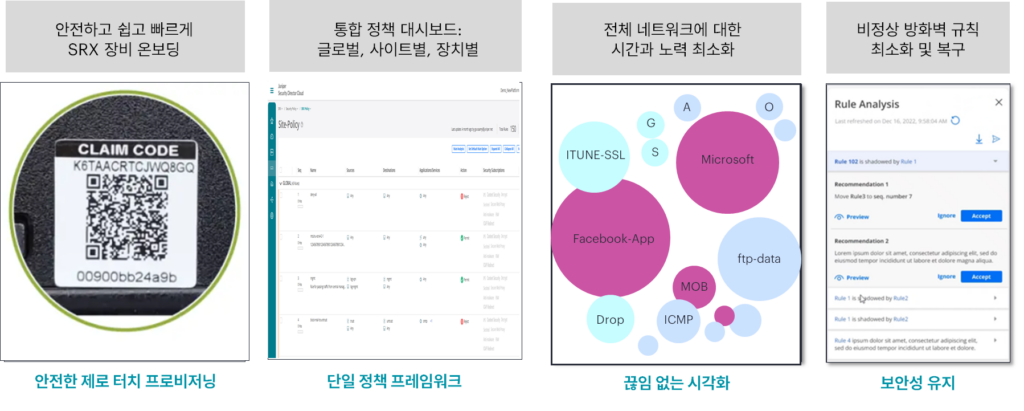
- Unified Policy Management: From physical SRXs on-premises, to virtual firewalls (vSRX) in the cloud, and even container environments (cSRX), a single configuration deploys consistent security policies across thousands of devices, regardless of environment. This is the only way to maintain consistent security, a core tenet of zero trust.
- Intent-based Policy: “Simply enter the administrator's intent—"who can do what?"—and SD Cloud translates this into complex firewall rules. This eliminates the "human error" associated with manually entering thousands of lines of ACLs.
- Security Policy Analyzer: As mentioned earlier, this tool visually identifies "unused rules" and "duplicate policies" and recommends optimization. This intelligent management tool prevents firewall overload and closes security holes in real time.
Traditional vs. AI Networking Firewalls
| Comparison items | Traditional Firewall (Legacy NGFW) | AI Native Firewall (Juniper SRX) |
| Threat identification | Static signature matching (DB-based) | ML-based behavioral analysis (Dynamic) |
| Encryption support | SSL decryption required (performance degradation of 50% or more) | ETI technology (threat identification without decryption) |
| Response speed | Apply rules after manual analysis by administrator | AI's real-time threat propagation and automatic blocking |
| How it works | CLI/GUI-based manual policy management | Mist AI-based autonomous operation (Self-Healing) |
| HPC optimization | Significant performance degradation when security features are enabled | Consistent performance based on robust routing DNA |
Conclusion: The transition to intelligent infrastructure is not an option, it's a necessity.
Firewalls are no longer simply 'blocking devices'.
In the age of AI where anyone can become a hacker and traffic is exploding, it is important to maintain the basic principle of 'All Deny'. Performance and IntelligenceThis requires a coordinated new approach. The firewall of the AI era An intelligent gateway that learns on its own, withstands exploding data, and communicates organically with the entire network.‘It should be.
at last Security in the AI EraThe following three beats must be met to complete the song.
- Powerful Engine (SRX): Robust hardware and security performance based on high-performance routing DNA
- Intelligent Brain (Mist AI): Network-wide threat detection and real-time troubleshooting
- Efficient Command Center (Security Director Cloud): Centralized management of complex security policies and simplified operations.
These three Connected SecurityWhen grouped together under the name of , administrators can face exploding traffic and evolving AI attacks. “Strong security, lightweight operation” You can build a truly sustainable zero-trust environment.
Many administrators feel hesitant to connect their firewalls to cloud AI. However, we must note that AI is not taking away administrators' power., The most sophisticated watchdog that monitors whether the 'All Deny' principle actually works perfectly on top of powerful routing performance. It's about playing a role.