With the recent generative AI craze, led by ChatGPT, the construction of an 'AI Data Center (AIDC)' has emerged as a hot topic in enterprise IT.
When we think of AI infrastructure, we often focus only on the tens of thousands of GPUs and the internal switch fabric connecting them.
But there is a key point that should not be overlooked.
AI will never be a data center‘안‘'It is a fact that it does not stop there.
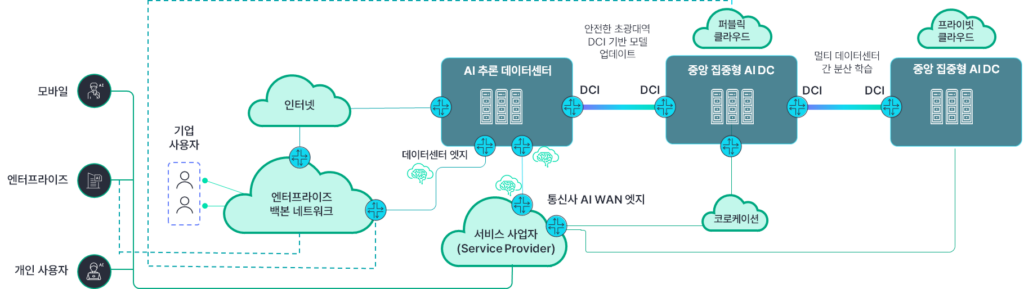
For a successful AI business, a huge amount of data is needed at the edge around the world. collectionIt must be done, and resources distributed across multiple data centers must be combined to train, and the final completed AI model must be delivered to users without delay. Inference It must be provided as a service.
The equipment that serves as a gateway and high-speed highway supporting this huge 'data pipeline', that is, Why High-End Routers Are More Important Than Everis right here.
1. The Essential Role of AI Data Pipelines and Routers (PTX/MX Series)
While routers of the past were simply gateways for internet access, routers in the AI era are end-to-end core neural networks capable of transporting petabytes of data without loss. It's clear why Juniper Networks' router lineup is gaining traction in AI infrastructure.
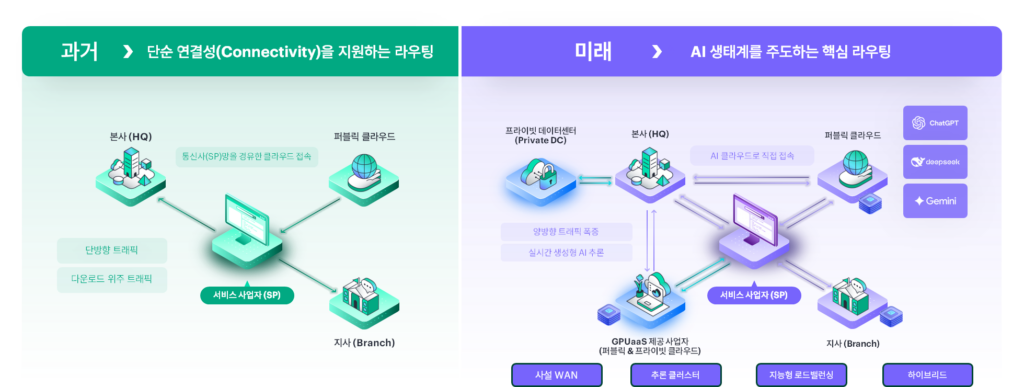
- Ultra-high capacity DCI (Data Center Interconnect): For AI training, multiple data centers must be connected with ultra-broadband bandwidths of 400G/800G or higher.
- Edge/Universal Routing: When deploying trained AI models to actual service networks (B2C, B2B), complex routing tables are processed and sophisticated peering with telecommunications companies (Telcos) and cloud service providers (CSPs) is performed. This ensures an ultra-low-latency AI experience for end users.
2. The InfiniBand Dilemma and the Unification of the Ethernet-Centric World
Once you understand the importance of routers, it becomes clear why the AI industry is moving from its traditional powerhouse, InfiniBand, to an Ethernet-based architecture.
InfiniBand performs well within a single data center (for GPU-to-GPU communication), but, Routing capabilities for external communications are woefully inadequate.do.
In other words, to collect data from the outside or to extend it through DCI, it must ultimately go through an Ethernet/IP-based router network, which causes serious protocol conversion overhead and bottlenecks.
What emerged to solve this is High-performance Ethernet (RoCEv2)Combination of BGP routing andno see.
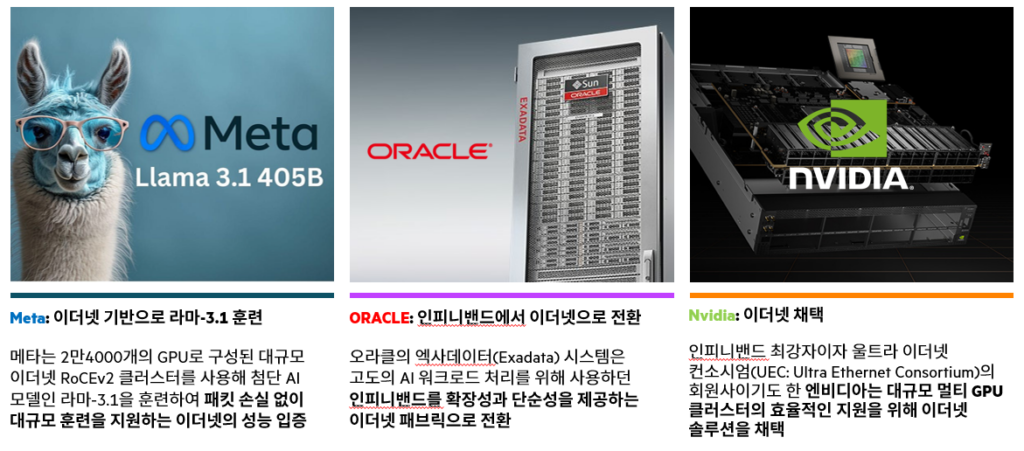
Recently, global big tech and enterprise companies are designing massive AI infrastructures instead of InfiniBand. Spine-leaf architecture based on high-performance Ethernet (RoCEv2) and BGP routingI am turning my eyes to .
Next-generation Ethernet-based switches (e.g., Juniper's QFX series) support InfiniBand-class lossless communications while utilizing BGP routing, a standard in the IP ecosystem. As a result, Switches (internal AI fabric) and routers (external DCI and edge) are integrated with the same IP/Ethernet language.This allows the entire collection-learning-inference process to be seamlessly connected into a single architecture.
| Pipeline stages | Infrastructure Requirements and Roles | Core Portfolio |
| Data collection (Far Edge) | Collecting and aggregating massive amounts of raw data generated at remote edge locations, such as IoT and 5G networks. | ACX Series (Metro/Edge Router) |
| AI Edge / Service Network (Inference area) | Sophisticated traffic engineering, complex peering, and minimal service latency. | MX Series (General Purpose Edge Router) |
| AI Core / DCI (External network connection) | 400G/800G ultra-wideband transmission, large-scale routing processing, and global data center connectivity. | PTX series (core router) |
| AI Fabric (Internal connection) | Lossless inter-GPU communication (RoCEv2), microburst control, BGP spine-leaf architecture | QFX Series (High-Performance Data Center Switches) |
3. Completing the Puzzle: The Real Reason HPE Acquired Juniper Networks
At this very point The explosive impact of Hewlett Packard Enterprise's acquisition of JuniperThis is revealed.
HPE already has the world's best AI computing power represented by Cray supercomputers, a data storage lineup, and a powerhouse in enterprise edge and campus networks. HPE Aruba Networkingwas fully equipped.
But the final piece of the puzzle needed to complete a true 'end-to-end AI full stack' was High-end router (PTX/MX) technology that connects the AI fabric (QFX) to handle massive traffic and the global data pipeline.It was.
Juniper Networks' addition isn't just about increasing scale.
This means that the next-generation AI network architecture based on Ethernet/IP can be seamlessly configured from switches to core routers.
With the addition of powerful BGP routing capabilities, deep buffer silicon, and the unrivaled AIOps platform, Mist AI.
In conclusion, HPE is now positioned as the only infrastructure leader in the AI era that can take charge of the entire data journey, from compute to storage, to the edge (Aruba), and to global core routing (Juniper).