Tech Lesson

  • [ACSA Education #31] Static & Dynamic LAG

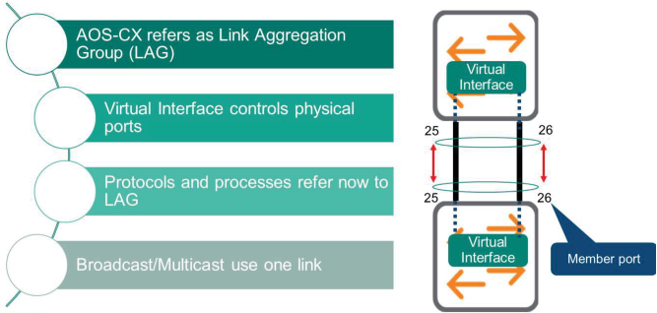
    In the previous post, we briefly looked at LAG (Link Aggregation Group). LAG has two operating modes: Static LAG and Dynamic LAG. Let's examine them in turn. Static LAG: In Static Link Aggregation mode, devices do not exchange any control information with each other. In other words, LAG between switch peers…

  • [ACSA Education #30] Link Aggregation

    Switches must provide connections to many devices located on various VLANs. All traffic generated here communicates with each other by sharing links between switches. Therefore, multiple links are sometimes connected between switches to enhance resilience. However, this does not increase the bandwidth of the connection between the two switches. Even if two links are connected, only one of them…

  • [ACSA Training #29] Rate Limit & Loop Protection

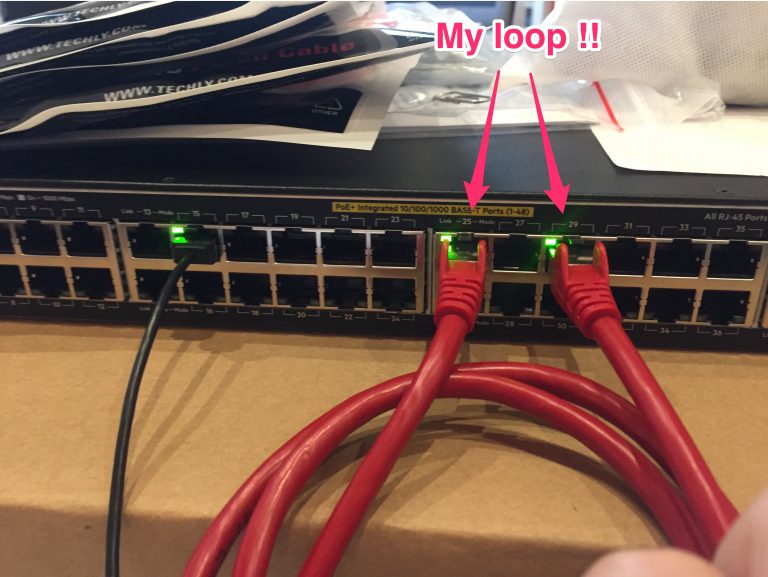
    If the Spanning Tree is configured incorrectly, a Layer 2 loop may be created. In such situations, AOS-CX can specify the amount of traffic that can be received on an Ethernet port or Link Aggregation Group (LAG), such as broadcast, multicast, or unknown unicast traffic. This feature is independent of the Spanning Tree, but CPU utilization…

  • [ACSA Education #28] MSTP Theory and Regional Structure

    A Common Spanning Tree (CST) defines a single Spanning Tree Instance for the entire network, regardless of the number of VLANs. All BPDUs use Untagged VLAN 1, so VLAN details are not considered. Additionally, due to the absence of load balancing, specifying alternative paths or achieving low line usage and potential performance degradation…

  • [ACSA Training #27] How RSTP Works

    RSTP (Rapid STP) operates a loop-free topology through the following algorithm: Selection of the Root Switch; Selection of the Root Port (RP) of all other non-root switches or non-designated bridge switches; Selection of the Designated Port (DP) of the links connecting each switch; Other ports operate in a blocked state to prevent loops; Root Switch…

  • [ACSA Education #26] RSTP Elements

    Continuing from last time, we will explore STP (Spanning Tree Protocol), specifically RSTP (Rapid STP). We will examine the key factors that the RSTP algorithm uses to determine which ports to use for traffic delivery and which not. Bridge Identifier Bridge Protocol Data Unit Rapid Spanning Tree Port States Rapid Spanning Tree Port Cost Rapid Spanning…

  • [ACSA Training #25] Spanning Tree Protocol

    Last time, while discussing network redundancy, we also talked about loops that can occur as a result. As an alternative, I briefly mentioned STP (Spanning Tree Protocol). Today, let's take a closer look at Spanning Tree Protocol. STP (Spanning Tree Protocol) Overview: IEEE 802.1d, the standard version of STP (Spanning Tree Protocol), [addresses] redundant environments…

  • [ACSA Education #24] Redundant Network

    Network communication is critical to IT infrastructure. It often has a significant impact on services. As shown below, if there is only one path connecting to the Core-1 switch, and the link between the two access switches and the Core-1 switch is severed, the network will be disconnected, and ultimately, Host A and Host B will be unable to communicate with each other. To solve this…

  • [ACSA Training #23] Frame Transmission Process

    Previously, while examining representative Layer 2 technologies such as VLANs and 802.1Q, we also mentioned frames. In a previous post, I also explained Ethernet frames, which correspond to Layer 2 in the OSI model. Therefore, today, I would like to examine how these frames operate during Layer 2 communication using actual examples. First, assuming the same VLAN, several…

  • [ACSA Education #22] Forwarding Table

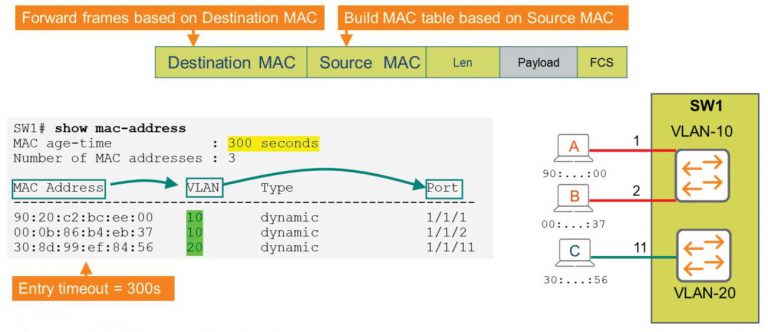
    Layer 2 switches transmit data based on MAC addresses. To do this, the switch uses a MAC address table. When a device connected to the switch sends a frame, the table is automatically created based on the MAC address of the source frame. So, how does it work? MAC Address Table: When power is turned on to Switch SW1, the MAC address table is initially empty...