
Edge Trend

  • AI vs. AI: In an era where everyone is a hacker, changing the firewall paradigm is crucial.

    The landscape of cybersecurity has been changing rapidly recently. The emergence of generative AI has gifted us with productivity, but at the same time, it has produced the side effect of the "democratization of attacks." We have entered an era where anyone can use AI to write sophisticated attack code and mass-produce malware variants, even without advanced hacking knowledge. At the same time, due to AI workloads, the scale of network traffic and…

  • [AI Data Center] The Heart of Massive Data Pipelines: Why Routers Again?

    With the recent surge in generative AI led by ChatGPT, the construction of 'AI Data Centers (AIDCs)' has emerged as a major topic in enterprise IT. When thinking about AI infrastructure, it is easy to focus only on tens of thousands of GPUs and the internal switch fabric connecting them. However, there is a key point that should not be overlooked: the fact that AI never remains confined 'inside' the data center. Successful AI…

  • AI Networking: From the Age of Connectivity to the Age of Intelligence

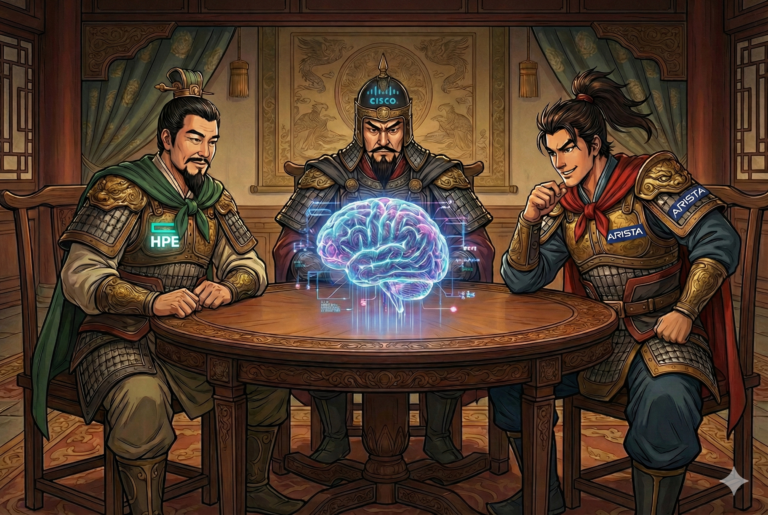
    Recently, the paradigm of AI data centers has been rapidly shifting from a 'computing' focus to a 'network fabric' focus. This is due to the growing importance of 'AI backend networks,' which combine tens of thousands of GPUs into one to process models with trillions of parameters. Today, we will look at the strategic moves of the three giants leading this market—Arista, Cisco, and HPE—and their…

  • Global Substation Security Scan Results: "Breached in 30 Minutes?"“

    Today, I would like to introduce a truly “heart-pounding” report that is directly related not only to the security industry but also to our daily lives. It is the result of an investigation conducted by OMICRON, an Austrian energy security specialist, into over 100 power plants and substations worldwide, and the findings are truly shocking. “As soon as the IDS (Intrusion Detection System) was installed, critical vulnerabilities poured out within just 30 minutes.” Indeed…

  • The Rise of ITIL 5: How Is ITSM Evolving?

    On February 12, 2026, ITIL 5 (ITIL Version 5), which the global IT industry has been waiting for, was officially released. Arriving approximately seven years after ITIL 4 in 2019, this new standard presents us with new challenges regarding 'AI-Native' and 'Experience'. Compared to the existing ITIL 4, there are the following major differences. Category ITIL 4 ITIL…

  • Zero Trust in 2026: Beyond "Concept" to "Reality"

    In an Era of Frequent Security Incidents, Why Is Our Zero Trust Failing? In 2025, a year marked by numerous large-scale incidents, we stand at a critical turning point. Zero Trust is no longer a marketing term or a vague philosophy. Leaders running organizations must now move away from an implicit trust model that "internal users are safe" and instead adopt an identity-centric model of least privilege…

  • When an employee's ‘role" changes, security automatically...

    Recent security breaches are primarily caused by human error and failure to adhere to the principle of least privilege. To address this, HPE Aruba Networking's Dynamic Segmentation can strengthen security through role-based access control, reduce human error, and build a zero-trust environment.

  • New security as data center traffic patterns change

    East-west traffic has recently become increasingly important within data centers, driven by the proliferation of virtualization and cloud computing. This shift introduces security vulnerabilities and operational inefficiencies, necessitating microsegmentation and internal traffic control to ensure data center security.

  • Cafe networking? A simple and secure network?

    As enterprises migrate applications to the cloud, traditional branch office networks have become increasingly complex and struggle to meet modern security and connectivity demands. With the proliferation of hybrid work, there is a growing need to provide a simple, secure, and consistent user experience—much like a café—regardless of whether employees are in the office or working remotely. This 'café network' architecture does not trust all endpoints…