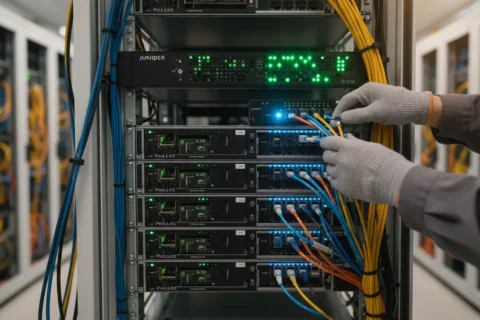
When building AI data center (AIDC) infrastructure, the key factor that must be considered as carefully as GPU specifications is ASIC (Application-Specific Integrated Circuit) installed in a network switch, Custom Semiconductor) Chipsetno see.
In a commercial silicon-based switch environment, a significant portion of processing bandwidth, buffer structure, packet control method, and latency is Which ASIC was adoptedis determined by.
1. Tomahawk vs. Trident: Clear Division of Roles in AIDC
Broadcom, one of the two major pillars of data center switch silicon Tomahawk와 TridentIt is clearly distinguished from its innate design philosophy to its application areas.
| Comparison items | Broadcom Tomahawk (TH4 / TH5) | Broadcom Trident (Trident 5-X12) |
| Design Purpose | Ultra-High Throughput & Spine Fabric | Programmability & Intelligent Leaf/ToR |
| Key Strengths | Overwhelming port density and raw bandwidth (Raw Throughput) | Packet identification, incast prevention, traffic engineering |
| pipeline | Simplified high-speed fixed forwarding pipeline | Flexible Programmable Pipeline (NPL Support) |
| On-chip intelligence | Pure high-speed switching concentration | NetGNT (On-chip Neural Network Engine) Installed |
| Main target area | AI Training Backend Fabric | AI Inference & Frontend Fabric |
- Tomahawk (Learning Backend Optimization):
In large-scale synchronous traffic (All-to-All, All-Reduce) environments where thousands of GPUs synchronize parameters, Tomahawk-based spine/backend switches with simple pipelines and maximized bandwidth deliver optimal performance. - Trident (Inference and Hybrid Workload Optimization):
Trident 5, with its intelligent packet processing and telemetry capabilities, is essential in sections where asynchronous packets of various sizes are mixed, such as user inbound queries, vector DB searches (RAG), and storage-based model loading.
2. Equipped with Trident 5 (TD5): Structural Features of QFX5140-24CD8O
Broadcom's latest Trident 5-X12A representative platform released equipped with is QFX5140-24CD8Ono see.

- 1RU Form Factor & 16Tbps Throughput: Maximizing interface efficiency with the latest accelerators based on 112G PAM4 SerDes
- Asymmetric I/O Port Configuration: 24x 400G (QSFP112) Downlink + 8x 800G (OSFP) Uplink
- Flexible Breakout: Dividing 400G ports into up to 96x 100G (or multi-breakout) to accommodate existing 100G nodes and next-generation 400G nodes in a single chassis.
- Next-generation transmission protocol: Native RoCEv2 support and next-generation UET (Ultra Ethernet Transport) backup
Especially built into the TD5 Networking General-purpose Neural-network Traffic-analyzer (NetGNT) Through the engine, the buffer is instantaneously exhausted when multiple nodes respond simultaneously Real-time detection of incast phenomena and preemptive mitigation at the hardware line rate leveldo.
3. The Paradox of Inference Traffic Seen Through Real-World Benchmarks (AMD MI300X Demonstration)
What role does the network play in a real production inference environment? Recently released AMD Instinct MI300X (8-GPU/Node) Based SGLang and Envoy Load Balancer Testbed The empirical results present notable insights.
[ Client Query Generator (GenAI-Perf) ] ↓ (100G) [ Envoy Proxy Load Balancer (Data Parallelism Distribution) ] ↓ (200G/400G) [ QFX5140 Leaf / ToR (NetGNT Congestion Relief) ] ├── Node 1: AMD MI300X (8 GPUs, SGLang Router) ⇄ [ GPUDirect Storage / RoCEv2 ] └── Node 2: AMD MI300X (8 GPUs, SGLang Router) ⇄ [ DeepEP / NIXL / NCCL Distributed Inference ]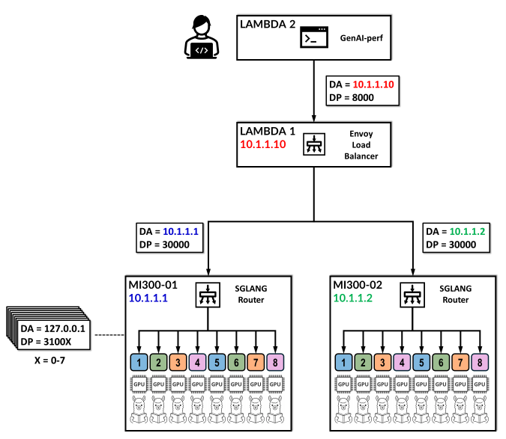
- Test Workload: Meta Llama 3.1 8B, Llama 3.3 70B, Qwen 2.5 72B (FP16 and FP8 quantization applied)
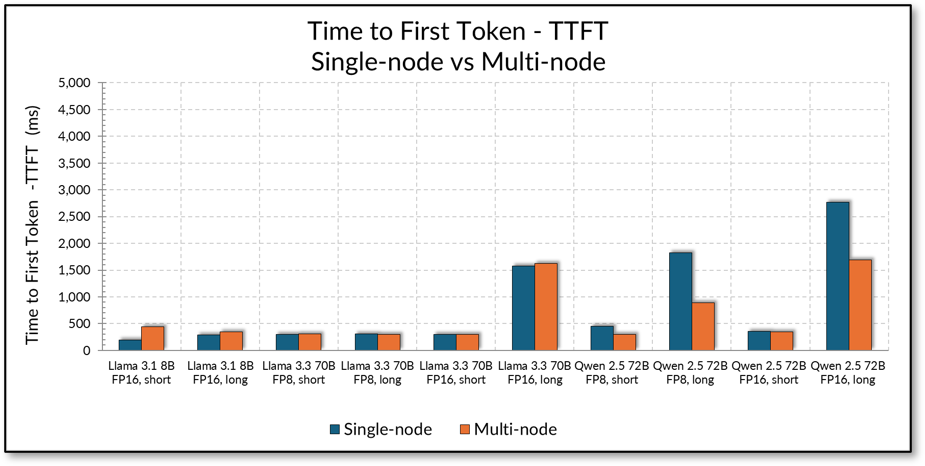
- Scenario Composition: Short Context (100 In / 100 Out) and Long Context RAG Summary (1,500 In / 250 Out)
“GPUs saturate before the network, so why is a 400G high-speed fabric needed?”
GenAI-Perf measurements showed that GPU activity reached 90–1001 TP3T, demonstrating linear token throughput scaling even in a multi-node environment. If we look only at pure text query/response bandwidth, the GPU computation speed reaches its limit first, even with a 100G link.
Nevertheless, the reason why a high-performance 400G fabric like the QFX5140 is essential is 'Traffic Convergence' in Production AI Environments‘ That is the reason.
- Bandwidth Slicing for Complex Workloads: The frontend fabric goes beyond simple query delivery; high-volume RAG vector search, storage-based model weight loading (GPUDirect Storage), agentic AI communication, and data collection workloads are intermingled within a single network. This diverse traffic must be isolated and allocated within a 400G pipeline without mutual interference.
- TTFT (Time To First Token) Defense: TD5's NetGNT and RoCEv2 congestion control defend against buffer contention occurring during the prefill phase of Long Context and RAG queries, stabilizing the first token latency in milliseconds.
- Distributed Inference (Expert Parallelism): It processes distributed communication based on DeepEP (DeepEveryParallel), NIXL, and NCCL occurring between nodes during the operation of the MoE (Mixture of Experts) model with ultra-low latency.
4. The Substantial Competitiveness of the QFX5140 Compared to Same-Generation Silicon/Competitive Products
There are platforms in the market that adopt the same commercial ASICs as various 400G/800G switches. Nevertheless, the reason the QFX5140 has a distinct advantage in AI inference fabrics is Topology optimization and the completeness of the software ecosystemis in.
① 1U Asymmetric I/O Optimization (Topology Efficiency)
Most existing 400G/800G switches adopted a symmetrical port structure of 32x 400G or 64x 800G, making the oversubscription ratio design between uplinks and downlinks inefficient when deployed as leaf switches.
QFX5140 is Optimized for 24 downlinks (400G/100G) and 8 800G uplinks in a 1U form factor with a 1:1 non-blocking ratioThus, top-of-rack (ToR) space and power waste were reduced.
② Verified Microservices NOS: Junos OS Evolved
No matter how excellent the performance of the hardware ASIC is, its functionality is limited if the OS cannot flexibly control it.
- Junos OS Evolved operates on a Linux-native microservices architecture, enabling immediate isolation and recovery from individual process failures without interrupting the entire control plane.
- It provides stability by streaming deep telemetry data from ASICs at high frequencies, enabling immediate reflection in real-time AI traffic analysis.
③ Apstra-based Intent-Based Fabric Automation and Observability
Beyond the spec competition of individual switches, How to manage the entire fabricThis determines the actual TCO of AIDC.
- Blueprint-based zero-downtime deployment: Deploys complex RoCEv2 parameters, PFC/ECN buffer settings, and EVPN-VXLAN multi-tenancy policies consistently across the fabric without human error.
- Real-time Closed-loop Verification: It prevents downtime in large-scale AI inference services by detecting incast points, slow drain nodes, and abnormal packet drops in real time and tracing their causes.
5. End-to-End AIDC Reference: Spine(TH) + Leaf(TD5)
The standard configuration proposed by HPE's Validated Designs is clear.
- Spine Layer: Secure maximum bandwidth and backbone scalability with Broadcom Tomahawk-based high-density switches
- Leaf layer: Performing intelligent packet control, multi-traffic convergence, and precise GPU/storage integration with the Broadcom Trident 5-based QFX5140
Conclusion: The combination of silicon innovation and fabric orchestration
AIDC networks cannot be solved solely by unconditional bandwidth expansion.
The training backend uses Tomahawk's raw bandwidththis, The inference and frontend fabric features Trident 5's on-chip neural network (NetGNT) and sophisticated traffic engineeringIt must be placed in the right place.
The QFX5140 is built on a powerful engine called Trident 5. Stability of Junos OS Evolved과 Apstra's Fabric Automation Verification CapabilitiesBy combining these, we provide the optimal engineering solution for enterprise AI inference infrastructure.