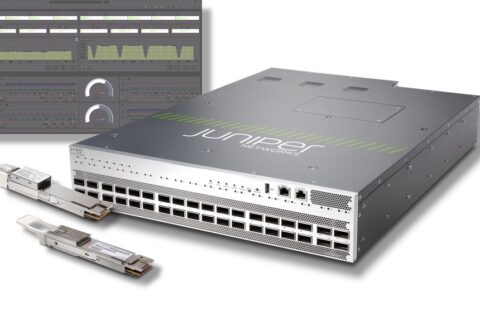
When working in network engineering or in the field at data centers, there is a question and requirement that is most commonly heard.
“"I need to connect the fiber optic cable to the switch over there, so please bring a few GBICs."‘
However, when you actually visit the site, you may have been confused to find that, in addition to simple optical modules, unique cables with integrated cables are used, and the module shapes and cable colors vary widely. Above all, the term 'GBIC,' which we habitually use, is actually the name of an old standard used 20 years ago during the 1Gbps era that has remained as a generic term.
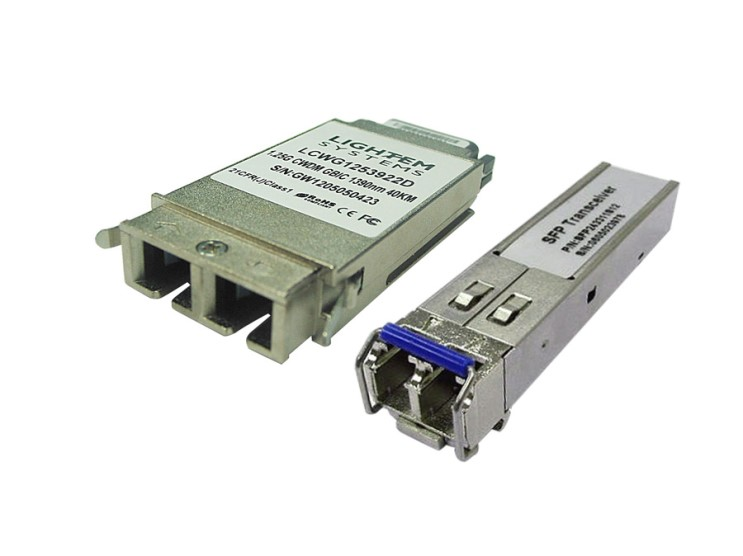
Today, in data centers and enterprise networks, pluggable optical transceivers and DAC, AOC cableThis is replacing that position. In this article, for those who only knew that “to connect an optical cable, you just need to plug in a module,” we will thoroughly explain the interconnection options and basic terminology between devices.
1. Three Options for Network Equipment Interconnection (Transceiver vs. DAC vs. AOC)
When connecting network switches, routers, and servers, the methods you can choose from are broadly divided into three types based on the physical structure.
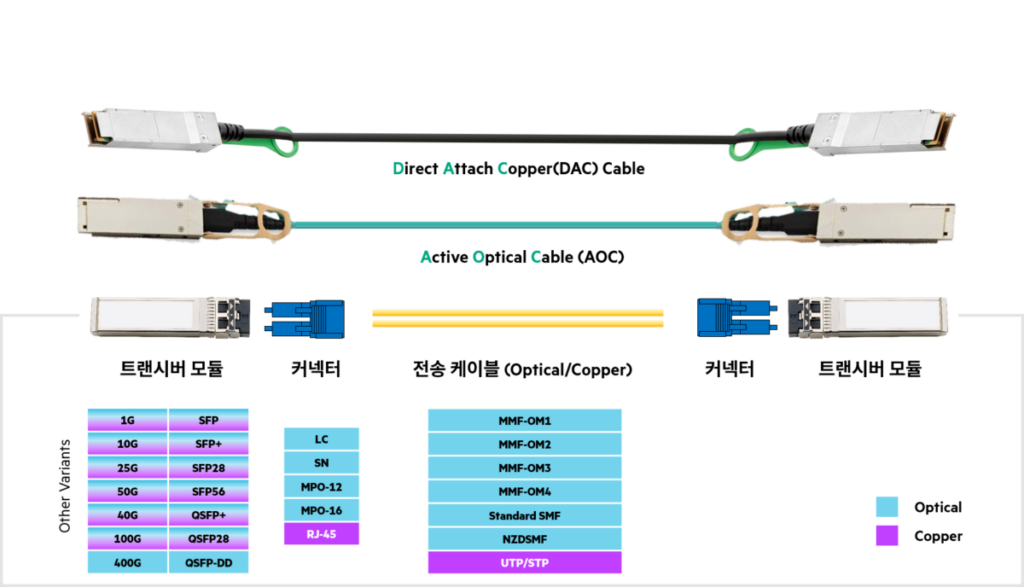
① Optical Transceiver Module
- structure: It is an independent module that plugs into a switch port and uses a separate optical cable connection.
- characteristic: It converts the electrical signal (Electrical Domain) of the switch port into an optical signal (Optical Domain).
- merit: Even if the cable length is insufficient or the cable is damaged, only the cable needs to be replaced, and long-distance transmission of tens of km is possible by connecting a single-mode (SMF) optical cable.
② DAC (Direct Attach Copper Cable)
- structure: It is released with transceiver-shaped connectors integrally connected to both ends of the cable using copper cable.
- characteristic: Without optical modulation process (laser driving) Direct transmission of electrical signals via copper wiresdo.
- merit: There are no internal optical components The price is very cheapdo Power consumption is extremely low..
- disadvantage: Due to the physical limitations of copper wires, the transmission distance is usually It is very short, ranging from 1m to 7m..
(For connecting Top-of-Rack switches ↔ servers within the same rack)
③ AOC (Active Optical Cable)
- structure: The module where optical conversion takes place inside the connector and the optical cable are fixed as a single unit.
- characteristic: Although it appears as a single-piece cable externally, it is internally converted into an optical signal for transmission.
- merit: It is lighter and thinner than a DAC, and resistant to electromagnetic interference (EMI). Transmit up to a distance of 10m to 100m It is possible. It is very convenient for on-site construction as there is no burden of cleaning the optical connector ends or managing dust contamination.
2. Evolution from 'GBIC' to 'SFP, QSFP'
The official specification name of 'Zivic,' which we are familiar with, has continuously evolved based on speed and form factor (module size).
| Standard Name | Support speed | Features and Description |
| GBIC (Gigabit Interface Converter) | 1Gbps | An early 1G module that appeared in the 1990s. It is as big as two fingers put together. |
| SFP (Small Form-factor Pluggable) | 1Gbps | A standard that reduces the GBIC to half the size. A form referred to in the field as 'Mini-GBIC'. |
| SFP+ / SFP28 / SFP56 | 10G / 25G / 50G | A standard that maintains the compact external size of SFP while significantly increasing speed. |
| QSFP+ / QSFP28 | 40G / 100G | A Quad configuration combining 4 SFP channels into one. (4x10G = 40G, 4x25G = 100G) |
| QSFP-DD / OSFP | 400G / 800G / 1.6T | A form factor that supports next-generation ultra-high-speed networks by doubling the pin density (Double-Density) or deploying 8 channels. |
3. Types of Optical Cables and Key Connector Terms
If you have selected a transceiver, you must check the corresponding optical cable matching elements.
1) Cable Mode (Single Mode vs Multi Mode)
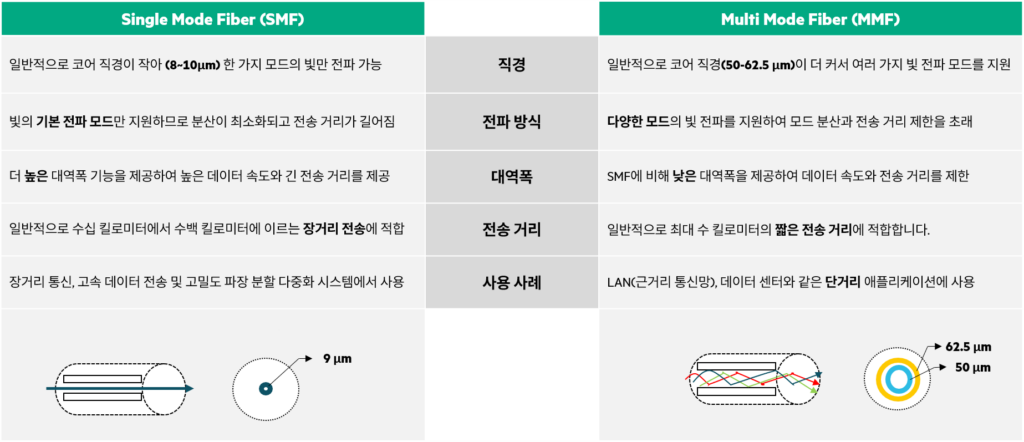
- Single Mode Fiber (SMF): The core diameter is very thin (about 9µm), so light travels in a straight line.
Low signal loss Long-distance transmission (up to 40km or more) and used in inter-building/metro networks. (Mainly yellow cables) - Multi Mode Fiber (MMF): The core diameter is relatively thick (50~62.5µm), so various wavelengths of light are reflected and propagated.
Short distance (maximum 300~600m) It is suitable for internal data center connections, and the unit cost of the transceiver is lower than that of SMF modules.
(Mainly orange or aqua cables – OM3, OM4, etc.)
2) Connector Types
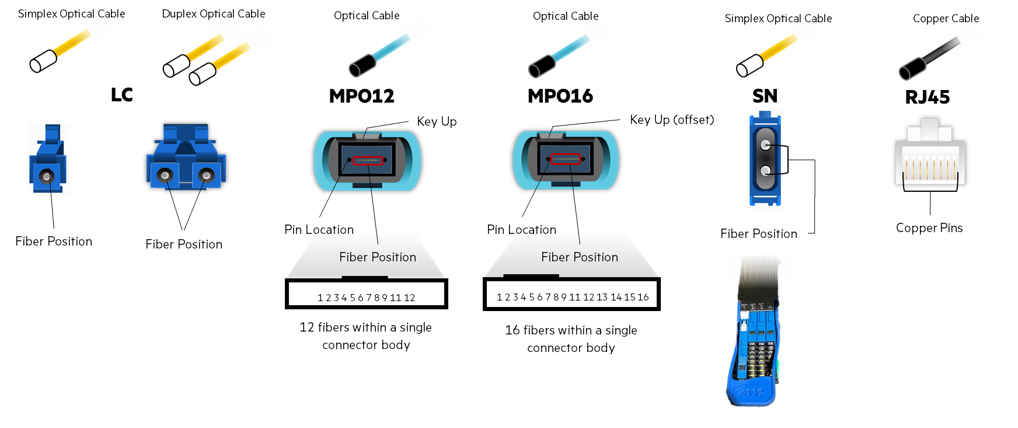
- LC Connector: The most commonly seen rectangular duplex (2-pin: Tx transmit, Rx receive) connector.
- MPO-12 / MPO-16: High-density connector with 12 or 16 fiber strands packed into a single connector head. Essential for 100G/400G/800G ultra-high-speed modules or port split (Breakout) connections.
- SN / MDC: Next-generation ultra-small short-distance connector for ultra-high-density environments.
4. 5 Steps to Selecting the Right Module/Cable (Step-by-Step)
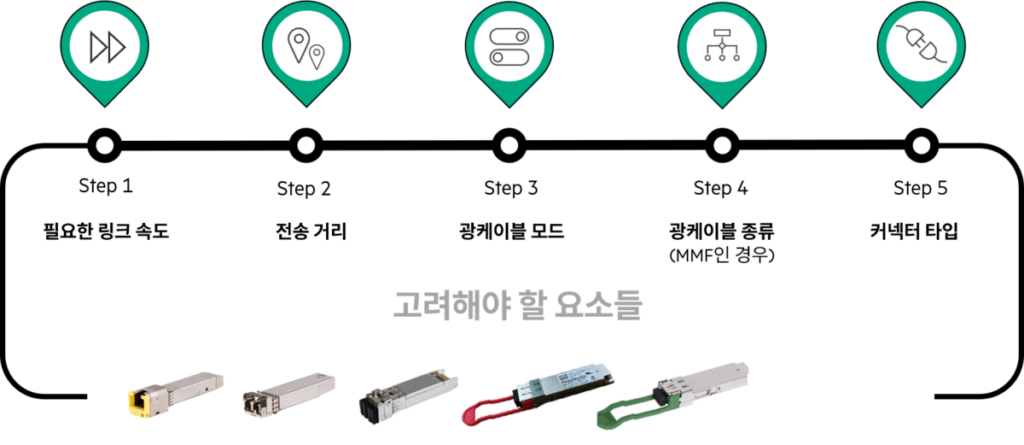
- Step 1. Required link speed: Select from 1G / 10G / 25G / 100G / 400G
- Step 2. Transmission distance: Check inside racks (3m) / between data centers (300m) / between buildings (10km), etc.
- Step 3. Optical Cable Mode: Single Mode (SMF) vs Multi Mode (MMF)
- Step 4. Detailed Types of Optical Cables: For MMF, check the specifications such as OM3, OM4, etc.
- Step 5. Connector Type: Check LC / MPO-12 / MPO-16, etc.
💡 How to Read the Full Name (Product Name) of a Transceiver
example:
HPE Aruba Networking 10G SFP+ LC SR 300m OM3 MMF Transceiver
- 10G: Maximum transfer speed 10Gbps
- SFP+: Small form factor for 10G
- LC: LC type connector attachment/detachment method
- SR (Short Reach): For short-distance transmission (LR: Long Reach, ER: Extended Reach)
- 300m OM3 MMF: Up to 300m transmission possible when using OM3 grade multimode cable
5. Field Application Summary Tips
- Same-rack internal server ↔ switch connection (1~5m): The lowest unit price and lowest power consumption DAC cable suggestion
- Data center rack-to-rack / switch-to-switch connection (5~100m): Highly flexible and easy to manage cable AOC or MMF Cable + SR Transceiver
- Inter-building / external long-distance connections (over 300m to tens of km):SMF (Single Mode) Cable + LR/ER Transceiver
Now, when communicating on-site, instead of unconditionally saying “Please bring the GBIC,”, “Please provide an LC-LC MMF cable for the 10G SFP+ SR module.” Or, try communicating clearly by saying, “Please give me a 3m DAC cable for direct server connection”!