AOS-CX

  • [ACSA Training #25] Spanning Tree Protocol

    Last time, while discussing network redundancy, we also talked about loops that can occur as a result. As an alternative, I briefly mentioned STP (Spanning Tree Protocol). Today, let's take a closer look at Spanning Tree Protocol. STP (Spanning Tree Protocol) Overview: IEEE 802.1d, the standard version of STP (Spanning Tree Protocol), [addresses] redundant environments…

  • [ACSA Education #24] Redundant Network

    Network communication is critical to IT infrastructure. It often has a significant impact on services. As shown below, if there is only one path connecting to the Core-1 switch, and the link between the two access switches and the Core-1 switch is severed, the network will be disconnected, and ultimately, Host A and Host B will be unable to communicate with each other. To solve this…

  • [ACSA Training #23] Frame Transmission Process

    Previously, while examining representative Layer 2 technologies such as VLANs and 802.1Q, we also mentioned frames. In a previous post, I also explained Ethernet frames, which correspond to Layer 2 in the OSI model. Therefore, today, I would like to examine how these frames operate during Layer 2 communication using actual examples. First, assuming the same VLAN, several…

  • [ACSA Education #22] Forwarding Table

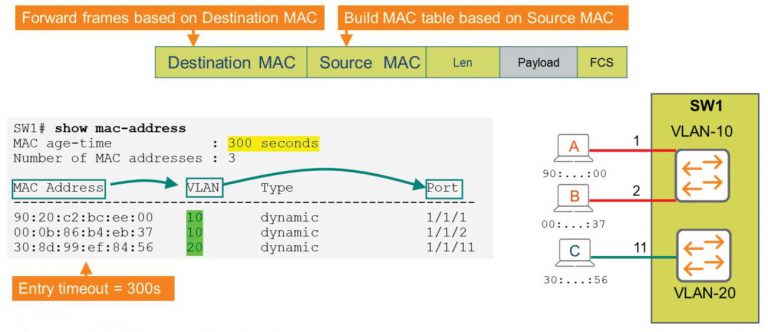
    Layer 2 switches transmit data based on MAC addresses. To do this, the switch uses a MAC address table. When a device connected to the switch sends a frame, the table is automatically created based on the MAC address of the source frame. So, how does it work? MAC Address Table: When power is turned on to Switch SW1, the MAC address table is initially empty...

  • [ACSA Training #21] 802.1Q

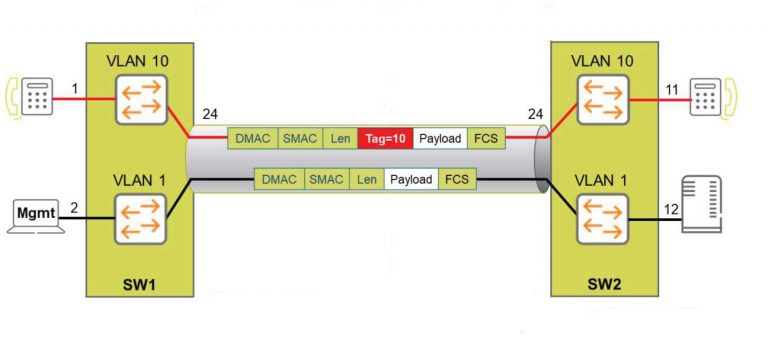
    In the previous post, we learned about VLANs. By creating a virtual switch within a single physical switch, we were able to create and manage broadcast domains more efficiently. Limitations of VLANs... However, let's take a look at the following figure. The figure shows two switches with ports configured in VLAN 10 and VLAN 20, respectively. Now, to connect these two switches, SW1's…

  • [ACSA Training #20] Virtual LAN

    LAN and VLAN. A LAN (Local Area Network) refers to a group of devices within the same broadcast domain. As shown in the figure, there are LAN-A and LAN-B. Two devices are connected to LAN-A. Host A is connected to Port 1, and Host B is connected to Port 2. Another switch, LAN-B, has a similar configuration. When the switch broadcasts a message from an arbitrary port…

  • [ACSA Education #19] Domain

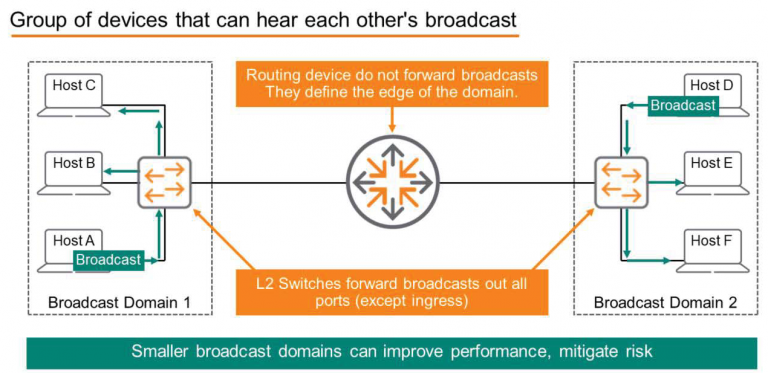
    In the previous post, we examined the basic commands of the AOS-CX switch. This time, we will explore design, deployment, configuration, and troubleshooting to enhance our understanding of Layer 2 concepts. First, let's look at the concept of Layer 2 domains. Collision Domain. Let's imagine Alice and Bob are having a conversation. Even though Alice has something she wants to say,…

  • [ACSA Training #18] ICMP and PoE

    You intend to add a new printer to an ICMP network and use it with a laptop. In this case, you will need to verify that the network is properly configured to ensure normal network communication between the two devices. ICMP helps resolve these issues. The Internet Control Message Protocol (ICMP) is a protocol belonging to the Internet Protocol. Network…

  • [ACSA Training #17] Basic Settings Commands

    After purchasing a switch, you must perform a few tasks before connecting it to the network. These include tasks such as setting the switch name or configuring the interfaces. So today, we will look at the very basic configuration commands for the AOS-CX switch. Hostname Configuration: Unless there is only one switch, you must assign a name to each switch. Therefore, in a large-scale network environment…

  • [ACSA Education #16] Show Command

    In today's post, we will explore the general functions of networking equipment along with very basic commands that help verify networking devices. This is the most important information to learn during the entry-level course, and excellent network engineers and administrators in the future must be proficient in verifying the actual state of network connections. Through this information, existing…