|

[ACSA Training #5] TCP/IP Stack

⏱️ Estimated reading time: Approx. 3 minutes (3 min read)

The Internet Protocol Suite is a conceptual model and communications protocol used on the Internet and computing networks.

Because the underlying protocols of this suite are TCP and IP, it is commonly known as the TCP/IP Stack.

This model provides end-to-end data communication. It specifies how data is packetized, addressed, transmitted, routed, and received.

The TCP/IP model OSI 7-layer modelIt is also compared to the OSI 7-layer model, which consists of 7 layers, but the TCP/IP model maps to 4 layers. In the OSI model, the Application, Presentation, and Session layers are all mapped to the Application layer of a single TCP/IP.
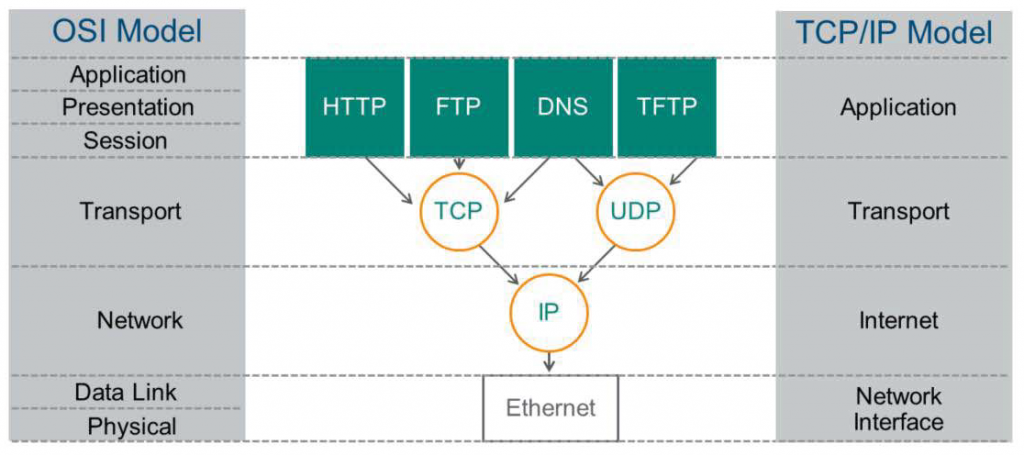
OSI Model Application Presentation Session Transport Network Data Link Physical FTP TCP DNS Ethernet T FTP UDP TCP/IP Model Application Transport Internet Network Interface
TCP/IP stack

Application Layer

That is, the TCP/IP-based Application Layer faces the user and creates data (Application Layer), arranges the data in an appropriate format (Presentation Layer), and manages the session (Session Layer).

Transport Layer

The Transport Layer of each model is directly mapped.
This layer is responsible for flow and error control. This layer establishes an end-to-end connection between two devices traversing a series of logical networks. The two options used in TCP/IP networks are UDP and TCP.

Internet Layer

The Network Layer of the OSI model maps to the Internet Layer of TCP/IP. Both perform the same functions, including defining packet formats and addressing formats and routing data through logical network paths.
IP version 4 (IPv4) and IP version 6 (IPv6) are protocols that operate at this layer.

Network Interface Layer

The functions of the OSI Data Link Layer and Physical Layer are both defined in the Network Interface Layer of the TCP/IP model. This layer also includes protocols related to physical communication media (copper cable, optical fiber, radio waves). It's also important to note that physical Media Access Control (MAC) also occurs here.
Common protocols operating at this layer are Ethernet and Wi-Fi.

In the next post, we will learn about Ethernet Frames, IPv4, and TCP/UDP headers in the TCP/IP Stack.

Similar Posts

  • [ACSA Education #3] Physical Media (Devices)

    ⏱️ Estimated reading time: Approx. 5 minutes (5 min read) Computer devices use different media to transmit information. Each medium has different characteristics depending on its type. Fiber optic media modulates light wavelengths, Wi-Fi modulates radio waves, and copper wire media modulates electrical characteristics such as voltage. Copper Cable past…

  • [APSC Training #1] Introduction to Aruba Central

    ⏱️ Estimated reading time: Approx. 8 minutes (8 min read) Aruba Central is a cloud-based system that allows you to upload Aruba network devices to the cloud. You can monitor your network more effectively by managing, verifying, and adding all devices in Aruba Central. This training covers not only obtaining the Aruba Central certification (APSC) but also Aruba…

  • HPE Aruba Networking Switch Portfolio

    HPE Aruba Networking's latest CX switch portfolio delivers effective network management through four core elements: unified infrastructure, zero trust, and intelligent operations. The switches, based on a single operating system, deliver powerful performance and support a variety of security and management features.

  • Configuring RoCE in AOS-CX (1) – Theory

    ⏱️ Estimated read time: Approx. 8 minutes (8 min read) Today's mission-critical storage environments require higher consistency, predictability, and performance to meet high business demands. Data centers require more I/O capacity to accommodate vast amounts of data, applications, and workloads. Along with this surge in data…

  • [ACSA Education #28] MSTP Theory and Regional Structure

    ⏱️ Estimated read time: Approx. 6 minutes (6 min read) A Common Spanning Tree (CST) defines a single Spanning Tree Instance for the entire network, regardless of the number of VLANs. All BPDUs use Untagged VLAN 1, so VLAN details are not considered. Additionally, there is no load balancing, so alternative…

  • [ACMA Training #3] RF Transmission Output

    ⏱️ Estimated read time: Approx. 9 minutes (9 min read) All manufacturers, including Aruba, specify the power (output) of the AP's antenna port. RF power can be measured in units of mW (milliwatts) or dBm (decibels per milliwatt). 0 dBm is equal to 1 mW. When the dBm value becomes negative, the milliwatt falls to a decimal point. In other words, mW (milliwatts) represents the data linearly, and…