In the previous post, we briefly touched upon the core theme of the HPE Discover 2026 keynote, 'Autonomous Driving Network.'.
Today, I would like to delve deep into the area where the most intense technological innovation is taking place: 'AI data center networking.'.
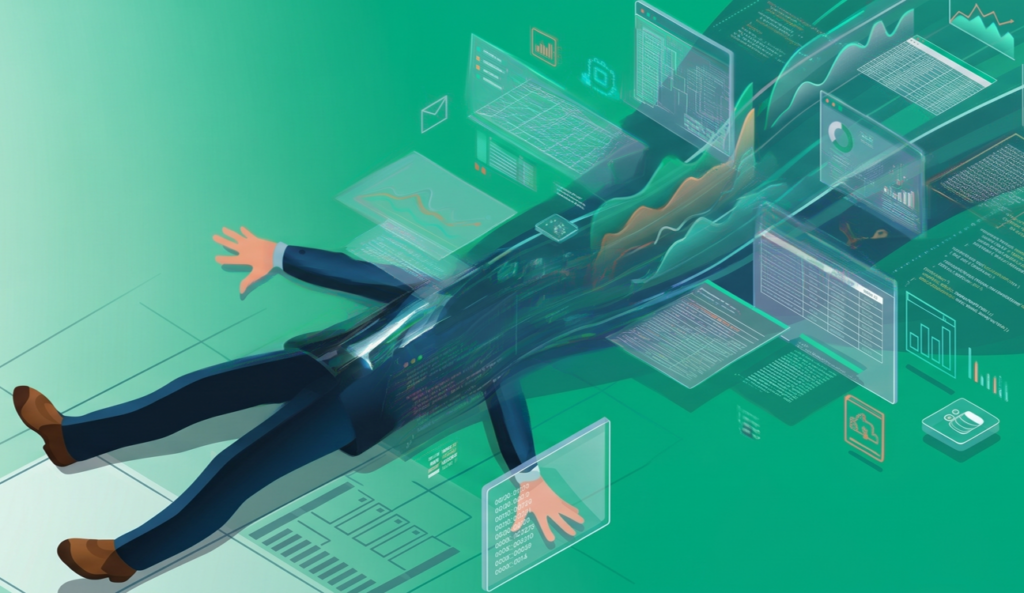
Today, enterprise data centers have truly reached an operational 'breaking point'.
Amidst the flood of data and complexity, engineers are trapped in the paradoxical situation of being “data rich, information poor”—where there is an abundance of data but a lack of substantive information for problem-solving.
The solution presented by HPE in this Discover is clear.
“Ultimately, AI operations also succeed only when the infrastructure's 'context' is understood.‘
We share the three core pillars of HPE's next-generation data center autonomous architecture, which is fundamentally different from the approach of attaching monitoring tools haphazardly after the fact, as other companies do.
1. Context Is Everything: Graph DB-based 'Real AI Ops'‘
While many network vendors talk about AI assistants, AI that analyzes only real-time logs without knowing the overall structure and relationships of the infrastructure is prone to misdiagnosis.
The unrivaled strength of HPE data centers is precisely this Apstra Data Center Directoris in.
- Apstra weaves the interconnected relationships of infrastructure like the neural network of the human brain. ‘'‘Contextual Graph Database‘'‘ It is built on top.
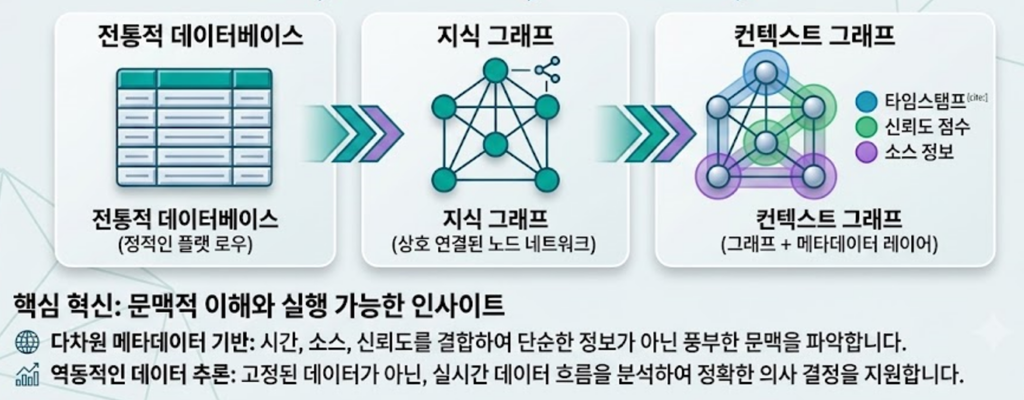
- Powered by this, the Marvis AI Assistant (Agentic AI) reasones like a human by integrating millions of global Technical Assistance (TAC) cases, real-time switch telemetry, and application flows with this 'graph database'.
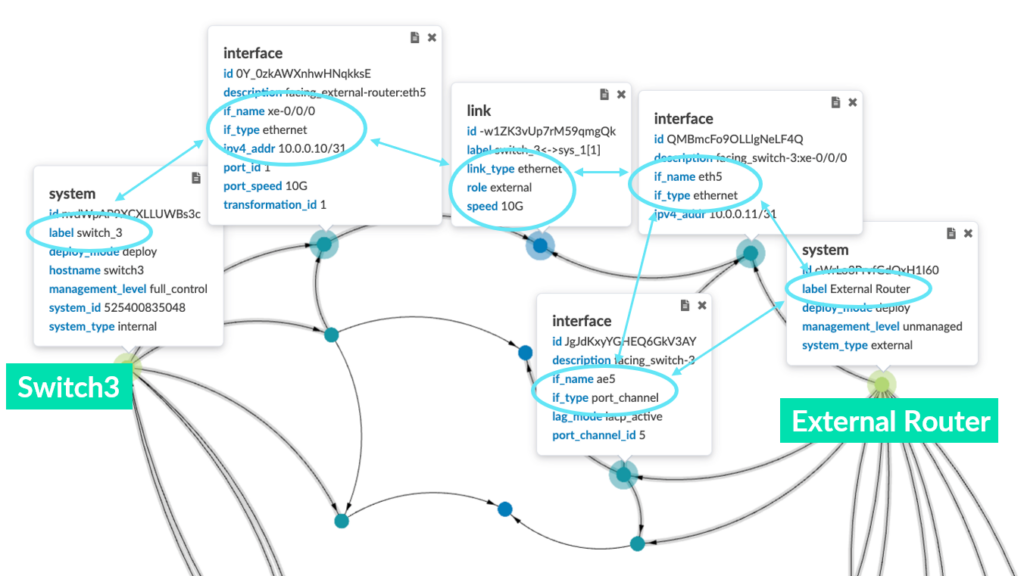
- As a result, complex data center failures that used to take days for root cause analysis (RCA) Pinpoint the issue with pinpoint accuracy and present a solution in just a few minutes.This is where the gap between AI that understands context and AI that does not arises.
2. Predictive Control and Digital Twin: Technology to Prevent Failures Before They Occur
In this announcement, two software innovations that dramatically improved data center stability received significant attention.
'Predictive Maintenance' analyzing over 30 metrics‘
The era of simply sounding an alarm that the “equipment is dead” is over.
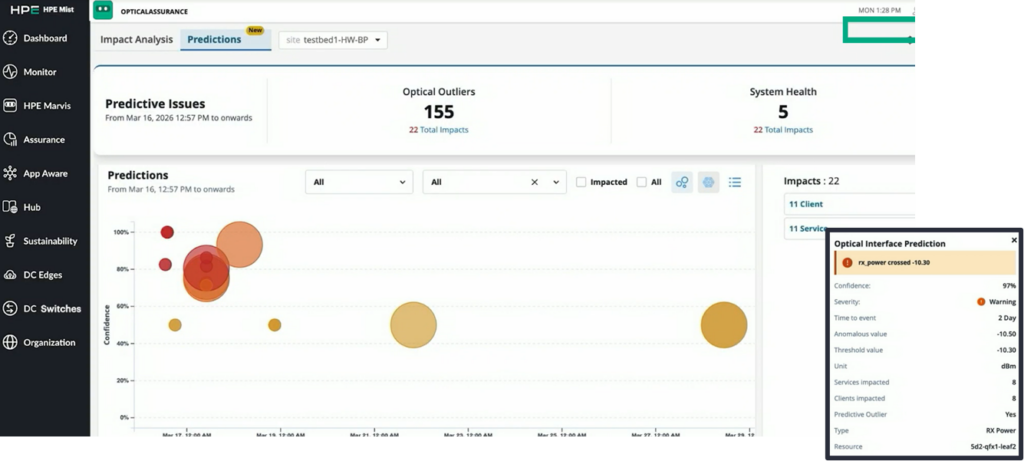
Voltage, current, temperature, CRC error, etc. of switches and optical modules (Optics) AI/ML models constantly analyze over 30 minute data trendsThis enables proactive measures by providing intuitive visualizations of the failure time, blast radius, and reliability long before the hardware actually fails.
Always-on digital twin 'Marvis Minis'‘
How great would it be if we could check at every moment whether the network is healthy without affecting actual operational traffic?
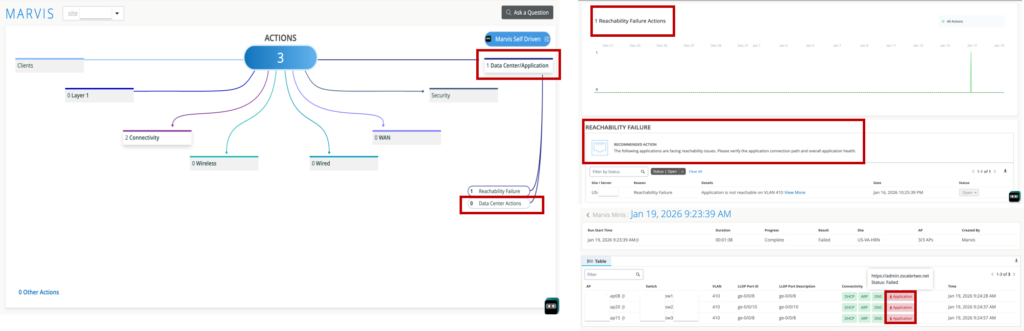
The Marvis platform for data centers is ‘Digital experience twin agent called 'Marvis Minis'Drives.
These virtual agents continuously validate paths and service status by flowing mock traffic between data center fabrics 24/7. Their role is to identify and clean up potential bottlenecks before users even notice them.
3. An Essential Item in the ESG Era: 'Prescription Sustainability Analytics'‘
Another headache for infrastructure engineers is the explosive power consumption and costs caused by AI workloads.
HPE introduced 'Prescriptive Optimization' beyond passive monitoring that simply displays power graphs.
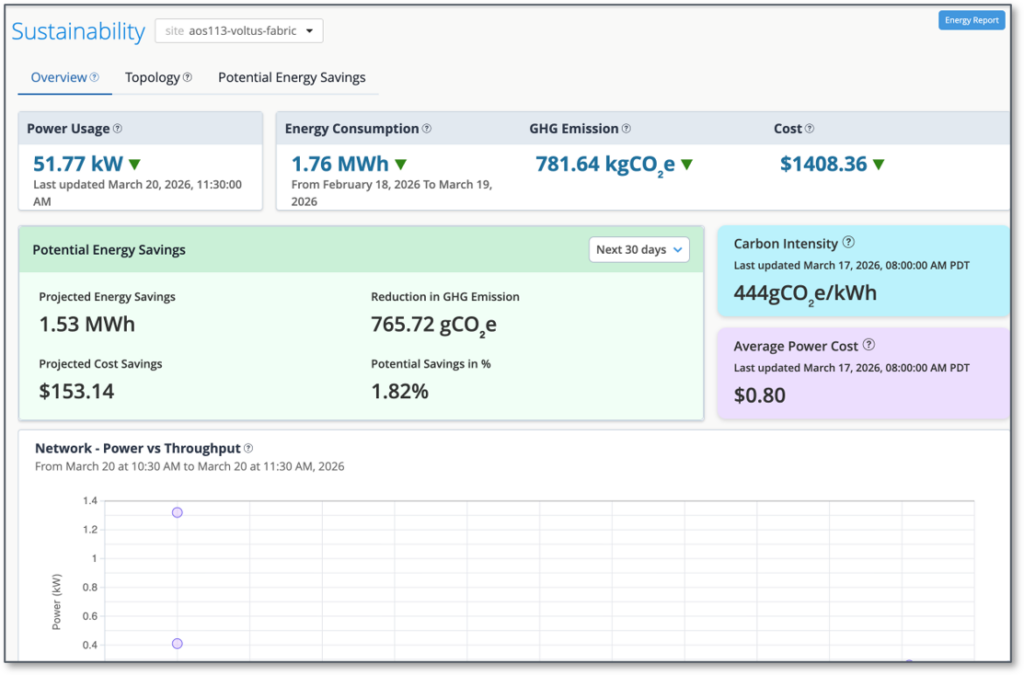
- While the AI was monitoring the inside of the data center in real time, Line cards idle relative to current traffic, idle Packet Forwarding Engines (PFE), and inactive portsIt finds it on its own.
- Furthermore, rather than simply outputting charts, it prescribes specific guidance and optimization steps, such as, “If you switch this port and engine to sleep mode, you can save this much in power costs without compromising Service Level Agreement (SLA).” In essence, it captures both performance and eco-friendliness.
4. Cross-Domain: Hybrid Cloud Integration Breaking Infrastructure Silos
The 'silo' phenomenon, where network, server, and storage teams operate independently, is the main culprit behind reduced data center agility.
HPE announced cross-domain integration to overcome this.
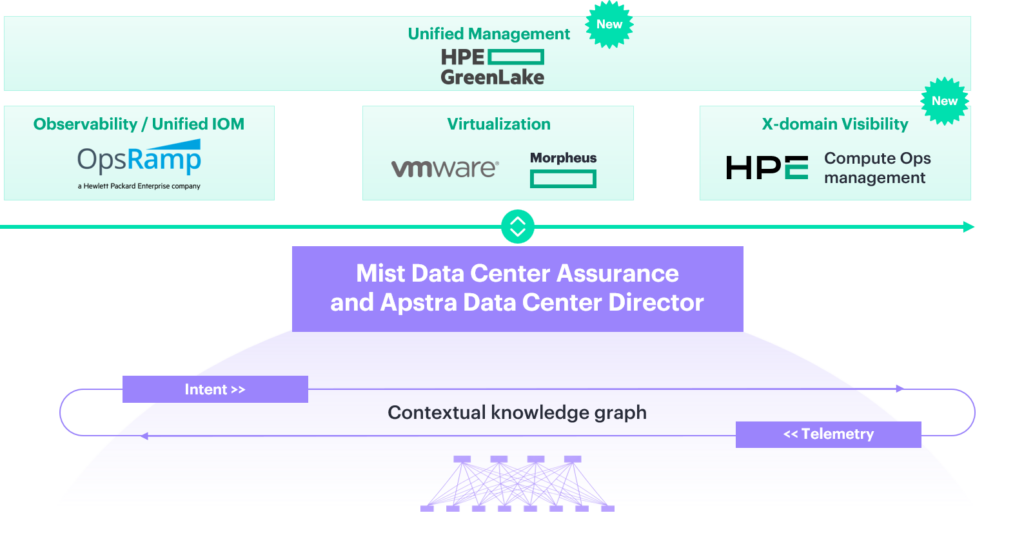
HPE Networking's Data Center Assurance technology HPE GreenLake 및 HPE Compute Ops ManagementIt is fully integrated with... Now, network-level AI telemetry and the server hardware management console are combined into one, opening up a true full-stack infrastructure ecosystem where infrastructure issues occurring across the entire hybrid cloud can be immediately cross-analyzed and resolved from a single point of control.
One-line review: So the GPU doesn't rest for even a second
The success or failure of an AI data center ultimately depends on how much the idle time of GPUs due to network latency can be reduced. This is because, no matter how good the hardware specifications are, a multi-billion dollar GPU cluster will come to a halt if the network slips.
Apstra's recently announced ‘AI Job Awareness’ The technology enables the network to detect massive AI learning patterns in real time, dynamically optimizing routing and load balancing. Combining context-aware AI Ops software with liquid-cooled hardware, HPE's architecture presents the clearest milestone yet for engineers suffering from being trapped in infrastructure silos.
True autonomous driving in data centers is no longer a distant future, but a reality right before our eyes.