


Wi-Fi 6E: How APs Operate at 6 GHz
6GHz is the largest unlicensed frequency band ever, and its size alone could solve several problems.
The new regulations are In each country It's different. In many countries, including the United States, South Korea, and others that follow FCC regulations, the 1200 MHz frequency band can be divided into 59 20 MHz channels. This is nearly three times the size of the existing 5 GHz band. While the UK and the European Union (EU) have less allocated bandwidth, the available capacity is still double that.
This additional 6GHz band significantly improves Wi-Fi 6E performance by reducing interference while utilizing up to seven 160MHz channels. However, it does present challenges in AP discovery in 6GHz.
What is AP Discovery?
AP Discovery is the process by which a terminal finds a suitable access point (AP) to connect to when it enters a building or is powered on.
The Discovery process is used by most client devices today.
The simplest way to do this process is...
- Scan channels sequentially by sending one or more probe requests.
- And receive responses from access points within that area,
- Checks if there is an SSID that matches the client's profile.
- Now that you've completed the inspection, it's time to move on to the channel.
There are three drawbacks to this:.
- While the wireless signal is away from the channel, it takes a significant amount of time, which can impact application performance.
- Broadcasting requires a large number of probe request and response frames, which reduces broadcast time efficiency.
- Affects client battery life.
In the 5GHz band, times of around 20ms per channel are already an issue.
To discover all available access points, a Wi-Fi 6E client must scan all available 20MHz channels in the band. As mentioned above, this problem becomes more serious because up to 59 20MHz channels can be created.
AP Discovery at 6GHz: Active Scanning
To address this issue, the new standard introduces several new features:.
- Every fourth channel “Preferred Scanning”is designated as .
- The access point will use this channel for signal transmission, and the client will scan this channel first.
In the 6GHz band, many expect it to be designed as an 80MHz channel.
At this time, the access point can more easily find the “Preferred Scanning” on the 80MHz channel with the Primary 20MHz channel.
Since 80MHz is a combination of four 20MHz channels, you can find 80MHz more easily by specifying every fourth channel as Preferred Scanning.
Here, it transmits a beacon signal and responds to probe requests.
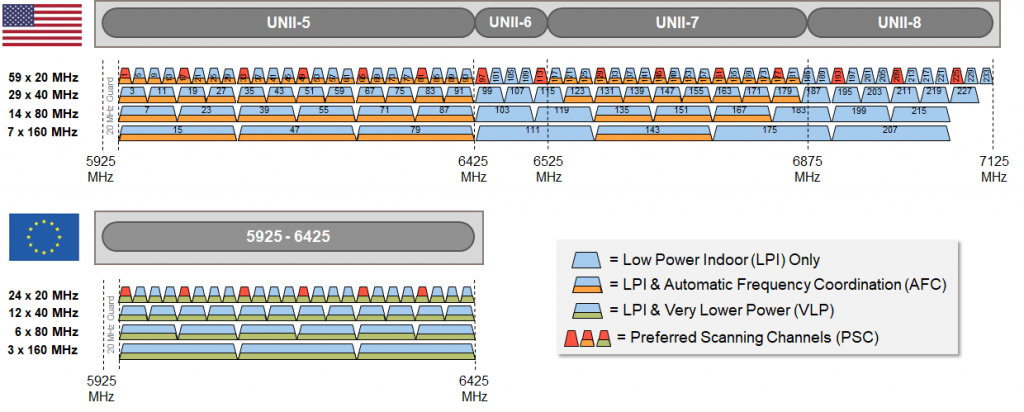
The arrangement of Preferred Scanning channels is helpful when a client device is not previously associated with the network and needs to scan for access points with probe requests.
However, for access points that use multiple frequency bands, a terminal may already be connected to a different band (2.4 or 5 GHz) on the same access point. In this case, the new standard adds a method for the access point to advertise on a lower band and to include information about its operating channel in the 6 GHz band.
Scanning or connecting using the 2.4GHz or 5GHz band as a stepping stone to 6GHz may be the fastest way to create a high-bandwidth connection, as the client can immediately move to the correct 6GHz channel and start connecting.
Additionally, by reducing the number of frames over the air, clients do not drain their batteries to transmit or receive search frames.
AP Discovery at 6GHz: Passive Scanning
Instead of active scanning, the Wi-Fi 6E standard provides a passive scanning path directly in the 6 GHz band for probe requests and responses.
“Fast Initial Link Setup (FILS)” Announcement and “Unsolicited Probe Responses”Through these two mechanisms, access points can broadcast a small beacon signal (Mini-Beacon) essentially every 20ms.
Therefore, the client device knows that it can hear the advertisement from the access point at 20ms intervals without transmitting a probe request, so it can tune its radio frequency to that channel.
This reduces frames during broadcasting and extends client battery life.

As a result of using a new frequency band called Wi-Fi 6E, a new standard has been established to address issues that may arise with existing methods.
Interest in Wi-Fi 6E is rapidly growing.
There seems to be a lot of interest in new technologies to enable faster and more comfortable wireless networks.
If so, we need to understand the technology even more and think about how to design it more efficiently.
To this end, Aruba provides technical guidance for implementing the 6GHz band and Wi-Fi 6E.