Continuing from the last post, I will introduce Aruba's portfolio.
ClearPass secures your network connection not only at the moment of connection but also during the connection.
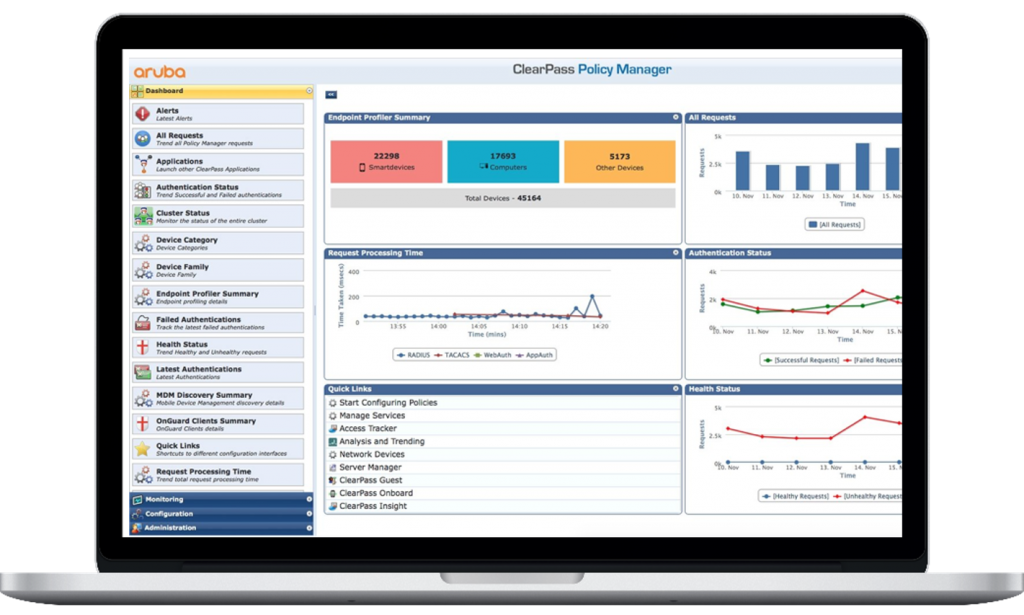
What is important along with wired and wireless network connections is securityno see.
Now, as everything is connected to the network, Data Protection 및 Block illegal usersThis is important.
And we will also need to detect and take action against internal threats that arise without our knowledge.
First, network authentication is the most commonly used method for verifying and blocking illegal users.
Authentication can also be done based on MAC address or ID/Password.
This authentication is now mandatory for wireless networks.
However, it is not widely used in wired networks because it is cumbersome and inconvenient.
However, this can be easily solved with Aruba's ClearPass.
ClearPass supports various methods including 802.1x authentication, MAC authentication, and certificate-based TLS authentication. backup
We can apply the appropriate method according to the customer's environment and needs.
ClearPass recommends leveraging existing databases, such as HR databases, Active Directory, and asset databases, rather than building your own.
ClearPass queries the database in real time to verify authentication.
Therefore, you can manage data directly in ClearPass or reflect it immediately without syncing with an external DB.
Combining multiple databases is also possible. By combining the HR database and the asset database, you can create a policy that only authenticates employees using company-issued devices.
By combining various data, detailed policies can be created and applied to each terminal.
For example, it becomes possible to create and apply policies like the following:.
Development Team의 iOS developersOnly about MacBookto provide access to the source code
Role-Based Policies with ClearPass
This is Aruba Role-based policiesIt is called.
The old way of dividing and managing networks with VLANs in wireless and mobility environments is inconvenient and difficult.
We now need to adopt user-centric security policies, and role-based policies are essential for this.
Roles are created based on various contextual information, such as when, who, where, from which terminal, how the connection was made, and what authentication method was used, and policies are applied to each role.
Using these role-based policies, you no longer need to create new networks, assign new VLANs, or change switch settings for each personnel assignment.
When applied in the HR DB, each time you are authenticated, you will be assigned a new role and the corresponding policy will be applied.
ClearPass not only provides authorization policies for authentication and authorization (roles), but also leverages accounting information to integrate with third-party systems. It can also integrate with next-generation firewalls to set firewall policies by role, and IoT devices can be used to track and update users.
In addition, you can provide guest portal services for guest users and limit QoS and data traffic for each guest user.
These days, many companies are looking into network access control solutions such as NAC (Network Access Control).
Aruba's ClearPass can meet a variety of security requirements, including NAC capabilities.
Cloud-based, all-in-one management platform – Aruba Central
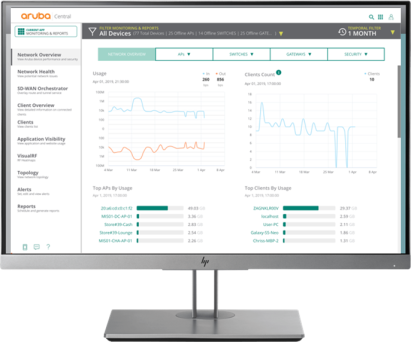
Once you've installed and configured your network equipment, the next thing to consider is management.
Without ongoing maintenance and management, newly built networks will be plagued by various issues and problems. To prevent this, a solution for network monitoring and management is needed.
Aruba Central is the answer.
Aruba Central is a solution that manages all of Aruba's wired and wireless networks, from gateways to controllers.
It does not simply provide NMS functionality.
In addition to provisioning, orchestration, and monitoring of network equipment, it also provides network status analysis, failure prevention, and troubleshooting capabilities through AIOps capabilities.
In a word, it is a total solution for network management.
Because Aruba Central is a cloud-based solution, there's no need to worry about scalability as network equipment grows. With a subscription model that only allows you to manage a single license for each device, the initial investment is minimal. It leverages the computing resources of the cloud environment to provide AI data analysis and offers additional features through ongoing software updates.
The core product of Aruba ESP, as explained in the last post, is Aruba Central.
A single-environment solution for integrated management of wired and wireless infrastructure, and a solution for AIOps.
That would be Aruba Central.
I predict that the future of Aruba will be with Aruba Central.
As Aruba Central becomes the framework and foundational platform for all Aruba products, all wired and wireless devices will operate under Aruba Central.
Now that the shift to the cloud is unstoppable, Aruba Central will help you keep your network running in a stable and optimized environment.
Other than that..?
Aruba has several solutions to enhance user experiences at the Edge.
– Location service function based on Wi-Fi or Bluetooth
– User-based network measurement tools
– Machine learning-based network terminal profiling system
– Flexible consumption model with services for network equipment, such as As-a-Service
We will cover each product and solution in separate posts.
Aruba is not just a hardware manufacturer that sells wired switches and wireless access points.
We manufacture and sell hardware, but we are targeting a software company.
Switches and wireless APs are just one infrastructure foundation for running the software, and are provided by Aruba.
I think it would be good to consider various solutions with more value based on infrastructure.