|

[ACSA Training #9] UDP Header

⏱️ Estimated reading time: Approx. 2 minutes (2 min read)

In the last post, we learned about TCP. TCP and UDP are the most representative protocols used at the Layer 4 transport layer. Today, let's take a look at UDP.
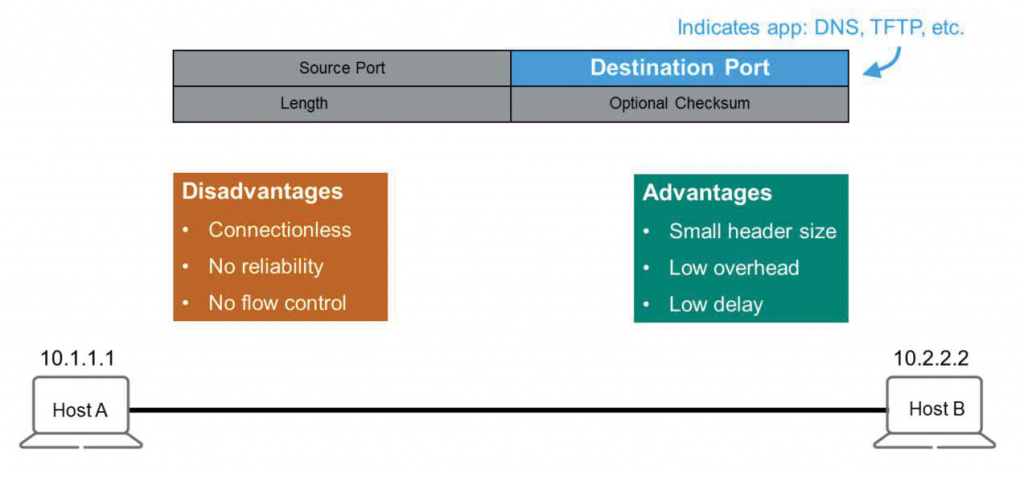
Source Port Length Disadvantages Connectionless • No reliability No flow control • 10.1.1.1 Host A Indicates app: DNS, TFTP, etc. Destination Port Optional Checksum Advantages Small header size • • Low overhead Low delay 10.2.2.2 Host B

If you look at the picture, the UDP header is Compare with TCP headerIf you do, you will see how simple it is.
It has the same source and destination ports as TCP, and only has length and checksum fields.

From an application's perspective, TCP is a remarkably dedicated and dedicated worker. It establishes a connection, checks for lost packets, retransmits any, and even adjusts data processing to minimize the burden on the receiving end.

Conversely, UDP can be viewed as a lazy worker, lacking connection, reliability, and flow control. It doesn't care whether packets reach their destination or whether the other end is unaffected. However, despite its apparent laziness, it's incredibly cheap. A smaller header size means less overhead. This means UDP can transmit data with lower latency.

Although it's less reliable, it's fast. This makes it ideal for applications like VoIP (Voice over IP) and video streaming. These applications don't require the full reliability of TCP, nor do they want to pay for it. Developers can easily implement the required reliability within their programs.

UDP can also use up to 65,536 ports, but like TCP, the first 1,024 are reserved for well-known applications. The remaining ports, 1025 through 65,525, are known as ephemeral ports, which, like TCP, are deleted after use.

In the past four or five posts, we've covered the expressions used from Layer 1 to Layer 4, as well as header information. I hope you now have a clear understanding of how Ethernet, IP, and TCP/UDP are used in the TCP/IP stack and why they're necessary.

Let's end the theoretical discussion here and learn about network devices in the next post.
Similar Posts

  • [ACSA Training #18] ICMP and PoE

    ⏱️ Estimated read time: Approx. 5 minutes (5 min read) You are adding a new printer to an ICMP network and intend to use it with a laptop. In this case, you will need to verify that the network is properly configured to ensure that network communication between the two devices is functioning correctly. ICMP helps resolve these issues. Internet Control Message Protocol (Internet…

  • Managing ArubaCX Switches with NetEdit

    ⏱️ Estimated reading time: Approx. 7 minutes (7 min read) Our networks are bound to grow. Existing networks expand, networks are split according to purpose, or new networks are created for new businesses. As networks grow in this way, maintenance becomes extremely difficult from an administrator's perspective. In particular, large-scale network changes involve every individual…

  • [ACSA Education #26] RSTP Elements

    ⏱️ Estimated read time: Approx. 6 minutes (6 min read) Continuing from last time, we would like to explore STP (Spanning Tree Protocol), specifically RSTP (Rapid STP). We will examine the key factors that the RSTP algorithm uses to determine which ports to use for traffic delivery and which not. Bridge Identifier Bridge Protocol Data Unit Rapid Spanning Tree…

  • [APSC Training #3] Using Aruba Central

    ⏱️ Estimated reading time: Approx. 4 minutes (4 min read) Continuing from the previous post, this time we will explore the various ways to use Aruba Central. Basically, Aruba Central is a cloud-based SaaS solution, but it offers various options to meet customer environments and requirements. In addition, the licensing structure has been simplified to make customer selection easier. Desired…

  • [acp-dc training#10] vsx (2)

    ⏱️ Estimated reading time: Approx. 8 minutes (8 min read) In the previous post, we explored VSX, the virtualization technology of HPE Aruba Networking AOS-CX switches. We explained the components of VSX, the differences from VSF, and its advantages. Today, we would like to cover the practical aspects. We will examine how to actually utilize VSX to perform live software upgrades and look at technologies such as Split Brain… .

  • [ACSA Training #27] How RSTP Works

    ⏱️ Estimated read time: Approx. 10 minutes (10 min read) RSTP (Rapid STP) operates a loop-free topology through the following algorithm: Select Root Switch Select Root Ports (RPs) of all other non-root switches or non-designated bridge switches Select Designated Ports (DPs) of links connected between each switch Other…