

Aruba Central License Changes
Last March, Aruba implemented a licensing change with the Central 2.5.3 update.
With ongoing updates, Aruba Central has become an essential component of any Aruba product and solution presentation. Aruba Central is more than just a cloud-based NMS for managing wired and wireless networks.
It is positioned as a cloud-based Aruba total solution platform.
With this continuous innovation, Aruba ESPAs AIOps, one of the main components, is being fully updated in Central, the licensing structure has also changed.
Previously, the subscription method for services required for each device was divided into Device Management Token and Service Token, but now it has been simplified from the customer's perspective by dividing it into Foundation and Advanced.
We will provide licenses with the same structure for all wireless APs, switches, and SD-Branch gateways.
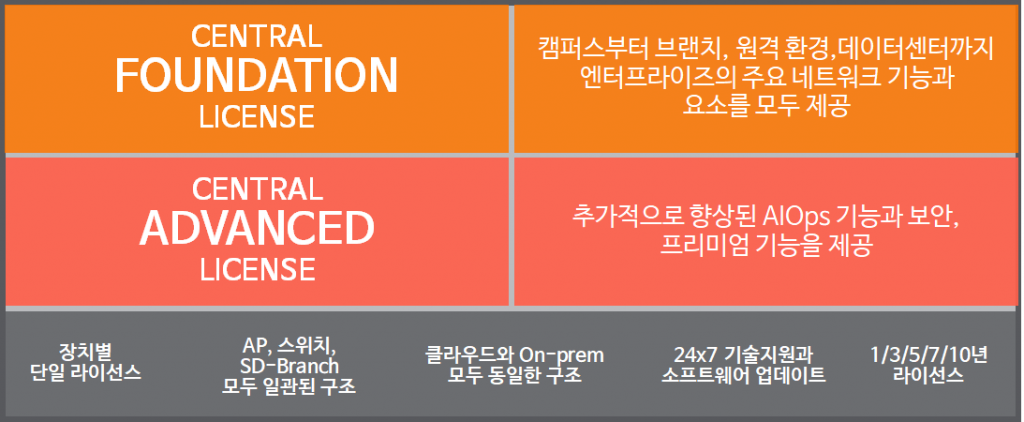
As shown above, Aruba's Foundation license is the most common license and provides all the elements necessary to configure and operate a network. Meanwhile, the Advanced license provides security and premium AIOps features in addition to the Foundation license features.
In other words, general customers can use it sufficiently with a Foundation license, but to use some premium features, you need to purchase an Advanced license.
Wireless

If you want to link a wireless AP to Central, you can purchase an AP Foundation or AP Advanced license.
As shown in the table above, Foundation LicenseIncludes features such as Presence and Cloud Guest, which were previously subscribed to as separate services, along with general configuration, monitoring, and troubleshooting.
It includes basic AIOps functions such as AI Insight and AI Search, as well as security functions such as AppRF and WebCC.
Advanced LicenseMore advanced features are added, starting with advanced AI Insights, as well as Air Slice, UCC, and more.
Switch (Wired)
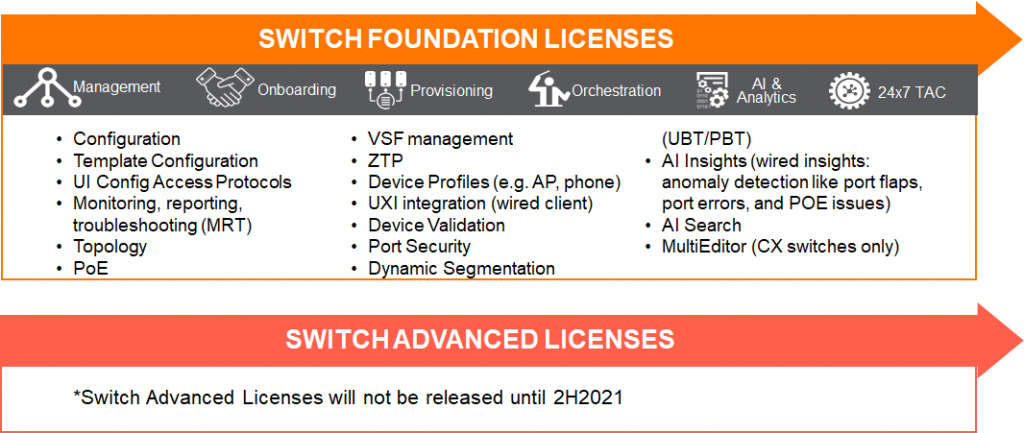
The switch does not yet have an Advanced license. When you connect the switch to Central, you can use all currently available features with a Foundation license.
However, switch licenses are differentiated by model. The core switch, the 6400, and the L2 access product, the 6100, have different licenses and pricing.
SD-Branch (Gateway)
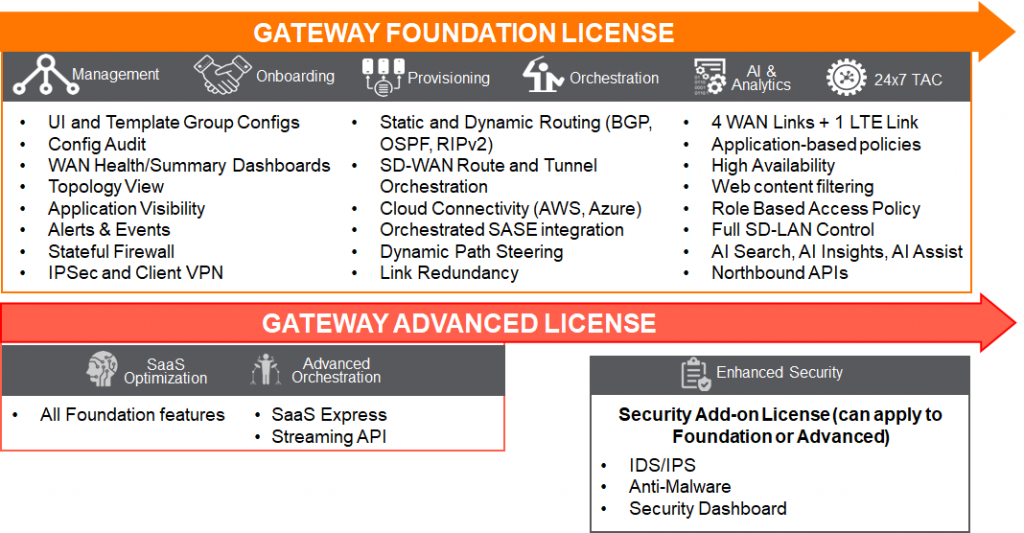
Most features of the SD-Branch Gateway are also included in the Foundation license.
All features are included in the Foundation license, except for some advanced features such as SaaS Express or streaming API. UTM features such as IDS/IPS can be added by adding a separate Security license.
As you can see, the features provided by Aruba Central have greatly expanded.
As mentioned earlier, Aruba is no longer a NMS-level product, but rather a platform that provides Aruba's total solution. Instead of subscribing to individual service licenses, you can access all of these features with a single Foundation license.
I look forward to seeing Aruba Central continue to be updated and developed.