Over the past two years since COVID-19, many things have changed around us.
Over the years, there have been extensive changes and restructurings in the way we work and live, and these changes continue. As networks become more connected, regardless of location or device, the demands for connectivity are growing.
IDC
These challenges are compounded by the increasing number of devices connected to infrastructure, particularly IoT devices.
Providing predictable, secure connectivity is becoming a challenge for IT teams across every business and organization.
The need for SASE is recognized by cloud-first organizations of all sizes, but SASE adoption and approaches vary. Enterprises now need to evolve their IT, especially their networking, in a new way.
We need technologies that increase flexibility and agility, enabling us to adapt to changing business, market, and operational conditions. This goes beyond simple SD-WAN; it requires solving problems and accelerating innovation at the network edge.
David Hughes, Aruba's Chief Product and Technology Officer (CTO), offers five predictions for the network edge as we head into 2022. Let's take a look at them one by one.
① By 2025, the number of terminals will exceed 10 times the number of people.
Digital transformation is driving the proliferation of IoT devices, and machine-to-machine (M2M) communication is growing rapidly. Today, there are more than five times as many devices connected to networks as people. Over the next three years, there will be ten times more devices connected to networks than people, making automated, secure connections in the IoT paramount.
Without an automated way to onboard, provision, and secure these devices, businesses will be vulnerable to increasingly sophisticated security breaches and attacks.
By 2025, 401,000 enterprises deploying SD-WAN will use artificial intelligence (AI) capabilities for automation.
Gartner
This is a significant improvement from the figure of less than 5% in 2021.
Aruba's offer
To keep pace with the rapid growth of IoT devices, enterprises must break free from the limitations of legacy network security. Protecting IoT devices requires edge-to-edge role-based segmentation, from access points (APs), through the LAN and switches, and across the WAN to data centers and the cloud.
By deploying a zero-trust architecture from the edge to the cloud, enterprises can simplify policy management and leverage AI and automation to detect devices and automatically apply the right security policies.
② Two approaches to SASE
As Secure Access Service Edge (SASE) deployments enter their early stages, the market will likely be divided into two approaches.
Small and medium-sized businesses (SMBs) prioritize simplicity and a single point of management, and will likely be attracted to all-in-one SASE products over those with advanced features.
However, large enterprises will not compromise on security, stability, or the quality of their user experience. They will seek a dual-vendor approach that offers industry-leading SD-WAN partners, secure web gateways (SWGs), cloud access security brokers (CASBs), and zero-trust network access (ZTNAs) for on-premises security and WAN connectivity.
By 2024, more than 701,000 SD-WAN customers will have implemented SASE architecture.
Gartner
Aruba's offer
Networking and security are inherently related, but they are both very different and complex fields of expertise.
Aruba's EdgeConnect provides an advanced SD-WAN foundation for a robust SASE architecture, enabling enterprises to choose from market-leading cloud-delivered security service providers, both now and in the future.
③ The transition to Wi-Fi 6E begins in earnest in 2022.
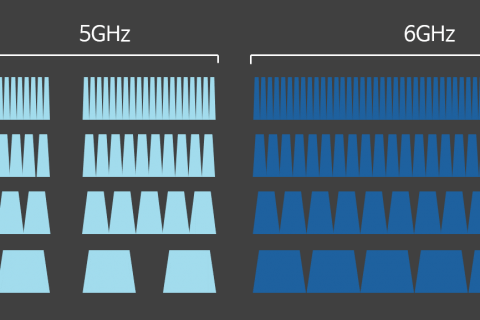
While much attention is focused on 5G mobile communications, campuses and enterprises are poised to transition to Wi-Fi 6E.
Wi-Fi 6E adds 1,200 MHz of new spectrum to provide higher capacity while maintaining backward compatibility.
Market intelligence firm 650 Group projects that Wi-Fi 6E enterprise APs will grow to over 2001 TP3T by 2022. This demonstrates that enterprise organizations recognize the need for and potential of Wi-Fi 6E for activities such as video conferencing, telemedicine, and distance learning.
Aruba's offer
Aruba Wi-Fi 6E solutions deliver improved speed, efficiency, flexibility, and scalability to meet the demands of hybrid work environments, IoT devices, and evolving user expectations. Wi-Fi 6E accommodates the growing number of mobile and IoT devices, better supporting IT and business requirements.
Higher data speeds and increased capacity deliver better user experiences, even in congested environments or demanding applications like AR/VR, boosting employee productivity and driving customer engagement.
④ Hybrid work environments will drive the rise of "micro-branches" powered by AI automation.
Even after the pandemic ends, remote work will continue. This new normal will drive the emergence of microbranches or single branches. Early in the pandemic, companies scrambled to expand VPNs and deploy remote access points (RAPs) to connect isolated employees.
In 2022, we will see tremendous growth in purpose-built micro-branch products that combine enterprise-grade Wi-Fi access with sophisticated multi-path WAN connectivity and reliability, along with advanced AIOps for a consistent user experience.
By 2024, 45% customer service centers for financial, retail, and hospitality industries will adopt a Branch of One architecture to support an efficient and secure enterprise-level work environment.
IDC FutureScape: Worldwide Future of Connectedness 2022 Predictions
Aruba's offer
The Aruba EdgeConnect Microbranch solution delivers an SD-WAN solution that optimizes performance, security, and manageability to simplify and accelerate the adoption of a “branch of one” model.
Designed for today's cloud-based enterprise, it delivers the highest quality to both users and IT teams, regardless of where applications reside.
⑤ Increasing demand for infrastructure consumption models such as Network-as-a-Service (NaaS).
A cultural shift is unfolding before our eyes. Consumers are placing greater value on "experiences" over "things," and the desire to "own something" is diminishing. This is already having a profound impact on our daily lives.
This shift, where companies focus less on equipment and facility investments and more on the business outcomes of their technology investments, will continue this year. Companies want to improve IT efficiency and keep pace with technological innovation, while also seeking greater financial flexibility and cost predictability.
A flexible infrastructure consumption model makes all this possible.
For businesses that aren't fully ready to commit, flexible consumption models offer the option to "try before you buy," allowing them to decide whether to adopt the technology and model at their own pace.
This model will significantly increase demand for consumption-based services like NaaS in 2022.
By 2025, 60% of midsize and large enterprises will adopt Network-as-a-Service (NaaS).
IDC FutureScape: Worldwide Future of Connectedness 2022 Predictions
Aruba's offer
Aruba offers a comprehensive Network as a Service (NaaS) offering, enabling enterprises to leverage edge connectivity and security as a service to drive business outcomes. NaaS offers agility, security, and flexibility, along with the option to outsource the entire network deployment lifecycle through a cloud-like subscription model.
We've examined Aruba's five key network predictions for 2022. Let's also examine Aruba's solutions for each of these trends to prepare for the future of IT and the network changes that lie ahead.
- By 2025, the number of devices will exceed the number of people by more than 10 times.
→ Discover how IoT security is the next frontier for SD-WAN - Two Approaches to SASE
→ Read our blog discussing key reasons to choose multiple SASE vendors - The transition to Wi-Fi 6E begins in earnest in 2022.
→ Read about our enterprise-grade Wi-Fi 6E solution - Hybrid work environments will drive the rise of AI-powered "micro-branches."
→ Find out more about our EdgeConnect Microbranch solution - Growing demand for infrastructure consumption models such as Network-as-a-Service (NaaS).
→ Find out what's in a NaaS experience and how insights and automation control put you in the driver's seat