

HPE Aruba Central with Generative AI
Many companies around the world are embracing AI to improve ITOps productivity faster than expected. To support this shift in networking, HPE Aruba Networkrking Central은 AIOps features 중 AI SearchIt is equipped with GenAI (generative AI) LLM (Large Language Model) technology.
In this post, we'll discuss how cutting-edge GenAI technology improves search accuracy and responsiveness, as well as how LLM can be responsibly implemented within the networking space and differentiated from previous GenAI implementations.

By leveraging multiple LLMs within Central, we'll be able to advance conversation and summarization features faster, more accurately, and more securely than ever before, delivering a more powerful search experience. Importantly, these new features will be fully rolled out across Central clusters worldwide by April.
LLM Improvements in AI Search
Over the past two years, HPE Aruba Central has been home to an AI Search feature designed to help users easily find answers to questions about their environment, leveraging advanced natural language processing (NLP).
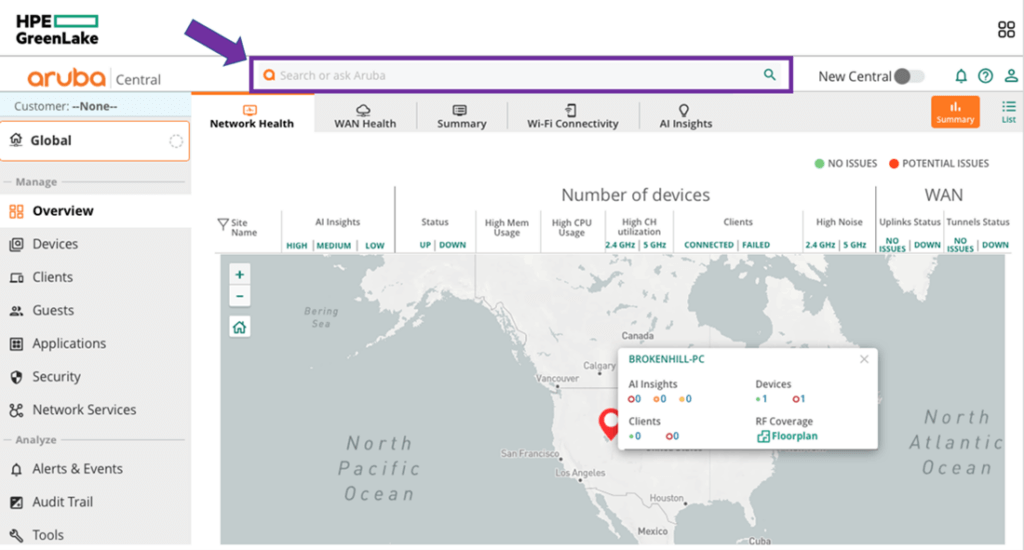
HPE is integrating its extensively trained and tuned LLM into Aruba Central, effectively "replacing the engine" for AI Search. This new engine will maintain the feel and functionality of existing AI Search while leveraging the latest capabilities in search accuracy, response times, and data protection.
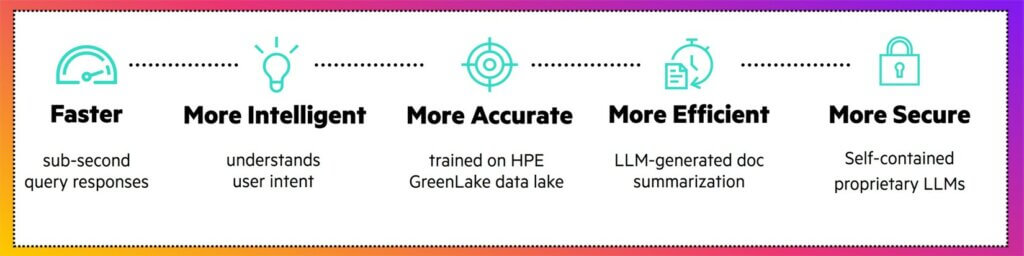
Improve search accuracy based on user intent
We leverage our self-trained and tuned LLM Transformer to better understand the intent of questions entered into AI Search.
Understanding the intent of your users' questions is paramount to providing better answers and improving user satisfaction.
Since its launch, AI Search has received over 3 million queries, and its machine learning has been trained based on this massive underlying data set.
As a result, AI Search ① Better understand and answer network terminology questionsAnd, ② Provides pre-entered auto-completion functiondo, ③ Introducing search-based navigation capabilities directly from the AI Search interface to other parts of the GUI.I did.
Document Summary
“It’s too long and difficult to read!”
Are you having trouble reading technical documentation for Aruba products that is over 20,000 pages long?
No need to worry anymore. Aruba Central's AI can help.
One of the most common types of questions received in AI Search is
Questions about 'how' to configure or enable a specific feature within a networking productno see.
Now, with AI Search's GenAI feature, many of these questions can be answered. Generate summarized answers as if a person were answeringdo, Also provides links to reference documents that form the basis of the generated results.This can save network operators a significant amount of time trying to find the documentation answers they need.
Response time
Anyone who has used AI tools like ChatGPT, Gemini, or Copilot will understand that each query has its own pros and cons.
The tradeoffs could be the number of seconds it takes ChatGPT to respond to a user's answer, the extent to which question data is "contributed" to Gemini's data lake for future training, or the sheer amount of compute required to continuously train Copilot's model.
HPE Aruba designs and utilizes several special-purpose LLM transformers to reduce or eliminate these tradeoffs.
Using a standalone LLM will provide faster response times and better search performance.
Data privacy first
Putting security first and respecting the principles of data privacy is one of the most important things we do at HPE Aruba.
This is also the basis of good AI.
Many businesses are using tools like ChatGPT. Serious concerns have been raised about privacy and security.It is happening.
This is natural. These tools The intellectual property of the company entered raises privacy and ownership issues.do.
The Aruba engineering team carefully considered this issue and designed a solution that leverages GenAI's advancements without compromising security. Using HPE Aruba Networking Central, we implemented multiple locally trained and hosted LLMs, blocking external API queries to the data lake and leveraging GenAI's human-level understanding and generative capabilities without risking data leakage.
In particular, the platform has a dedicated language model for identifying PII/CII (personally and corporately identifiable information).
This feature allows AI Search to better understand the entered device and site name queries, providing more accurate answers.
This feature also obfuscates the data identified in the training data lake.
Experience new AI and LLM capabilities with HPE Aruba Central!
Generative AI is incredibly powerful, and many industries are just beginning to embrace real-world AIOps applications.
LLM-based AI Search is highly anticipated, not only because it will bring significant benefits to today's HPE Aruba Networking Central users, but also because it is the first of many GenAI use cases we are working on as we transition to the next generation of Central.
If you'd like to experience LLM in action alongside other security, automation, and orchestration capabilities offered by HPE Aruba Networking Central, request an Aruba Central demo through the link below!
Request a demo of HPE Aruba Networking Central – [Shortcut]